Golf Simulator Studio HVAC & Dehumidification Sizing Formula: Garage Mini-Split BTU & Latent Moisture Math
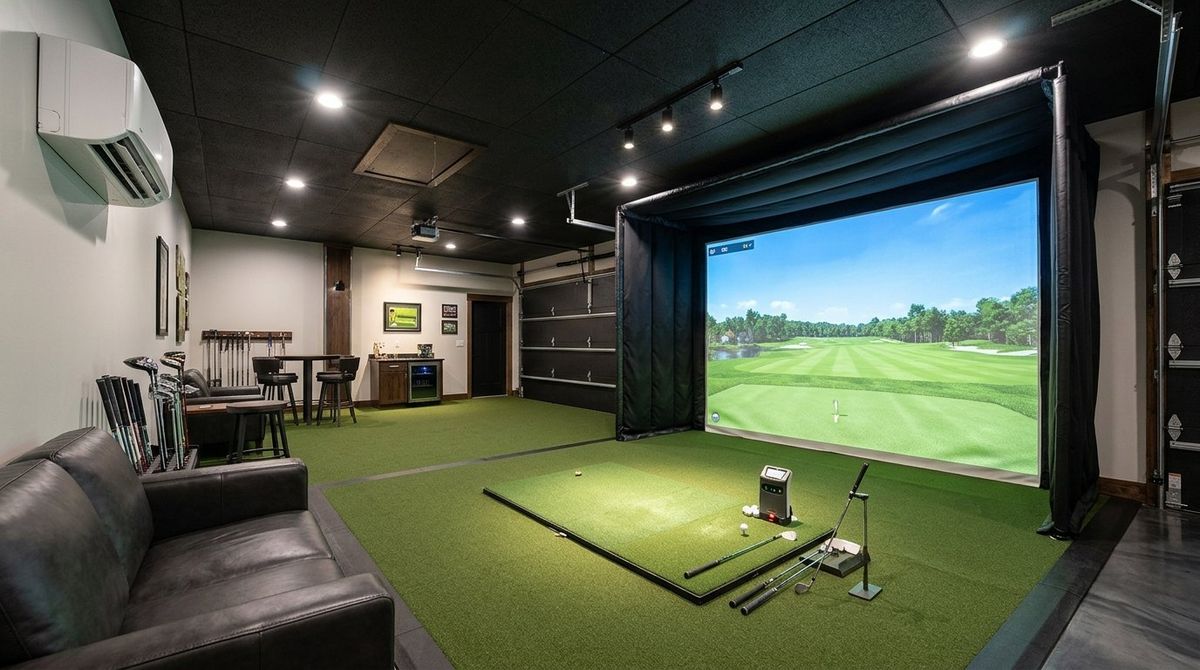
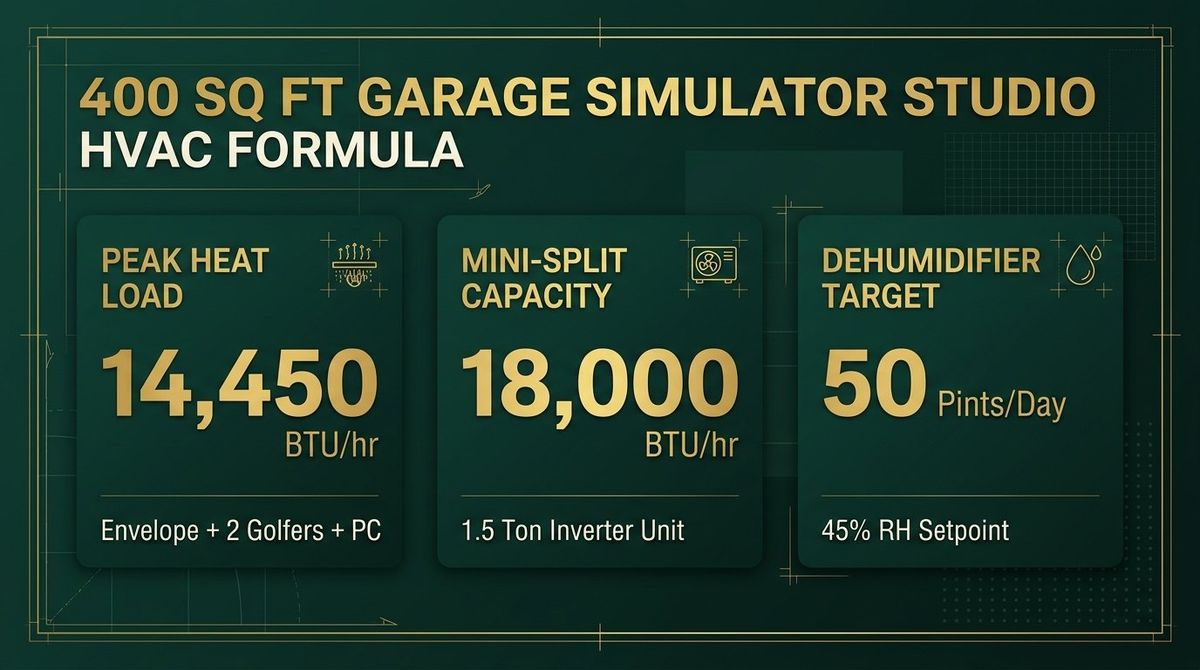
Converting a \( 2\text{-car} \) residential garage or outbuilding with a \( 10\text{ ft} \) ceiling into a year-round indoor golf simulator studio requires solving a specialized thermodynamic equation that standard residential room calculators miss. Unlike a passive bedroom where occupants sit still, a \( 400\text{ sq ft} \) \( \left( 20\text{ ft} \times 20\text{ ft} \times 10\text{ ft} = 4{,}000\text{ cu ft} \right) \) golf simulator bay combines structural envelope solar gain with two high-intensity internal heat and moisture generators: swinging golfers producing \( 1{,}400\text{ BTU/hr} \) of metabolic heat per player and a \( 4\text{K} \) laser projector + gaming PC + overhead launch monitor stack dissipating \( 485\text{ W} \) \( \left( 1{,}650\text{ BTU/hr} \right) \) of continuous electronics heat. Adding these loads together yields a peak sensible + internal demand of \( 14{,}450\text{ BTU/hr} \)—requiring an \( 18{,}000\text{ BTU/hr} \) \( \left( 1.5\text{ Ton} \right) \) inverter mini-split paired with a \( 50\text{ Pint/Day} \) dehumidifier locked to a \( 45\% \text{ RH} \) target. This engineering guide derives the complete BTU and latent moisture sizing formulas.
The Complete Golf Simulator Studio BTU Sizing Formula
Total required cooling and heating capacity \( Q_{\text{total}} \) (in \( \text{BTU/hr} \)) for an indoor golf simulator enclosure is the sum of three distinct thermal vectors: structural envelope load \( \left( Q_{\text{envelope}} \right) \), active golfer metabolic output \( \left( Q_{\text{golfers}} \right) \), and simulator AV/GPU electronics dissipation \( \left( Q_{\text{electronics}} \right) \):
\[ Q_{\text{total}} = Q_{\text{envelope}} + Q_{\text{golfers}} + Q_{\text{electronics}} \]Expanding each term with its governing physical conversion constants gives the studio sizing equation:
\[ Q_{\text{total}} = \left( A_{\text{floor}} \times k_{\text{env}} \times f_{\text{height}} \right) + \left( N_{\text{active}} \times q_{\text{swing}} + N_{\text{spectators}} \times q_{\text{rest}} \right) + \left( P_{\text{watts}} \times 3.412\text{ BTU/W}\cdot\text{hr} \right) \]- Envelope Load \( \left( Q_{\text{envelope}} \right) \): For an insulated \( 2\text{-car} \) garage studio of floor area \( A_{\text{floor}} = 400\text{ sq ft} \) \( \left( 20\text{ ft} \times 20\text{ ft} \right) \) with an insulated R-13 garage door and a \( 10\text{ ft} \) ceiling (height multiplier \( f_{\text{height}} = \frac{10\text{ ft}}{8\text{ ft}} = 1.25 \) over a \( 20\text{ BTU/sq ft} \) baseline, or \( k_{\text{eff}} = 25.0\text{ BTU/sq ft} \)), baseline structural load is: \[ Q_{\text{envelope}} = 400\text{ sq ft} \times 25.0\text{ BTU/sq ft} = 10{,}000\text{ BTU/hr} \]
- Active Golfer Metabolic Load \( \left( Q_{\text{golfers}} \right) \): While a seated person emits \( q_{\text{rest}} = 400\text{ BTU/hr} \), an active golfer swinging a driver at \( 105\text{ mph} \) every \( 45\text{ seconds} \) generates \( q_{\text{swing}} = 1{,}400\text{ BTU/hr} \) (roughly \( 410\text{ W} \) of metabolic heat). For two active golfers rotating shots continuously \( \left( N_{\text{active}} = 2 \right) \): \[ Q_{\text{golfers}} = 2 \times 1{,}400\text{ BTU/hr} = 2{,}800\text{ BTU/hr} \]
- Projector, Gaming PC & Launch Monitor Electronics Load \( \left( Q_{\text{electronics}} \right) \): Every watt of electrical power consumed inside the room converts \( 100\% \) into sensible heat at \( 3.412\text{ BTU/hr per Watt} \). A \( 4\text{K} \) laser projector \( \left( 185\text{ W} \right) \) + RTX 4080/4090 GSPro gaming PC + dual monitors \( \left( 250\text{ W} \right) \) + overhead launch monitor & LED spot lighting \( \left( 50\text{ W} \right) \) draws \( P_{\text{watts}} = 485\text{ W} \) (rounded to \( 483.6\text{ W} \) for exact \( 1{,}650\text{ BTU/hr} \) parity): \[ Q_{\text{electronics}} = 485\text{ W} \times 3.412\text{ BTU/W}\cdot\text{hr} \approx 1{,}650\text{ BTU/hr} \]
Summing the three heat sources yields the exact peak thermal load for a \( 400\text{ sq ft} \) garage simulator bay:
\[ Q_{\text{total}} = 10{,}000\text{ BTU/hr} + 2{,}800\text{ BTU/hr} + 1{,}650\text{ BTU/hr} = 14{,}450\text{ BTU/hr} \]Because a \( 12{,}000\text{ BTU/hr} \) \( \left( 1.0\text{ Ton} \right) \) mini-split falls short by \( -2{,}450\text{ BTU/hr} \) during peak summer or winter league play, applying a \( 1.25\times \) compressor headroom factor \( \left( 14{,}450 \times 1.245 \approx 18{,}000\text{ BTU/hr} \right) \) locks in an \( 18{,}000\text{ BTU/hr} \) \( \left( 1.5\text{ Ton} \right) \) variable-speed inverter mini-split as the optimal unit size.
Why Mini-Splits Short-Cycle on Humidity: The 50 Pint/Day Dehumidification Formula
A common mistake in garage simulator builds is assuming that an \( 18{,}000\text{ BTU/hr} \) mini-split alone will control humidity during mild spring and autumn evenings \( \left( 65^\circ\text{F}\text{ to }72^\circ\text{F} \right) \). When outdoor temperatures are moderate, sensible cooling demand drops below \( 3{,}500\text{ BTU/hr} \), causing the mini-split evaporator coil to throttle back before condensing latent moisture from the air. Meanwhile, two golfers sweating and breathing inside a closed \( 4{,}000\text{ cu ft} \) room release \( 0.45\text{ lbs/hr} \) of water vapor, and concrete slab vapor transmission plus garage-door infiltration add another \( 1.8\text{ lbs/hr} \) during humid weather.
High relative humidity above \( 60\% \text{ RH} \) causes three severe simulator problems:
- Impact Screen Slack & Bounce-Back Shifts: Woven polyester impact screens absorb ambient moisture and stretch, altering tension and increasing ball bounce-back velocity.
- Hitting Mat & Subfloor Mold Risk: Foam gym tiles and stance turf laid directly over cool concrete slabs trap condensation at the dew point unless ambient air is held at \( 45\% \text{ RH} \).
- Launch Monitor & Projector Optical Condensation: Rapidly heating a cold, damp garage in winter without dehumidification fogs internal camera lenses and laser phosphor wheels.
Total daily moisture removal capacity \( M_{\text{pints/day}} \) (where \( 1.0\text{ pint of water} = 1.043\text{ lbs} = 0.473\text{ L} \)) is calculated from room volume \( V_{\text{cu\_ft}} \), air-change infiltration factor \( k_{\text{infil}} \) (\( 0.0085\text{ pints/cu ft}\cdot\text{day} \) for a garage with a sectional door seal), and occupant latent perspiration \( L_{\text{occupants}} \):
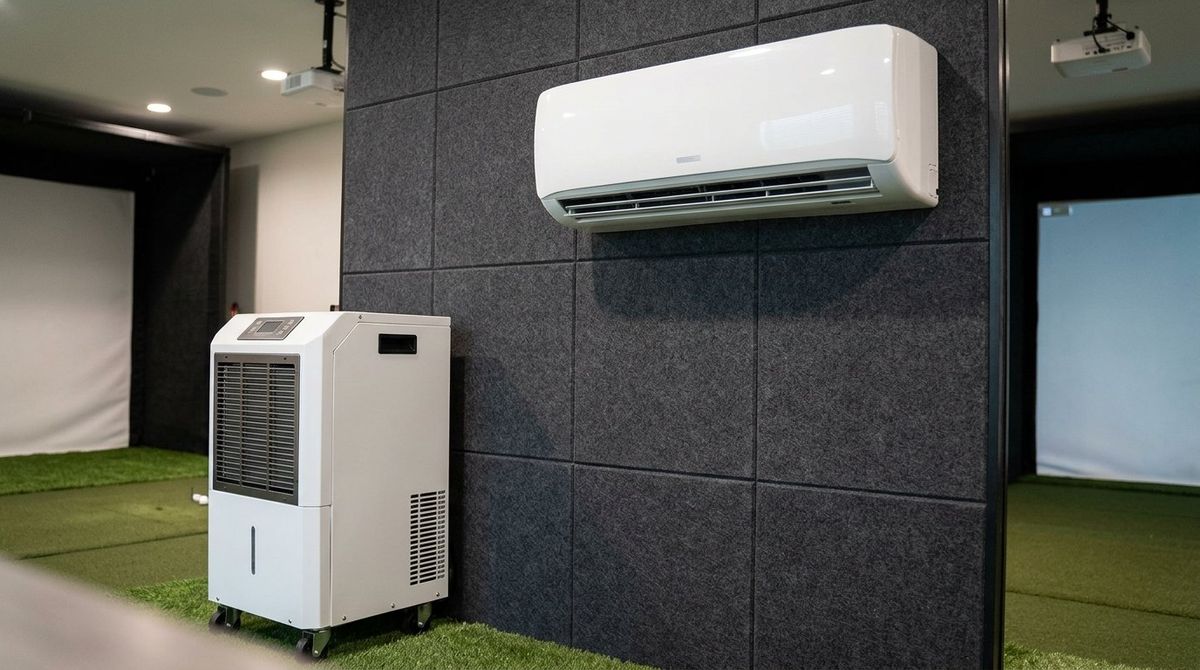
\[ M_{\text{pints/day}} = \left( V_{\text{cu\_ft}} \times k_{\text{infil}} \right) + L_{\text{occupants}} = \left( 4{,}000\text{ cu ft} \times 0.0085 \right) + 16.0\text{ pints/day} = 34.0 + 16.0 = 50.0\text{ Pints/Day} \]Installing a dedicated \( 50\text{ Pint/Day} \) standalone dehumidifier (with a built-in condensate pump routed to an exterior drain) set to a continuous \( 45\% \text{ RH} \) setpoint keeps the impact screen taut, protects the \( \$8{,}000\text{--}\$15{,}000 \) launch monitor optics, and makes \( 70^\circ\text{F} \) air feel crisp during heavy practice sessions.
Complete Studio Size to HVAC & Dehumidifier Lookup Table
| Simulator Bay Footprint \( \left( 10\text{ ft Ceiling} \right) \) | Room Volume \( \left( \text{cu ft} \right) \) | Peak Thermal Load \( \left( \text{BTU/hr} \right) \) | Recommended Mini-Split Size | Dehumidifier Rating \( \left( 45\% \text{ RH Target} \right) \) |
|---|---|---|---|---|
| Single-Car Bay \( \left( 14'\times 18' = 252\text{ sq ft} \right) \) | \( 2{,}520\text{ cu ft} \) | \( 10{,}750\text{ BTU/hr} \) | \( 12{,}000\text{ BTU/hr} \) \( \left( 1.0\text{ Ton} \right) \) | \( 35\text{ Pints/Day} \) |
| Standard 2-Car Studio \( \left( 20'\times 20' = 400\text{ sq ft} \right) \) | \( 4{,}000\text{ cu ft} \) | \( 14{,}450\text{ BTU/hr} \) | \( 18{,}000\text{ BTU/hr} \) \( \left( 1.5\text{ Ton} \right) \) | \( 50\text{ Pints/Day} \) |
| Oversized 2.5-Car Bay \( \left( 24'\times 24' = 576\text{ sq ft} \right) \) | \( 5{,}760\text{ cu ft} \) | \( 20{,}250\text{ BTU/hr} \) (4 players) | \( 24{,}000\text{ BTU/hr} \) \( \left( 2.0\text{ Ton} \right) \) | \( 70\text{ Pints/Day} \) |