Minimum Room Dimensions for Home Golf Simulators: Radar vs. Camera Space Calculator Guide (2026)
Investing thousands of dollars in a home golf simulator setup without precisely measuring your room dimensions is one of the most expensive mistakes a golfer can make. Radar-based launch monitors require extensive longitudinal depth behind and in front of the tee, while high-speed optical camera systems function in significantly tighter footprints.
Key Takeaways: - Radar Depth Requirements: Doppler radar units (Garmin R10, Mevo+) require 18 to 21 feet of total room depth to accurately calculate ball spin and trajectory. - Camera/Photometric Depth: Optical units (Bushnell Launch Pro, SkyTrak+, Uneekor) sit beside or above the golfer, operating effectively in 14 to 16 feet of depth. - Ceiling Height Realities: While 9'0" ceiling height allows iron swings for average-height golfers, a 9'6" to 10'0" clearance is mandatory for unrestricted driver swings without hitting drywall or garage opener tracks.
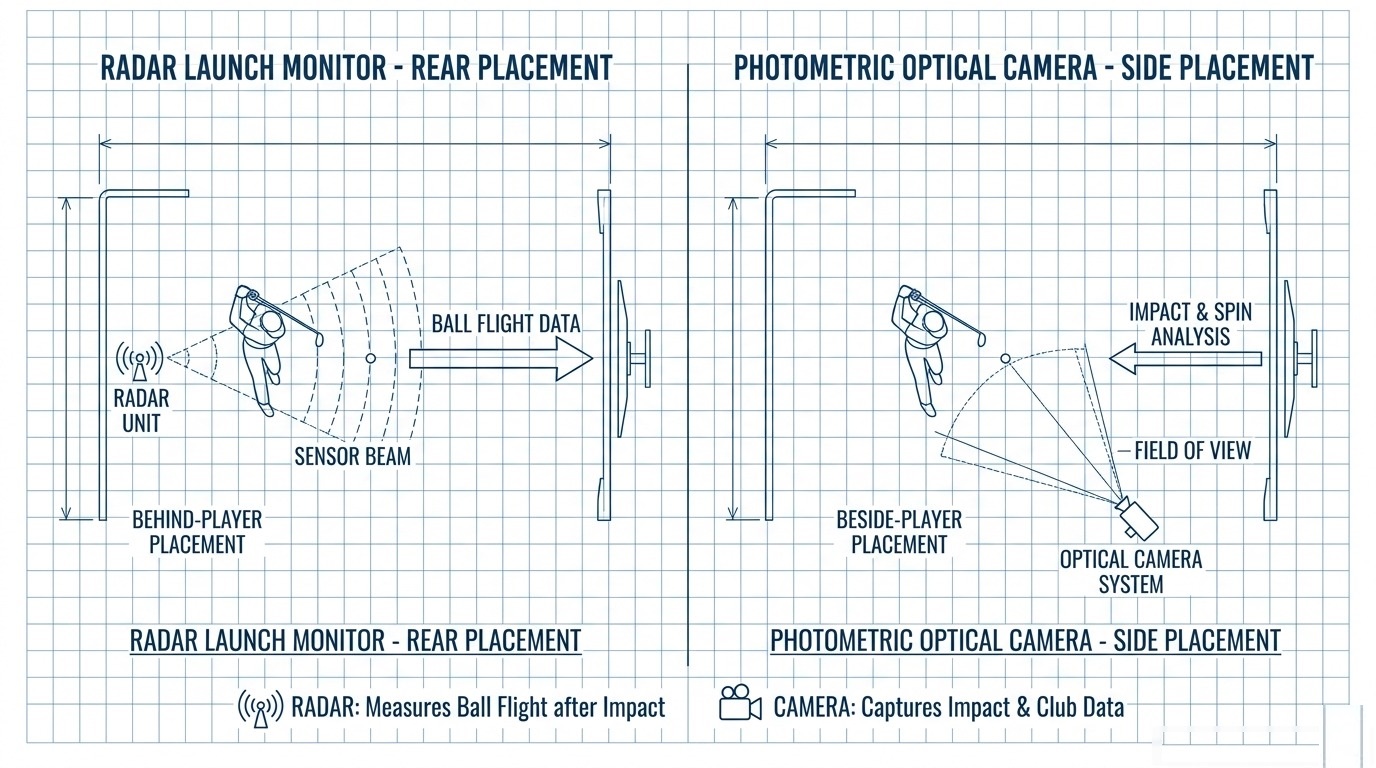
The Master Room Dimension & Clearance Formulas
Before purchasing hardware, use these architectural spatial equations to evaluate your garage, basement, or spare room against exact equipment tolerance limits:
Radar Tracking Depth Formula: $$\text{Total Depth} =\text{Radar Sensor to Tee (7-8 ft)} +\text{Tee to Impact Screen (10-12 ft)} +\text{Screen to Wall Buffer (1 ft)} = 18\text{ to }21\text{ ft}$$
Optical / Camera Tracking Depth Formula: $$\text{Total Depth} =\text{Golfer Backswing Clearance (6-7 ft)} +\text{Tee to Impact Screen (9-10 ft)} +\text{Screen to Wall Buffer (1 ft)} = 16\text{ to }18\text{ ft}$$
Minimum Ceiling Height Formula: $$\text{Min Ceiling Height} =\text{Golfer Height} +\text{Driver Length (45.5")} +\text{Mat Thickness (2")} +\text{Dynamic Follow-Through Buffer (12"-14")}$$
Room Width Equation: $$\text{Centered Hitting Width} = 14\text{ to }15\text{ ft} \quad \Big| \quad\text{Offset Hitting Width} = 10\text{ to }12\text{ ft}$$
Understanding these spatial requirements prevents costly post-purchase regret when setting up your indoor practice enclosure.
You can verify official equipment specifications and swing mechanical standards through regional golf governing resources like the United States Golf Association (USGA).
Radar vs. Photometric Camera Systems: Architectural Breakdown
The primary factor determining room depth is the underlying technology your launch monitor uses to capture ball flight data.
Radar Launch Monitors (Garmin R10, FlightScope Mevo+, TrackMan)
Doppler radar units sit 7 to 8 feet directly behind the golfer and track the ball over a flight path of 10 to 12 feet before it strikes the screen. If you position the ball closer than 10 feet from the impact screen, the radar lacks sufficient flight data to measure backspin and axis tilt accurately, leading to "wedge flyovers" or flat spin misreads.
Photometric & Camera Units (Bushnell Launch Pro, SkyTrak+, Uneekor)
High-speed camera and optical tracking systems sit directly beside or mounted above the hitting mat. By taking instantaneous high-speed flash photos of the ball during the first few inches of launch, camera units completely eliminate the 8-foot "dead space" requirement behind the golfer.
The Garage Door Opener & Ceiling Track Obstacle
In standard 8'6" garage spaces, low-hanging garage door opener motors and horizontal steel tracks frequently bisect the driver swing arc. Installing a side-mount jackshaft garage opener and raising ceiling tracks is often required to unlock adequate swing clearance.
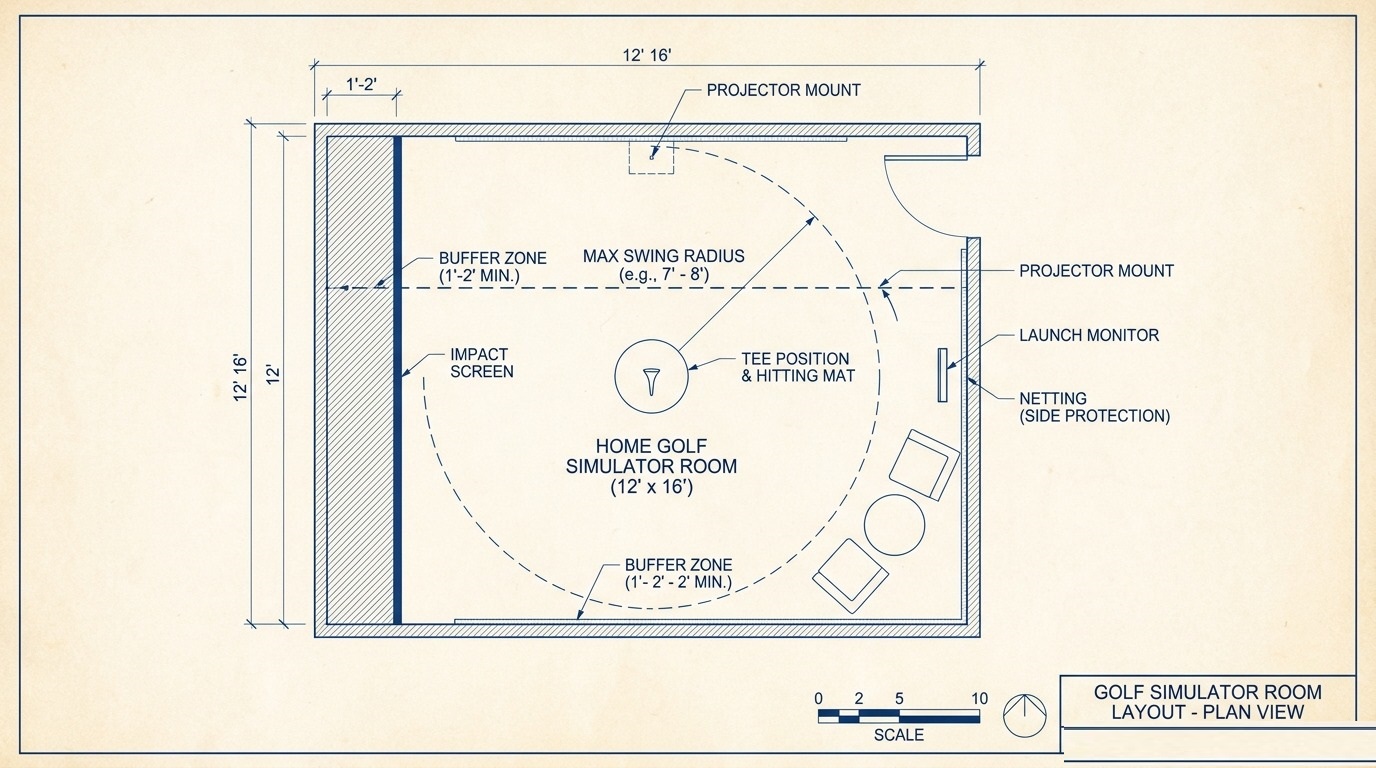
Launch Monitor Technology & Room Dimension Matrix
Compare spatial requirements across different launch monitor form factors to match your room dimensions:
| Launch Monitor Form Factor | Minimum Ceiling Height | Minimum Room Depth | Minimum Room Width | Centered Hitting Capability |
|---|---|---|---|---|
| Floor Radar (Mevo+, R10) | 9'6" (Recommended) | 18'0" – 21'0" | 12'0" – 14'0" | Requires 14'0"+ Width |
| Floor Camera (Launch Pro, SkyTrak+) | 9'0" (Irons) / 9'6" (Driver) | 16'0" – 18'0" | 10'0" – 12'0" (Offset) | Requires 14'0"+ Width |
| Overhead Camera (Uneekor, Foresight Falcon) | 9 me" – 10'0" | 15'0" – 16'0" | 12'0" – 15'0" | Excellent (14'0"+ Width) |
| Professional Dual-Tracking (TrackMan 4) | 10'0" | 19'0" – 22'0" | 15'0" | Excellent (15'0"+ Width) |
Home Simulator Room Planning Checklist
Follow this pre-installation checklist to confirm your space is 100% ready before placing an order:
- Measure floor-to-ceiling clearance at three points (backswing, tee position, and follow-through peak).
- Account for 2-inch turf stance mat thickness when calculating overhead swing clearance.
- Verify 12 inches of buffer space behind the impact screen to prevent wall rebound damage.
- Measure horizontal width from wall-to-wall at tee height to determine if centered hitting is achievable.
- Inspect overhead space for ceiling fans, garage opener tracks, light fixtures, and ductwork.
- Test slow-motion driver swings with your longest club to check dynamic wrist-hinge clearance.
- Select photometric camera hardware if total room length is under 17 feet.
Free Golf Launch Monitor Space Fitter Tool
Before spending thousands on a launch monitor that your space cannot support, input your room length, width, and ceiling height into our free Golf Launch Monitor Fitter above to see instant hardware compatibility.
Frequently Asked Questions (FAQ)
Can you swing a driver with a 9-foot ceiling?
Golfer height and swing mechanics dictate whether a 9-foot ceiling is sufficient for driver swings. Golfers under 5'9" with flatter swing planes can often swing a standard 45.5-inch driver under 9'0" ceilings on a 2-inch mat. However, taller golfers or those with steep, upright swings require 9'6" to 10'0" of clearance to avoid striking the ceiling during dynamic follow-through.
How far should the impact screen be positioned from the drywall?
An impact screen should be positioned a minimum of 12 inches (1 foot) away from the back wall or drywall. This buffer zone allows premium double-layer impact screens to absorb high-velocity ball impacts (150+ mph ball speed) without billowing back far enough to strike the wall or frame support structure.
What is the minimum width needed to accommodate both left-handed and right-handed golfers?
To comfortably accommodate both left-handed and right-handed players on a centered hitting mat, your room must be at least 14 feet wide (15 feet is ideal). In rooms narrower than 14 feet (10 to 12 feet wide), you must offset the hitting zone toward one side wall, which restricts play to single-handedness unless the mat is physically moved.