Golf Simulator Retractable Roll-Up Impact Screen Ceiling Joist Span and Torque Tube Deflection Formula: 5 Garage Bay Calculations
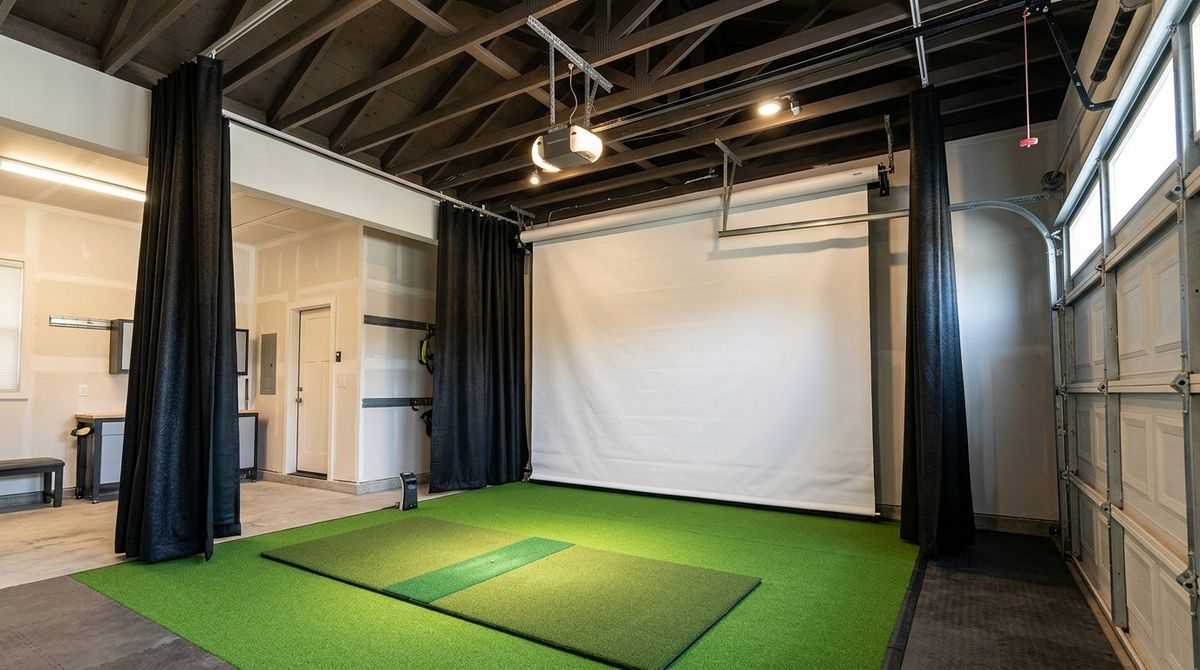
Executive Engineering Summary: Installing a ceiling-mounted motorized retractable impact screen (such as a SportScreen Vanish, MeTechs Heavy-Duty Roller, or G-TRAK Retractable) allows you to convert a two-car residential garage into a \( 16:9 \) golf simulator bay in \( 45\text{ seconds} \) and still park both vehicles inside at night. However, spanning a \( 10.0\text{ ft} \) to \( 16.0\text{ ft} \) unsupported aluminum roller tube across garage ceiling joists introduces two structural hazards: mid-span roller tube sag (\( \delta_{\max} > L/500 \)) that creates permanent diagonal V-wrinkles in 3-layer poly-spacer impact fabric, and dynamic lag-bolt pullout from \( 170\text{ mph} \) golf ball kinetic energy. Run the 5 structural engineering formulas below or plug your exact garage dimensions into the Golf Launch Monitor & Bay Clearance Fitter.
1. Calculation 1: Simply Supported Roller Tube Mid-Span Deflection & V-Wrinkle Threshold
Unlike a fixed EMT conduit enclosure that supports the top edge of an impact screen every \( 12\text{ in} \) with ball bungees, a retractable roll-up screen hangs its entire fabric mass and weighted bottom hem bar from a single horizontal aluminum torque tube supported only at its left and right end brackets. We model the roller tube of unsupported span length \( L \), Young's modulus \( E_{\text{Al}} = 68.9\text{ GPa} \) (\( 10.0 \times 10^6\text{ psi} \) for 6063-T6 extruded aluminum), outer diameter \( D_o \), and inner diameter \( D_i \) as a simply supported Euler-Bernoulli beam carrying a uniform distributed load \( w_{\text{total}} \):
\[ I_{\text{tube}} = \frac{\pi \cdot \left( D_o^4 - D_i^4 \right)}{64} \text{ in}^4, \quad w_{\text{total}} = \frac{W_{\text{tube}} + W_{\text{screen}} + W_{\text{weight-bar}}}{L} \text{ lb/in} \]The maximum vertical mid-span deflection \( \delta_{\max} \) at the center of the roller tube (\( x = L/2 \)) is governed by:
\[ \delta_{\max} = \frac{5 \cdot w_{\text{total}} \cdot L^4}{384 \cdot E_{\text{Al}} \cdot I_{\text{tube}}} \text{ in} \]Notice that mid-span sag scales with the fourth power of span width (\( L^4 \)): widening your retractable screen from \( 10.0\text{ ft} \) (\( 120\text{ in} \)) to \( 14.0\text{ ft} \) (\( 168\text{ in} \)) increases roller tube sag by \( (1.4)^4 = 3.84\times \)! When \( \delta_{\max} \) exceeds the textile flatness limit of \( L/500 \) (or roughly \( 0.30\text{ in} \) across a \( 13.0\text{ ft} \) span), the outer edges of the impact screen wind onto a larger effective radius than the sagging center, producing deep diagonal V-creases that distort projected \( 4\text{K} \) images and cause unpredictable ball rebound.
| Screen Width Span (\( L \)) | Total Hanging Load (\( W_{\text{total}} \)) | \(\varnothing 2.5\text{ in}\) Tube Sag (\(\delta_{\max}\)) | \(\varnothing 3.5\text{ in}\) Structural Tube Sag (\(\delta_{\max}\)) |
|---|---|---|---|
| \( 10.0\text{ ft} \) (\( 120\text{ in} \)) | \( 52.0\text{ lbs} \) (\( 0.433\text{ lb/in} \)) | \( 0.19\text{ in} \) (Pass: \( \le 0.24\text{ in} \)) | \( 0.06\text{ in} \) (Pass: Ultra-Flat) |
| \( 12.0\text{ ft} \) (\( 144\text{ in} \)) | \( 64.0\text{ lbs} \) (\( 0.444\text{ lb/in} \)) | \( 0.41\text{ in} \) (Fail: V-Wrinkles) | \( 0.13\text{ in} \) (Pass: \( \le 0.29\text{ in} \)) |
| \( 13.3\text{ ft} \) (\( 160\text{ in} \), \( 16:9 \) at \( 9\text{ ft} \)) | \( 72.0\text{ lbs} \) (\( 0.450\text{ lb/in} \)) | \( 0.63\text{ in} \) (Severe Center Sag) | \( 0.20\text{ in} \) (Pass: \( \le 0.32\text{ in} \)) |
| \( 15.0\text{ ft} \) (\( 180\text{ in} \)) | \( 84.0\text{ lbs} \) (\( 0.467\text{ lb/in} \)) | \( 1.05\text{ in} \) (Structural Failure) | \( 0.34\text{ in} \) (Requires \( \varnothing 4.0\text{ in} \) Tube) |
2. Calculation 2: Dynamic Ball-Impact Kinetic Energy & Ceiling Lag-Bolt Pullout Load
A regulation golf ball (\( m_{\text{ball}} = 45.93\text{ g} = 0.04593\text{ kg} \)) struck with a driver at \( v_{\text{ball}} = 170\text{ mph} \) (\( 76.0\text{ m/s} \)) carries translational kinetic energy \( E_k \):
\[ E_k = \frac{1}{2} \cdot m_{\text{ball}} \cdot v_{\text{ball}}^2 = 0.5 \cdot 0.04593\text{ kg} \cdot \left( 76.0\text{ m/s} \right)^2 = 132.6\text{ J} \text{ (or } 97.8\text{ ft}\cdot\text{lbf)} \]When the ball deforms the retractable impact screen rearward by a dynamic stopping deflection \( d_{\text{stop}} \) (typically \( 10.0\text{ in} \) to \( 14.0\text{ in} \), or \( 0.30\text{ m} \)), the transient membrane tension pulse transferred upward into each ceiling end-bracket \( F_{\text{bracket}} \) with a dynamic shock safety factor \( \text{SF} = 2.0 \) is:
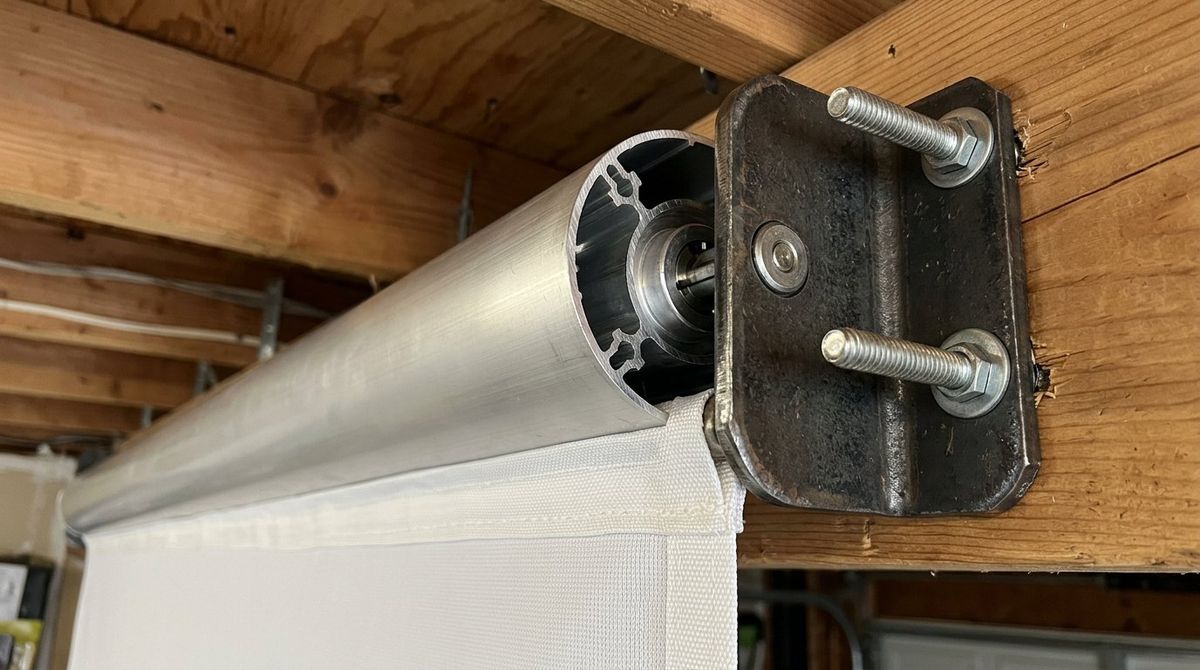
\[ F_{\text{bracket}} = \frac{W_{\text{total}}}{2} + \left( \frac{E_k}{d_{\text{stop}}} \cdot \sin\theta_{\text{catenary}} \right) \cdot \text{SF} \text{ lbf} \]At a \( 12.0\text{ in} \) (\( 0.305\text{ m} \)) stopping pocket depth, each end bracket experiences a transient downward and forward impulse exceeding \( 185\text{ lbf} \). Never mount a retractable golf impact screen into drywall anchors or thin furring strips: lag-bolt each steel end bracket directly into solid \( 2\times 8 \) or \( 2\times 10 \) Southern Pine / Douglas Fir ceiling joists (or across two joists using a \( 2\times 6 \) structural wood stringer ledger) using two \( 5/16\text{ in} \times 3.5\text{ in} \) hex lag screws pre-drilled to \( 7/32\text{ in} \), yielding a withdrawal capacity over \( 920\text{ lbf} \) per bracket.
3. Calculation 3: High-Lift Garage Door Track & Torsion Bar Vertical Clearance Formula
As detailed in r/Golfsimulator retractable screen ceiling measurement threads and ceiling track mounting discussions, garage builders frequently miscalculate the usable vertical screen height \( H_{\text{screen-net}} \) when mounting beneath or beside overhead garage door tracks:
\[ H_{\text{screen-net}} = H_{\text{ceiling}} - \Delta H_{\text{bracket}} - D_{\text{roll-packed}} - H_{\text{floor-gap}} \text{ in} \]- Direct-to-Joist Mount (With High-Lift Track + Jackshaft Opener): Converting a standard \( 7.0\text{ ft} \) horizontal garage track to a high-lift track with a wall-mounted LiftMaster 8500W / 98022 jackshaft opener hugs the door within \( 5.0\text{ in} \) of the ceiling. With a \( 114.0\text{ in} \) (\( 9.5\text{ ft} \)) ceiling, a \( 1.5\text{ in} \) bracket drop, a \( 5.0\text{ in} \) rolled screen diameter, and a \( 0.5\text{ in} \) bottom hover gap, you achieve \( H_{\text{screen-net}} = 107.0\text{ in} \) (\( 8\text{ ft } 11\text{ in} \)) of active vertical screen height—requiring a \( 120\text{ in} \) total fabric drop so \( 13.0\text{ in} \) of sacrificial cushion wrap remains wound around the aluminum bar at full extension.
- Drop-Bracket Mount Below Standard Garage Tracks: If you suspend the retractable roller below standard horizontal garage door tracks that hang \( 16.0\text{ in} \) below a \( 10.0\text{ ft} \) (\( 120.0\text{ in} \)) ceiling, your net screen height drops to \( 98.0\text{ in} \) (\( 8\text{ ft } 2\text{ in} \)), requiring a high-density foam baffle wrapped around the exposed top roller tube to prevent \( 60^\circ \) lob wedge ricochets.
4. Calculation 4: Rear Wall Stand-Off & Bottom Weight-Bar Blowback Pendulum Arc
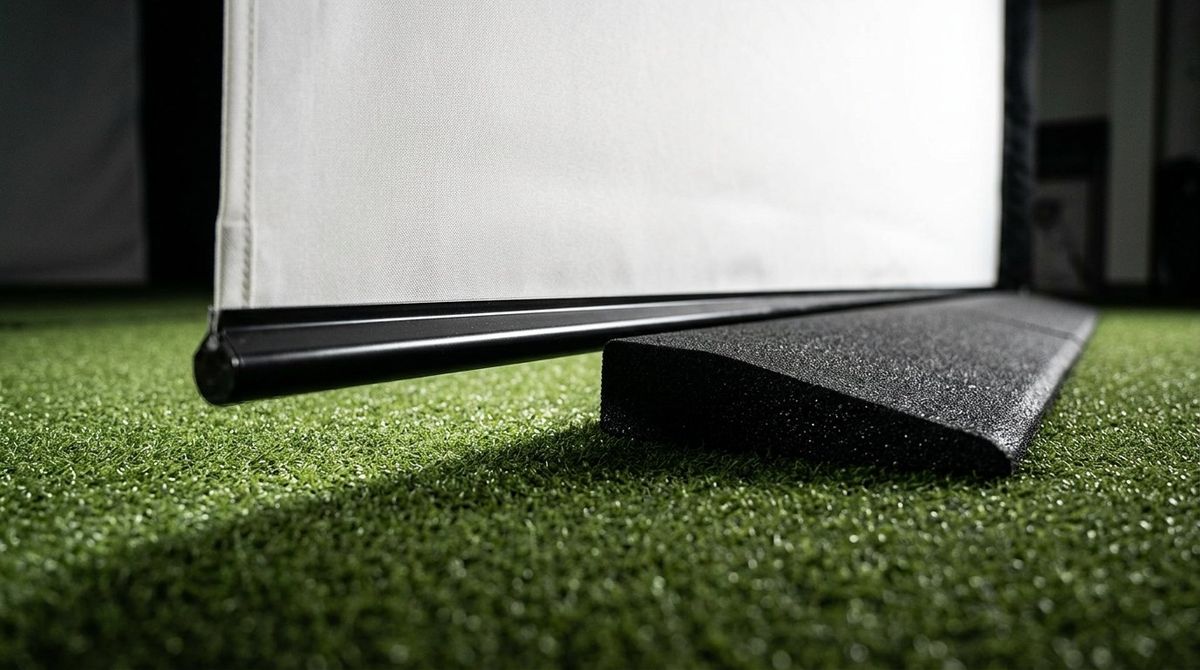
Unlike a 4-corner bungee-tensioned enclosure, a retractable screen relies on a heavy steel or sand-filled bottom hem bar (\( m_{\text{bar}} = 12\text{ lbs} \) to \( 22\text{ lbs} \)) plus optional side Velcro/bungee tethers to resist rearward blowback. Using conservation of momentum and pendulum energy, the rearward horizontal excursion \( X_{\text{blowback}} \) of the screen center when struck at height \( y_{\text{hit}} \) above the floor is bounded by:
\[ X_{\text{blowback}} = \sqrt{ d_{\text{elastic}}^2 + \left( \frac{E_k \cdot (1 - \eta_{\text{fabric}})}{m_{\text{bar}} \cdot g} \cdot \frac{L_{\text{drop}}}{y_{\text{hit}}} \right)^2 } + C_{\text{safety}} \text{ in} \]Where \( \eta_{\text{fabric}} \approx 0.72 \) is the viscoelastic energy absorption of a 3-layer poly-spacer mesh screen and \( C_{\text{safety}} = 4.0\text{ in} \) is the rigid object buffer. Across a \( 9.0\text{ ft} \) drop with an \( 18\text{ lb} \) bottom bar and lower corner bungee anchors, a \( 170\text{ mph} \) driver strike deflects the fabric \( 12.5\text{ in} \) rearward—meaning you must mount the ceiling roller brackets at least \( 16.0\text{ in} \) to \( 18.0\text{ in} \) forward of any solid rear wall, window, or garage door panel.
5. Calculation 5: Tubular Motor Torque Sizing & Sacrificial Top-Wrap Cushion
As emphasized in r/Golfsimulator MeTechs and Spectrum retractable screen builds and retractable vs fixed enclosure comparisons, sizing your internal tubular AC/DC roller motor torque \( \tau_{\text{motor}} \) (in \( \text{N}\cdot\text{m} \)) requires accounting for the maximum outer wrap radius \( R_{\text{max-wrap}} \) when the thick \( 4.5\text{ mm} \) poly-spacer screen is nearly fully rolled up:
\[ \tau_{\text{motor}} \ge \left( W_{\text{screen}} + W_{\text{weight-bar}} \right) \cdot 4.448\text{ N/lbf} \cdot R_{\text{max-wrap}} \cdot \text{SF}_{\text{motor}} \text{ N}\cdot\text{m} \]For a \( 35\text{ lb} \) poly-spacer screen plus a \( 20\text{ lb} \) bottom weight bar (\( 55\text{ lbs} = 244.6\text{ N} \)) winding onto a \( \varnothing 3.5\text{ in} \) (\( R_{\text{max-wrap}} = 0.058\text{ m} \)) roller with a \( 1.75\times \) motor duty safety factor, your tubular motor must deliver at least \( 24.8\text{ N}\cdot\text{m} \) (specify a \( 30\text{ N}\cdot\text{m} \) to \( 40\text{ N}\cdot\text{m} \) heavy-duty tubular motor). Always order your screen height \( 12\text{ in} \) to \( 15\text{ in} \) taller than your ceiling-to-floor drop so at least two full wraps of padded impact fabric remain around the aluminum tube at full extension—protecting the metal roller if a guest hits a high sky-mark or flop shot.
Run Your Exact Garage Joist Span, Ceiling Height & Screen Aspect Ratio
Use our interactive simulator bay calculator to verify your roller tube diameter, rear wall stand-off, and projector throw distance in seconds.
Open the Golf Launch Monitor & Bay Fitter