Golf Simulator Recessed Hitting Strip and Raised Subfloor Platform Depth Formula: 5 Structural Calculations
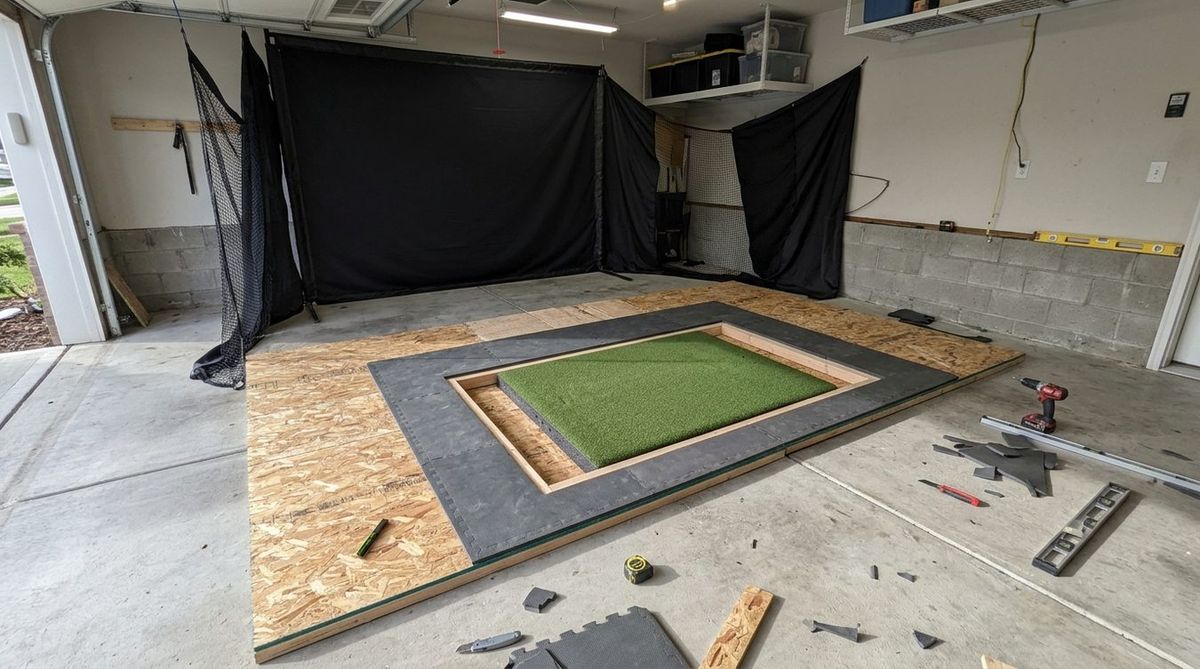
Every serious indoor golfer eventually learns a painful biomechanical lesson: striking \( 150\text{ iron shots per week} \) off a thin \( 0.75\text{ in} \) nylon mat glued directly onto a concrete garage slab transmits peak vertical ground-reaction impact forces exceeding \( 1{,}400\text{ N} \) straight into the medial epicondyle (golfer's elbow) and left wrist TFCC cartilage. Upgrading to a deep-compression injury-prevention hitting strip—such as the SIGPRO Softy Hitting Strip (\( 2.375\text{ in} \) total thickness) or Fiberbuilt Grass Series Strip (\( 1.75\text{ in} \) thickness)—absorbs clubhead deceleration safely, but introduces an immediate carpentry challenge: how do you build a surrounding raised subfloor platform so your stance turf sits dead-flush (\( \Delta H = 0.00\text{ in} \)) with the recessed hitting strip while preserving safe driver ceiling clearance? You can run your exact room dimensions and ceiling height interactively at Golf Launch Monitor Fitter and compare launch monitor optical height tolerances on our sister site SimGolfBenchmarks.com.
1. Calculation 1: The Flush-Deck Subfloor Shimming Equation (\( \Delta S \))
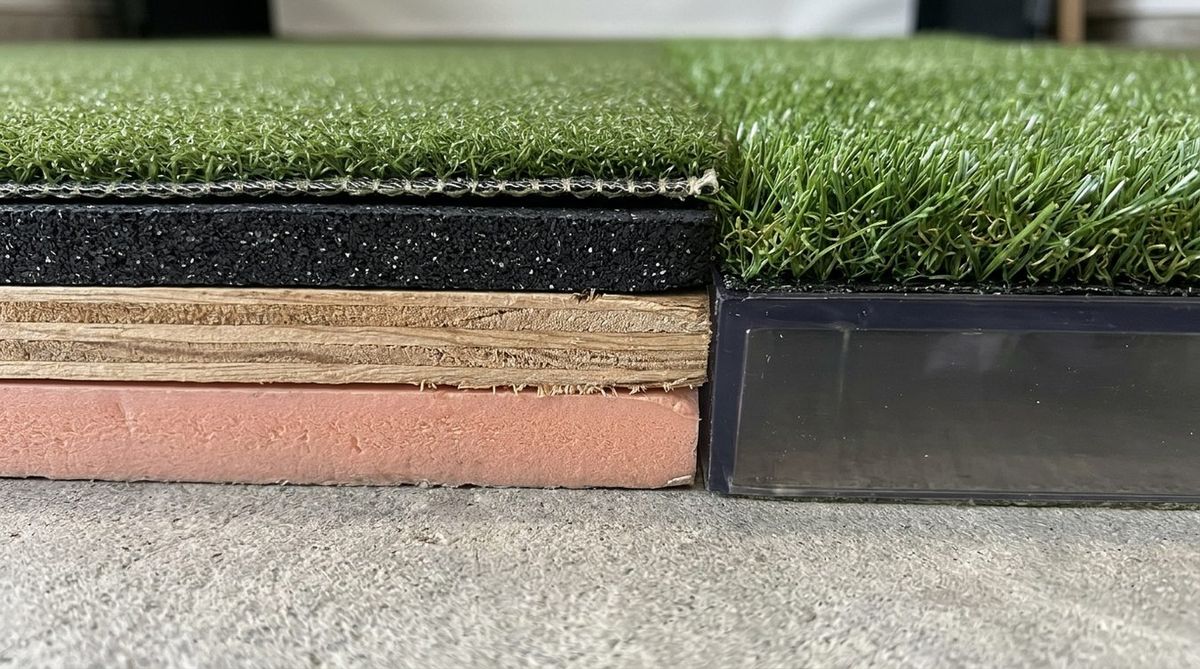
If your golf ball sits even \( 0.50\text{ in} \) (\( 12.7\text{ mm} \)) higher or lower than your feet because your hitting strip and stance deck are mismatched, you permanently alter your dynamic lie angle by \( \pm 1.25^\circ \) and groove a flawed indoor swing plane. Let \( T_{\text{strip}} \) denote the total unloaded height of your drop-in hitting strip (in inches), and let the surrounding stance deck comprise an upper putting/stance turf layer of pile-plus-backing thickness \( t_{\text{turf}} \), an interlocking high-density EVA foam gym tile layer \( t_{\text{foam}} \), an oriented strand board (OSB) or plywood sheathing layer \( t_{\text{ply}} \), and dimensional wood or XPS rigid foam sleepers \( t_{\text{sleeper}} \).
To achieve a flush playing surface where the top of the surrounding stance deck matches the hitting strip (\( H_{\text{deck}} = T_{\text{strip}} \)), the required structural under-strip shim or recess pocket depth is governed by:
\[ H_{\text{deck}} = t_{\text{sleeper}} + t_{\text{ply}} + t_{\text{foam}} + t_{\text{turf}} \] \[ \Delta S_{\text{shim}} = H_{\text{deck}} - T_{\text{strip}} \]- Case A — Foam-Only Modular Build for SIGPRO Softy (\( T_{\text{strip}} = 2.375\text{ in} = 2\frac{3}{8}\text{ in} \)): Suppose you lay two layers of \( 1.00\text{ in} \) high-density interlocking EVA gym tiles (\( t_{\text{foam}} = 2.00\text{ in} \)) topped with \( t_{\text{turf}} = 0.50\text{ in} \) NP45 putting turf (\( H_{\text{deck}} = 2.50\text{ in} \)). Because \( H_{\text{deck}} > T_{\text{strip}} \), you place a \( \Delta S_{\text{shim}} = 2.50\text{ in} - 2.375\text{ in} = 0.125\text{ in} \) (\( \frac{1}{8}\text{ in} \) neoprene rubber sheet) underneath the SIGPRO Softy cutout so both surfaces sit at an exact \( 2.500\text{ in} \) elevation.
- Case B — Framed 2x4 Sleeper Subfloor (\( H_{\text{deck}} = 2.625\text{ in} \)): Using flat-laid \( 2\times 4 \) lumber sleepers (\( t_{\text{sleeper}} = 1.50\text{ in} \)), \( \frac{23}{32}\text{ in} \) (\( 0.719\text{ in} \)) tongue-and-groove OSB subfloor panels, and \( t_{\text{turf}} = 0.406\text{ in} \) (\( \frac{13}{32}\text{ in} \)) padded turf yields \( H_{\text{deck}} = 2.625\text{ in} \). Dropping a \( 1.75\text{ in} \) Fiberbuilt Grass strip into the framed cutout requires a \( \Delta S_{\text{shim}} = 2.625\text{ in} - 1.750\text{ in} = 0.875\text{ in} \) (\( \frac{7}{8}\text{ in} \) plywood + rubber isolation pad) inside the strip well.
2. Calculation 2: Effective Ceiling Height Clearance Reduction (\( H_{\text{eff}} \))
Every inch you raise your simulator floor directly subtracts from your overhead driver swing buffer! Given a raw floor-to-joist room height \( H_{\text{raw}} \), a raised subfloor thickness \( H_{\text{deck}} \), and the minimum safe driver swing clearance \( H_{\text{swing\_min}} \) required for a golfer of standing height \( H_{\text{golfer}} \) (where empirical 3D motion-capture shows a 45.5-inch driver follow-through peaks at \( H_{\text{swing\_min}} \approx 1.38 \cdot H_{\text{golfer}} + 14.0\text{ in} \)), your effective remaining ceiling clearance margin \( M_{\text{ceil}} \) is:
\[ H_{\text{eff}} = H_{\text{raw}} - H_{\text{deck}} \] \[ M_{\text{ceil}} = H_{\text{eff}} - \left( 1.38 \cdot H_{\text{golfer}} + 14.0\text{ in} \right) \]For a golfer standing \( 6\text{ ft } 0\text{ in} \) tall (\( H_{\text{golfer}} = 72.0\text{ in} \)), the peak driver apex reaches \( 1.38(72.0) + 14.0 = 113.36\text{ in} \) (\( 9\text{ ft } 5.4\text{ in} \)). In a garage with a \( 10\text{ ft } 0\text{ in} \) (\( H_{\text{raw}} = 120.0\text{ in} \)) ceiling and a \( H_{\text{deck}} = 2.50\text{ in} \) raised subfloor, \( H_{\text{eff}} = 117.5\text{ in} \) (\( 9\text{ ft } 9.5\text{ in} \)), leaving a safe \( M_{\text{ceil}} = +4.14\text{ in} \) overhead buffer. However, in a \( 9\text{ ft } 6\text{ in} \) (\( 114.0\text{ in} \)) basement, a \( 2.50\text{ in} \) subfloor reduces \( H_{\text{eff}} \) to \( 111.5\text{ in} \) (\( M_{\text{ceil}} = -1.86\text{ in} \), guaranteeing ceiling strikes with driver!). In tight \( 9\text{ ft } 6\text{ in} \) rooms, use a low-profile \( 1.375\text{ in} \) (\( 1\frac{3}{8}\text{ in} \)) SIGPRO Super Softy Lite or EzTee Hybrid strip rather than a \( 2.50\text{ in} \) raised sleeper deck.
3. Calculation 3: Dynamic Divot Deflection & Photometric Launch Monitor Trigger Offset
Soft foam-and-air-channel hitting strips compress vertically by \( \delta_{\text{divot}} = 0.35\text{ in} \) to \( 0.62\text{ in} \) under a steep \( -5.5^\circ \) 7-iron attack angle. Furthermore, if you place a floor-standing optical launch monitor (such as a Foresight GC3, Bushnell Launch Pro, or Uneekor EYE MINI) on top of the firmer surrounding stance turf while the golf ball rests on a slightly crowned or worn hitting strip, the vertical camera-to-ball lens offset \( \Delta z_{\text{cam}} \) shifts. Optical launch monitors require the ball equator to sit within:
\[ -0.25\text{ in} \le z_{\text{ball}} - z_{\text{monitor\_base}} \le +0.50\text{ in} \]Keeping \( \Delta S_{\text{shim}} \) calibrated within \( \pm 0.0625\text{ in} \) (\( \frac{1}{16}\text{ in} \)) ensures your floor launch monitor never misses low-launch stingers or misreads vertical launch angle.
4. Calculation 4 & 5: Joist Span Deflection (\( L/360 \)) & Garage Slab Moisture Vapor Barrier
When framing a raised wooden platform over a sloped concrete garage floor (which typically pitches \( \frac{1}{8}\text{ in} \) to \( \frac{1}{4}\text{ in per foot} \) toward the garage door for drainage), two structural rules prevent spongy stance feel and subfloor rot:
- Calculation 4 — Sleeper Spacing & Stance Deflection: During an aggressive \( 115\text{ mph} \) driver downswing, a \( 210\text{ lb} \) golfer exerts a peak lead-foot vertical load of \( P_{\text{peak}} \approx 1.85 \times 210\text{ lbf} = 388.5\text{ lbf} \). Pairing \( \frac{23}{32}\text{ in} \) (\( 18.3\text{ mm} \)) OSB sheathing over sleepers spaced at \( s = 16.0\text{ in} \) on-center limits mid-span bending deflection \( \delta_{\text{span}} \) to \( 0.019\text{ in} \)—exceeding the commercial \( L/360 = 0.044\text{ in} \) stiffness criterion by \( 2.3\times \).
- Calculation 5 — Garage Slope Rip-Wedge Taper Formula: Over a \( L_{\text{bay}} = 16.0\text{ ft} \) bay pitched at \( m_{\text{slope}} = 0.1875\text{ in/ft} \) (\( \frac{3}{16}\text{ in/ft} \)), the front impact screen sits lower than the rear of the bay by: \[ \Delta H_{\text{slope}} = L_{\text{bay}} \cdot m_{\text{slope}} = 16.0\text{ ft} \times 0.1875\text{ in/ft} = 3.00\text{ in} \] Always lay a \( 6\text{ mil} \) polyethylene moisture barrier (or dimpled DMX 1-Step air-gap underlayment) over bare concrete before scribing tapered sleeper wedges so ground moisture never warps the OSB deck.
5. Popular Hitting Strip Thickness & Subfloor Stack-Up Lookup Table
| Hitting Strip Model | Exact Strip Thickness (\( T_{\text{strip}} \)) | Matching Stance Stack-Up (\( H_{\text{deck}} \)) | Under-Strip Shim (\( \Delta S_{\text{shim}} \)) |
|---|---|---|---|
| SIGPRO Softy Strip (28"x12") | \( 2.375\text{ in} \) (\( 2\frac{3}{8}\text{ in} \)) | \( 2.00\text{ in} \) EVA Foam + \( 0.50\text{ in} \) Turf (\( 2.50\text{ in} \)) | \( +0.125\text{ in} \) (\( \frac{1}{8}\text{ in} \)) Neoprene Pad |
| Fiberbuilt Grass Series Strip | \( 1.750\text{ in} \) (\( 1\frac{3}{4}\text{ in} \)) | \( 1.50\text{ in} \) EVA Foam + \( 0.50\text{ in} \) Turf (\( 2.00\text{ in} \)) | \( +0.250\text{ in} \) (\( \frac{1}{4}\text{ in} \)) Rubber Mat |
| Carl's Place HotShot Gel/Foam | \( 1.750\text{ in} \) (\( 1\frac{3}{4}\text{ in} \)) | \( 1.00\text{ in} \) XPS + \( 0.50\text{ in} \) OSB + \( 0.375\text{ in} \) Turf | \( +0.125\text{ in} \) (\( \frac{1}{8}\text{ in} \)) Neoprene Pad |
| Holy Grail Hitting Strip | \( 1.875\text{ in} \) (\( 1\frac{7}{8}\text{ in} \)) | \( 1.50\text{ in} \) EVA Foam + \( 0.50\text{ in} \) Turf (\( 2.00\text{ in} \)) | \( +0.125\text{ in} \) (\( \frac{1}{8}\text{ in} \)) Neoprene Pad |
| TrueStrike Single Gel Module | \( 2.250\text{ in} \) (\( 2\frac{1}{4}\text{ in} \)) | \( 1.50\text{ in} \) 2x4 + \( 0.50\text{ in} \) Plywood + \( 0.50\text{ in} \) Turf | \( +0.250\text{ in} \) (\( \frac{1}{4}\text{ in} \)) Rubber Pad |
6. Recommended Hitting Strip, Subfloor & Launch Monitor Hardware
Verified Elbow-Safe Hitting Deck & Studio Equipment:
- Tier 1 Complete Flush-Deck Flooring System: SIGPRO Commercial Modular Subfloor & Recessed Softy Hitting Strip System (\( \$1{,}299\text{ to }\$3{,}499\text{ USD} \)) — Pre-engineered flush turf tiles and integrated \( 2.375\text{ in} \) Softy hitting strip with full-size putting cups.
- Tier 2 Heavy-Duty Modular Stance & Bristle System: Fiberbuilt Grass Series Double-Sided Studio Mat (12'x4' Combo) (\( \$1{,}599\text{ USD} \)) — Rated for \( 300{,}000\text{ strikes} \) with zero-shock nylon bristle suspension.
- Tier 3 Precision Photometric Floor Launch Monitor: Bushnell Launch Pro / Foresight GC3 Triscopic Launch Monitor (\( \$1{,}999\text{ to }\$6{,}999\text{ USD} \)) — Pairs seamlessly with a dead-flush recessed hitting strip for sub-degree launch angle telemetry.
Next Step: Measure your raw floor-to-ceiling height \( H_{\text{raw}} \) first, pick the thickest injury-prevention hitting strip that leaves at least \( 3.5\text{ in} \) of driver follow-through buffer, and build your surrounding EVA foam or sleeper deck to match \( T_{\text{strip}} \) within \( \frac{1}{16}\text{ in} \). Calculate your complete bay geometry right now at Golf Launch Monitor Fitter.