Golf Simulator Radar Ball Flight Distance Formula: 5 Essential Doppler Spin Capture Calculations
Golf Simulator Radar Ball Flight Distance Formula: 5 Essential Doppler Spin Capture Calculations
The single most common source of indoor distance errors in garage golf simulators—where a launch monitor reads 7-iron carry within a yard of outdoor range numbers, yet inexplicably robs a well-struck driver of 22 yards or Invented 3,600 RPM ballooning spin—comes down to insufficient tee-to-screen ball flight distance. When golfers build around a rear-mounted Doppler radar launch monitor such as the FlightScope Mevo+, Garmin Approach R10, Full Swing KIT, or Trackman 4, manufacturer spec sheets often advertise an optimistic “8 feet minimum ball flight” without explaining the rotational physics that govern high-speed driver spin capture.
In this engineering guide, we derive the exact Doppler Radar Rotational Kinematics Formula that links your ball speed (), backspin rate (), and minimum required tee-to-screen flight distance (), and show how to calculate your total end-to-end room depth () before framing your enclosure. You can plug your personal driver speed and garage dimensions directly into our interactive Golf Launch Monitor Fitter, and compare how radar stacks up against side-mounted camera units in our SimGolfBenchmarks hardware tests.
Quick Reference: Minimum Tee-to-Screen Flight Distance by Swing Speed
________________
Calculation 1: The Doppler Rotational Kinematics Formula ()
________________
To understand why a Doppler radar requires significantly more flight distance for a 170 mph driver than for a 115 mph 8-iron, we must look at how microwave radar measures backspin. As veteran simulator builders point out in r/Golfsimulator Mevo+ ball-to-screen distance discussions, a 24GHz radar does not photograph dimples; instead, it measures the periodic micro-Doppler frequency modulation as the top of the spinning ball rotates toward the screen (moving at ) and the bottom rotates back toward the radar (moving at ).
First, convert ball velocity from miles per hour () to feet per second () using the exact conversion factor \( \frac{5,280\text{ ft}}{3,600\text{ s}} = 1.4667\):
Next, convert backspin rate from revolutions per minute () to revolutions per second ():
Dividing linear velocity () by rotational frequency () yields the exact linear distance in feet that the golf ball travels through the air during one single 360-degree revolution ():
Notice the dramatic contrast across your bag:
Calculation 2: Minimum Tee-to-Screen Flight Distance ()
________________
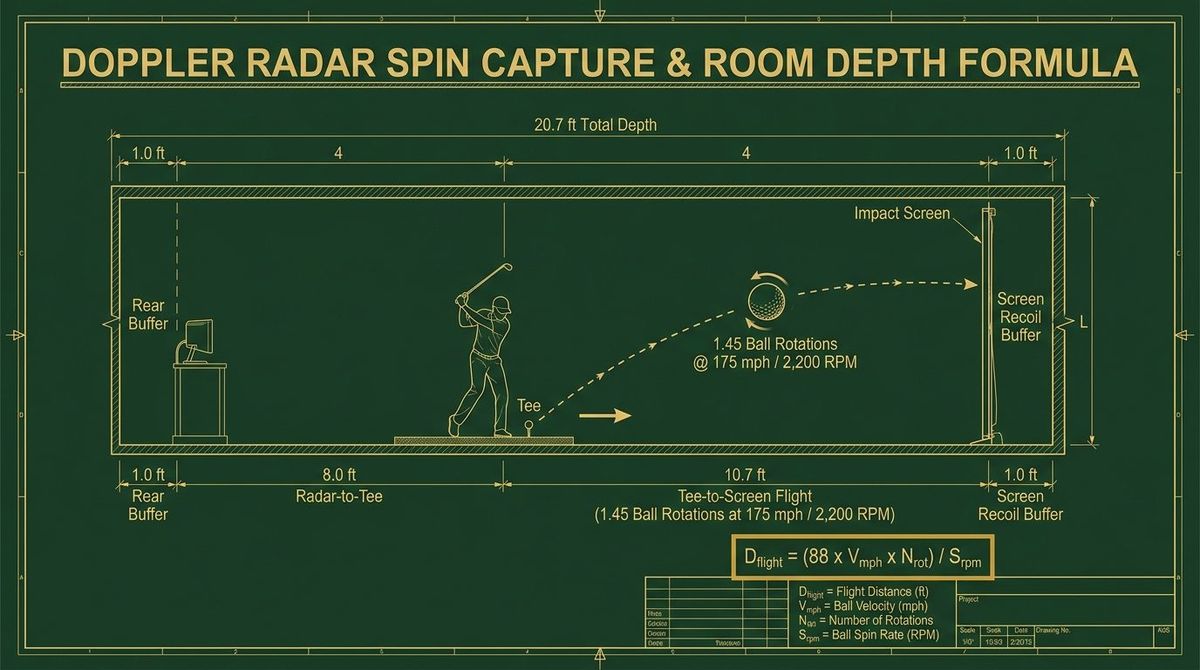
For a Fast Fourier Transform (FFT) signal processor inside a Doppler radar launch monitor to distinguish true spin frequency from acoustic screen slap and background clutter, it must observe a minimum number of complete ball revolutions () in free flight before the ball contacts the impact screen:
Multiplying by gives the Master Radar Tee-to-Screen Flight Distance Formula:
Club & Shot Profile
Ball Speed ()
True Backspin ()
Distance per 1 Rev ()
Min Flight w/ RCT or Dot ()
Min Flight Bare White Ball ()
8-Iron Approach
115 mph
7,500 RPM
1.35 ft
7.0 ft (Floor min)
7.0 ft (Floor min)
5-Iron / Hybrid
138 mph
4,600 RPM
2.64 ft
7.5 ft (Floor min)
7.5 ft (Floor min)
Moderate Driver
145 mph
2,650 RPM
4.82 ft
7.8 ft
9.6 ft
Scratch Amateur Driver
162 mph
2,300 RPM
6.20 ft
9.0 ft
12.4 ft
High-Speed Driver
170 mph
2,150 RPM
6.96 ft
10.1 ft
13.9 ft
Tour / Low-Spin Bomb
180 mph
1,950 RPM
8.12 ft
11.8 ft
16.2 ft
Calculation 3: Flight Time Window () & Italicized Spin Fallbacks
________________
Why do players in r/Golfsimulator Mevo+ driver distance troubleshooting threads notice that their launch monitor displays spin numbers in italics (estimated spin) and under-reports driver carry by 20+ yards when hitting from 8 feet away? We can calculate the exact free-flight observation window in milliseconds ():
At () across an 8.0-foot tee-to-screen gap, the golf ball is in the air for only 32.1 milliseconds before slamming into the screen! Worse still, the first 6 inches after impact are masked by the giant radar cross-section of the moving titanium driver head, leaving less than 29 milliseconds of clean ball return. When the DSP cannot resolve 1.45+ spin cycles inside that 29 ms window, it falls back on an internal neural-network lookup table that estimates backspin from launch angle and ball speed—frequently assigning 3,100–3,500 RPM to a low-spin 2,100 RPM drive and robbing you of 22 yards of carry.
Calculation 4: Total Longitudinal Room Depth Formula ()
________________
When sizing a garage or basement bay for a rear-mounted Doppler radar, tee-to-screen flight () is only one of four longitudinal segments. As discussed in r/Golfsimulator 18-foot room depth evaluations, you must sum four distinct zones:
1. Rear Wall / Tripod Buffer (): Space behind the launch monitor for the leveling stand legs, USB-C power cable, and rear wall clearance.
2. Radar-to-Tee Setback ():
3. Tee-to-Screen Flight (): Calculated via Formula 2 above based on your peak driver ball speed.
4. Impact Screen Recoil Buffer (): Mandatory air gap behind the tensioned impact screen so a 170 mph ball deflecting the fabric by 9 inches never strikes the drywall or framing studs.
Worked Example (168 mph Driver with FlightScope Mevo+ & RCT Balls):
Calculation 5: Radar Tilt, Tee Height Leveling & Metallic Interference Audit
________________
Even with 10.5 feet of tee-to-screen flight, a Doppler radar will misread spin axis and club path—as highlighted in r/Golfsimulator Mevo+ swing path and face angle threads—if two physical alignment rules are violated:
Frequently Asked Questions
________________
How much ball flight distance does a FlightScope Mevo+ or Garmin R10 need indoors?
While 8.0 feet of tee-to-screen flight is the bare minimum for irons and sub-145 mph driver swings using metallic dots or Titleist RCT balls, golfers with driver ball speeds between 160 and 175 mph need 10.0 to 12.0 feet of tee-to-screen flight (and 19.5 to 21.5 feet of total room depth) to capture accurate low-spin driver numbers without spin-estimation errors.
Why does driver ball speed and low backspin require more tee-to-screen distance?
Linear distance traveled per revolution is directly proportional to ball speed and inversely proportional to spin rate: . A 175 mph drive spinning at 2,000 RPM travels 7.70 feet for every single 360-degree rotation, whereas a 115 mph 8-iron spinning at 7,500 RPM travels only 1.35 feet per rotation.
Do Titleist Pro V1 RCT balls eliminate the need for silver metallic stickers?
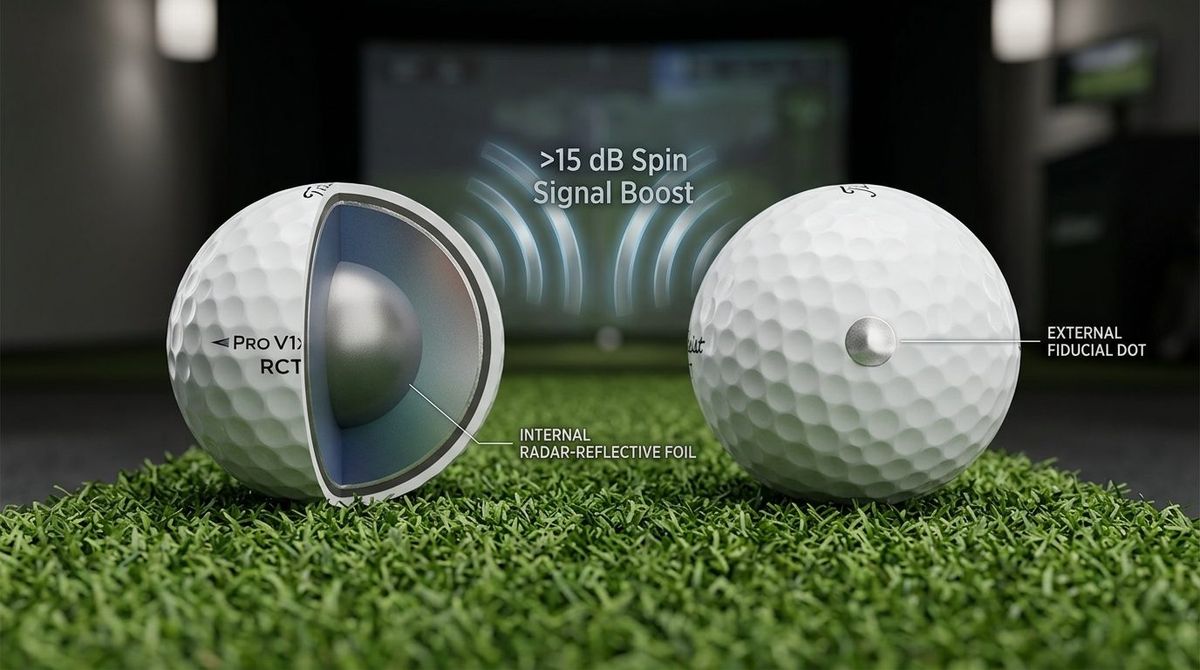
Yes. Titleist Radar Capture Technology (RCT) balls contain an internal radar-reflective marker layer engineered in partnership with Trackman and FlightScope. They deliver a clean spin-modulation return from any tee orientation without requiring external foil stickers that peel off onto your impact screen.
What should I do if my garage is only 15 feet deep?
If your total room depth is 15 feet or less, a rear-mounted Doppler radar will not have enough combined radar-to-tee (7–8 ft) and tee-to-screen (8–10 ft) distance. You should select a side-mounted photometric camera launch monitor (such as the Uneekor EYE MINI, Bushnell Launch Pro, or Foresight GC3) or an overhead camera unit, which require zero rear radar setback.
Run the Interactive Calculator: Use our Golf Launch Monitor Fitter to model your exact parameters and tolerances in real time.