Golf Simulator Off-Axis Projector Horizontal Lens Shift, Shadow Cone & Corner Keystone Pixel Loss Formula: 5 Optical Calculations
Executive Optical Summary: When a garage door opener track, structural steel I-beam, or low \( 8.5\text{-ft to } 9.0\text{-ft} \) ceiling prevents you from mounting your golf simulator projector directly over the tee at \( 9.0\text{ ft to } 11.0\text{ ft} \), moving the projector backward (\( 13.0\text{ ft to } 15.0\text{ ft} \)) or offsetting it laterally (\( 18.0\text{ in to } 36.0\text{ in} \) off-center) is the standard way to protect the unit from driver strikes and eliminate golfer body shadows. However, confusing optical horizontal lens shift with digital 2D/4-corner keystone correction routinely destroys \( 18\% \text{ to } 34\% \) of native \( 4\text{K UHD} \) (\( 3840 \times 2160 \)) pixel resolution and leaves an unsightly illuminated gray trapezoid border on the enclosure wall. Below are the 5 exact optical ray-tracing and pixel-retention formulas to engineer a shadow-free off-axis projection bay, paired with our interactive Golf Launch Monitor Fitter.
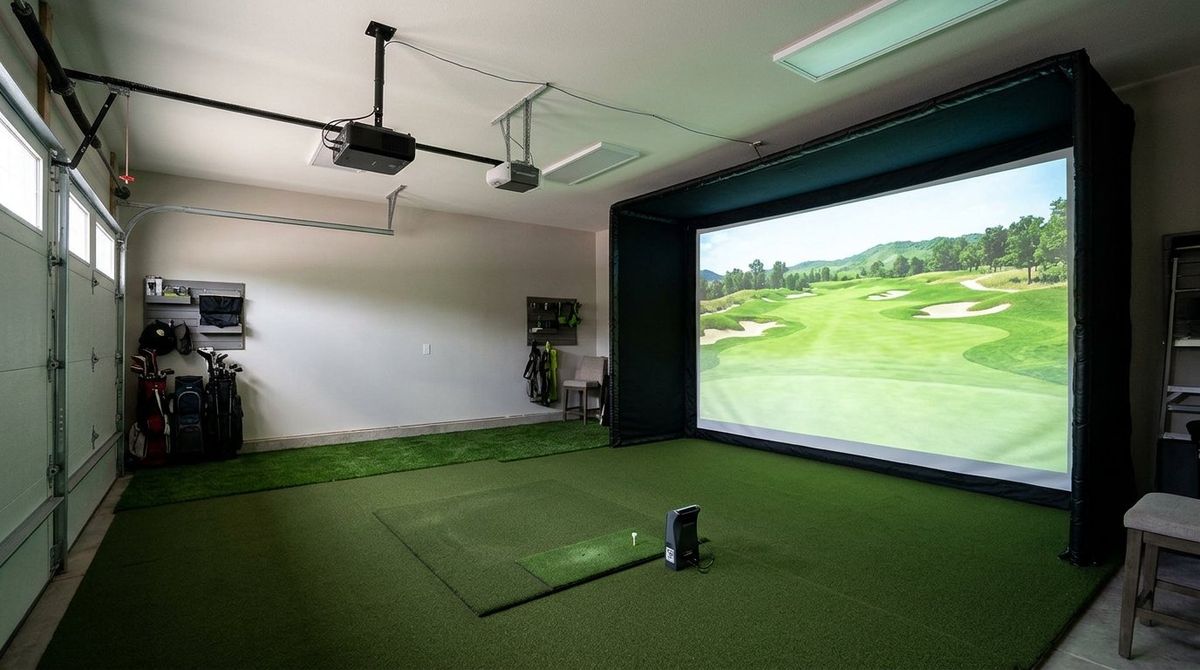
1. Formula 1: Vertical & Lateral Golfer Shadow Cone Ray-Tracing Equation
As builders frequently ask in r/Golfsimulator centered vs off-center projector shadow threads, a golfer casts a shadow onto the bottom of the impact screen whenever any part of their body or clubhead intersects the lower boundary plane of the projector's light frustum. Let \( H_{\text{lens}} \) be the projector lens height above the finished hitting mat, \( H_{\text{bottom}} \) be the bottom edge of the projected image on the screen (typically \( 0.0\text{ in} \) for floor-to-ceiling turf alignment), \( D_{\text{throw}} \) be the horizontal perpendicular distance from the lens to the screen, and \( D_{\text{golfer}} \) be the horizontal distance from the screen to the golfer's head/shoulders at address. The vertical height of the lowest light ray at the golfer's plane, \( Z_{\text{ray}}(D_{\text{golfer}}) \), is:
\[ Z_{\text{ray}}(D_{\text{golfer}}) = H_{\text{bottom}} + \left(H_{\text{lens}} - H_{\text{bottom}}\right) \cdot \left(\frac{D_{\text{golfer}}}{D_{\text{throw}}}\right) \]Worked Benchmark: Suppose you mount a BenQ TK700STi or BenQ AK700ST with its lens at \( H_{\text{lens}} = 98.0\text{ in} \) (\( 8.17\text{ ft} \)) and \( D_{\text{throw}} = 156.0\text{ in} \) (\( 13.0\text{ ft} \)) back from the screen, with the image touching the floor (\( H_{\text{bottom}} = 0.0\text{ in} \)). If a \( 5\text{ ft }11\text{ in} \) (\( 71.0\text{-in} \)) golfer stands with their head at \( D_{\text{golfer}} = 120.0\text{ in} \) (\( 10.0\text{ ft} \)) from the screen:
\[ Z_{\text{ray}}(120.0\text{ in}) = 0.0\text{ in} + 98.0\text{ in} \cdot \left(\frac{120.0\text{ in}}{156.0\text{ in}}\right) = 98.0\text{ in} \cdot 0.76923 = 75.38\text{ in} \quad (6\text{ ft } 3.38\text{ in}) \]Because \( Z_{\text{ray}} = 75.38\text{ in} \) is \( 4.38\text{ in} \) higher than the \( 71.0\text{-in} \) golfer's head, the golfer casts zero head shadow at address! However, if you move the projector back to \( D_{\text{throw}} = 180.0\text{ in} \) (\( 15.0\text{ ft} \)) to clear a ceiling beam while keeping the golfer at \( D_{\text{golfer}} = 120.0\text{ in} \), \( Z_{\text{ray}} \) drops to \( 98.0 \times (120 / 180) = 65.33\text{ in} \) (\( 5\text{ ft } 5.33\text{ in} \)), casting a \( 16.0\text{-inch} \) head-and-shoulder shadow across the bottom of the screen unless you offset the projector laterally.
2. Formula 2: Pure Optical Horizontal Lens Shift vs Ray Geometry
A common misconception in r/Golfsimulator horizontal lens shift physics discussions is that optical lens shift bends the light beam around the golfer. In reality, optical horizontal lens shift (\( S_H \), expressed as a percentage of screen width \( W_{\text{screen}} \)) translates the internal lens group parallel to the screen plane while keeping the projector chassis pointed dead perpendicular (\( \psi_{\text{yaw}} = 0^\circ \)) to the impact screen. The maximum lateral distance \( X_{\text{opt, max}} \) you can move the projector off the screen centerline using pure zero-distortion optical lens shift is:
\[ X_{\text{opt, max}} = W_{\text{screen}} \cdot \left(\frac{S_H}{100\%}\right) \]On a \( W_{\text{screen}} = 144.0\text{ in} \) (\( 12.0\text{ ft} \)) enclosure, a projector with \( S_H = \pm 15.0\% \) optical horizontal lens shift (such as commercial installation models from Epson or Panasonic) allows you to mount the lens \( X_{\text{opt, max}} = 144.0\text{ in} \cdot 0.15 = 21.6\text{ in} \) to the right of the screen centerline with \( 100.0\% \) native pixel retention and \( 0.0\text{ ms} \) scaling latency. While the extreme left boundary ray still travels in a straight line from \( x = +21.6\text{ in} \) at the lens to \( x = -72.0\text{ in} \) at the left screen edge, shifting the source \( 21.6\text{ in} \) to the right moves the lower-center rays behind the trail shoulder of a right-handed golfer.
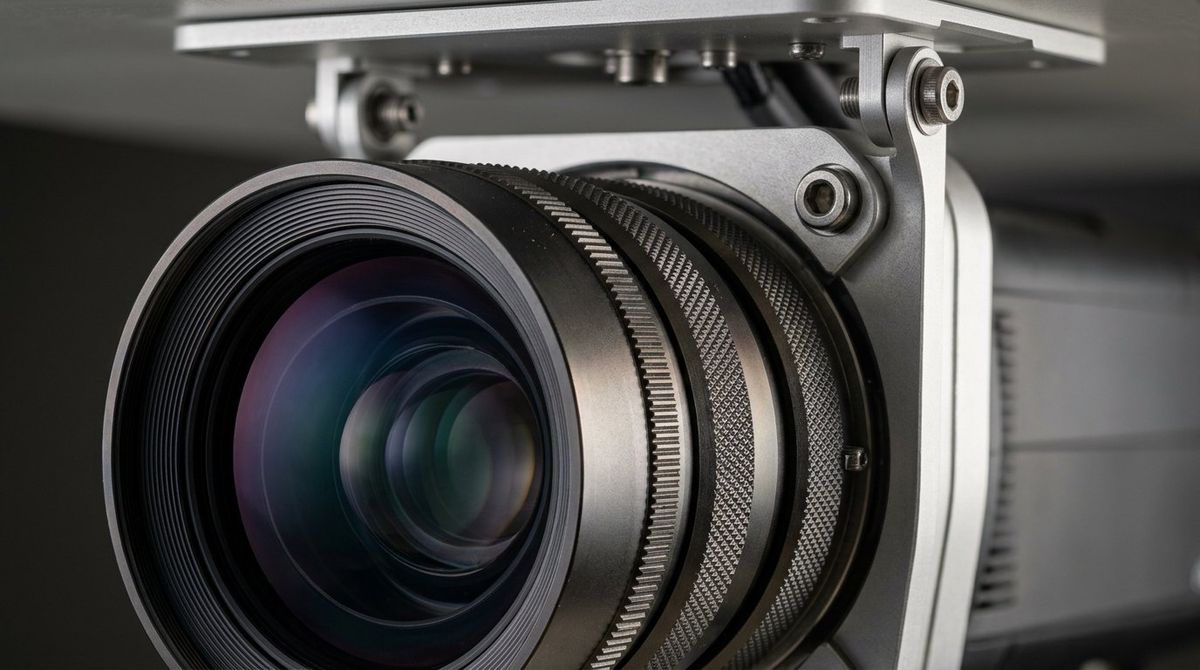
3. Formula 3 & 4: Off-Axis Yaw Angle & Digital Corner Keystone 4K Pixel Loss
Most dedicated short-throw golf simulator projectors under \( \$3{,}000\text{ USD} \) (such as the BenQ AK700ST, BenQ LK936ST, and Optoma GT2100HDR) feature minimal or zero horizontal optical lens shift (with the notable exception of the flagship \( \$5{,}599\text{ USD} \) BenQ LK936ST, which offers \( \pm 23\% \) horizontal and \( +60\% / -0\% \) vertical optical lens shift). When using a fixed-center-lens projector mounted laterally off-center by a horizontal offset \( X_{\text{offset}} \) at a throw distance \( D_{\text{throw}} \), you must physically yaw (rotate) the projector inward toward the screen center by an angle \( \psi_{\text{yaw}} \):
\[ \psi_{\text{yaw}} = \arctan\left(\frac{X_{\text{offset}}}{D_{\text{throw}}}\right) \]As analyzed in r/Golfsimulator off-axis shadow mitigation threads, yawing a short-throw projector (throw ratio \( TR = D_{\text{throw}} / W_{\text{screen}} = 0.80 \)) causes the side of the image farthest from the projector to expand vertically and horizontally into a trapezoid. To force that trapezoid back into a rectangular enclosure using Digital Horizontal Keystone / 4-Corner Fit, the projector's internal scaler downsamples the active DMD/LCD pixel grid. The fraction of native \( 4\text{K UHD} \) (\( N_0 = 8{,}294{,}400\text{ pixels} \)) lost to horizontal and vertical keystone compression, \( L_{\text{pixel}}(\psi_{\text{yaw}}) \), is governed by the projective foreshortening ratio:
\[ \eta_{\text{pixel}} \approx \frac{\cos(\psi_{\text{yaw}})}{1 + \left(\frac{1}{2 \cdot TR}\right) \cdot \sin(\psi_{\text{yaw}})} \quad \implies \quad L_{\text{pixel}} = \left(1 - \eta_{\text{pixel}}\right) \times 100\% \]Worked Calculation: If you offset a \( TR = 0.80 \) short-throw \( 4\text{K} \) projector by \( X_{\text{offset}} = 30.0\text{ in} \) (\( 2.5\text{ ft} \)) at a throw distance of \( D_{\text{throw}} = 144.0\text{ in} \) (\( 12.0\text{ ft} \)) without optical lens shift:
\[ \psi_{\text{yaw}} = \arctan\left(\frac{30.0\text{ in}}{144.0\text{ in}}\right) = \arctan(0.20833) = 11.77^\circ \] \[ \eta_{\text{pixel}} \approx \frac{\cos(11.77^\circ)}{1 + \left(\frac{1}{1.60}\right) \cdot \sin(11.77^\circ)} = \frac{0.97897}{1 + 0.625 \cdot 0.20398} = \frac{0.97897}{1.12749} = 0.8683 \quad (86.83\% \text{ vertical/horizontal linear scale}) \] \[ \text{Total 2D Active Pixel Retention} = (\eta_{\text{pixel}})^2 = (0.8683)^2 = 75.39\% \quad \implies \quad L_{\text{pixel}} = 24.61\% \text{ 4K pixel loss} \]In other words, a \( 30.0\text{-inch} \) off-axis mount corrected purely via digital keystone throws away \( 2{,}041{,}250\text{ pixels} \) (\( 24.61\% \) of your \( 4\text{K} \) array), softens green-reading grid lines on the far side of the screen due to asymmetric focus depth (\( \Delta D_{\text{focus}} = W_{\text{screen}} \cdot \sin(11.77^\circ) = 29.37\text{ in} \) path difference between left and right screen edges), and adds \( 16.7\text{ ms to } 25.0\text{ ms} \) of video processing latency.
| Lateral Offset (\( X_{\text{offset}} \) at \( 144\text{ in} \) Throw) | Required Yaw Angle (\( \psi_{\text{yaw}} \)) | Left-to-Right Focus Path Delta (\( \Delta D_{\text{focus}} \)) | 2D Digital Keystone 4K Pixel Retention | Active Pixels Retained (of \( 8.29\text{M} \)) |
|---|---|---|---|---|
| \( 0.0\text{ in} \) (Centered or Pure Optical Shift) | \( 0.00^\circ \) | \( 0.00\text{ in} \) (Perfect planar focus) | \( 100.00\% \) (\( 0.00\% \) loss) | \( 8{,}294{,}400\text{ px} \) |
| \( 12.0\text{ in} \) (\( 1.0\text{ ft} \) Lateral Offset) | \( 4.76^\circ \) | \( 11.96\text{ in} \) | \( 90.02\% \) (\( 9.98\% \) loss) | \( 7{,}466{,}619\text{ px} \) |
| \( 24.0\text{ in} \) (\( 2.0\text{ ft} \) Lateral Offset) | \( 9.46^\circ \) | \( 23.67\text{ in} \) | \( 79.68\% \) (\( 20.32\% \) loss) | \( 6{,}608{,}978\text{ px} \) |
| \( 30.0\text{ in} \) (\( 2.5\text{ ft} \) Lateral Offset) | \( 11.77^\circ \) | \( 29.37\text{ in} \) | \( 75.39\% \) (\( 24.61\% \) loss) | \( 6{,}253{,}150\text{ px} \) |
| \( 36.0\text{ in} \) (\( 3.0\text{ ft} \) Lateral Offset) | \( 14.04^\circ \) | \( 34.93\text{ in} \) | \( 70.64\% \) (\( 29.36\% \) loss) | \( 5{,}859{,}164\text{ px} \) |
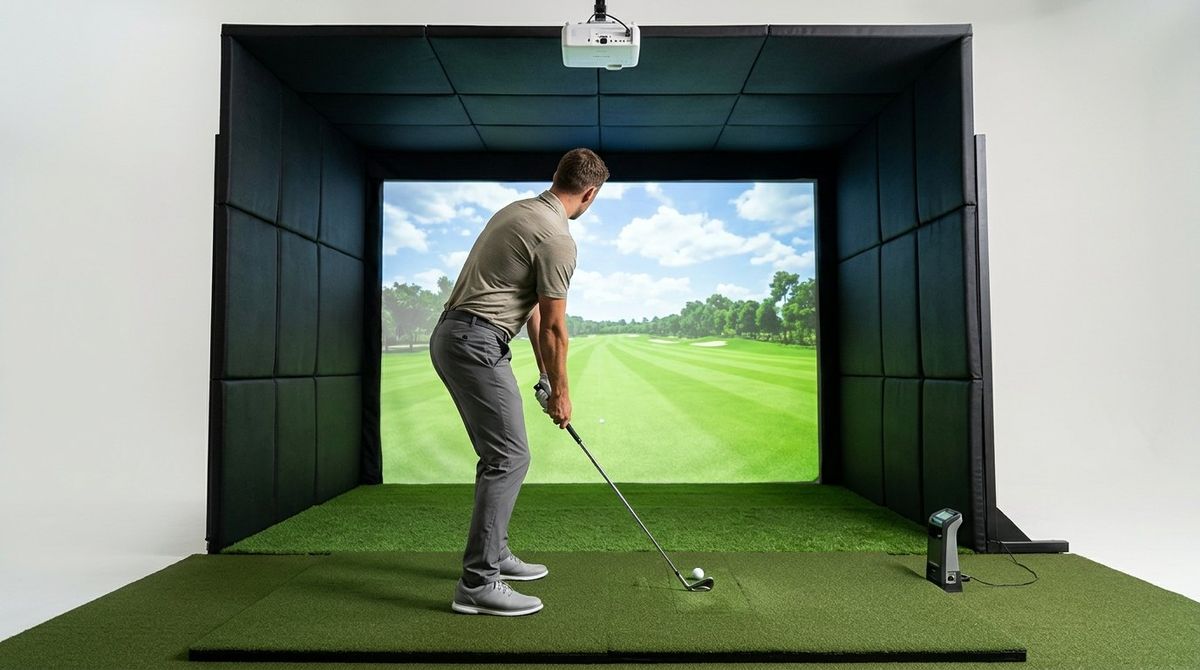
4. Formula 5: The Hybrid Tee-Offset + Optical Lens Shift Optimization Rule
To eliminate golfer shadows in a narrow \( 10.0\text{-ft to } 12.0\text{-ft} \) garage bay without sacrificing \( 25\% \) of your \( 4\text{K} \) pixels, combine your right-handed hitting strip lateral offset (\( X_{\text{tee}} \), typically \( 12.0\text{ in to } 18.0\text{ in} \) right of screen center) with optical horizontal lens shift (\( X_{\text{opt}} \)) before applying any digital yaw (\( \psi_{\text{yaw}} \le 4.5^\circ \)):
\[ X_{\text{total}} = X_{\text{opt, max}} + D_{\text{throw}} \cdot \tan(\psi_{\text{max}}) \]For example, on a BenQ LK936ST (\( S_H = \pm 23\% \) optical horizontal lens shift on a \( 144.0\text{-in} \) screen = \( 33.12\text{ in} \)), you can mount the projector a full \( 33.0\text{ in} \) right of center with \( \psi_{\text{yaw}} = 0.0^\circ \), placing the lens completely outside the overhead driver arc and garage door opener rail while preserving \( 100\% \) native \( 4\text{K} \) sharpness and edge-to-edge optical focus.
Calculate Your Exact Projector Throw, Offset & Shadow Clearance
Enter your ceiling height, screen dimensions, and hitting strip offset into our spatial calculator to verify shadow-free mounting coordinates.
Open the Interactive Golf Launch Monitor Fitter