Golf Simulator Mini-Split BTU and Projector PC Heat Load Formula: 5 Thermal Sizing Calculations for Garage Bays
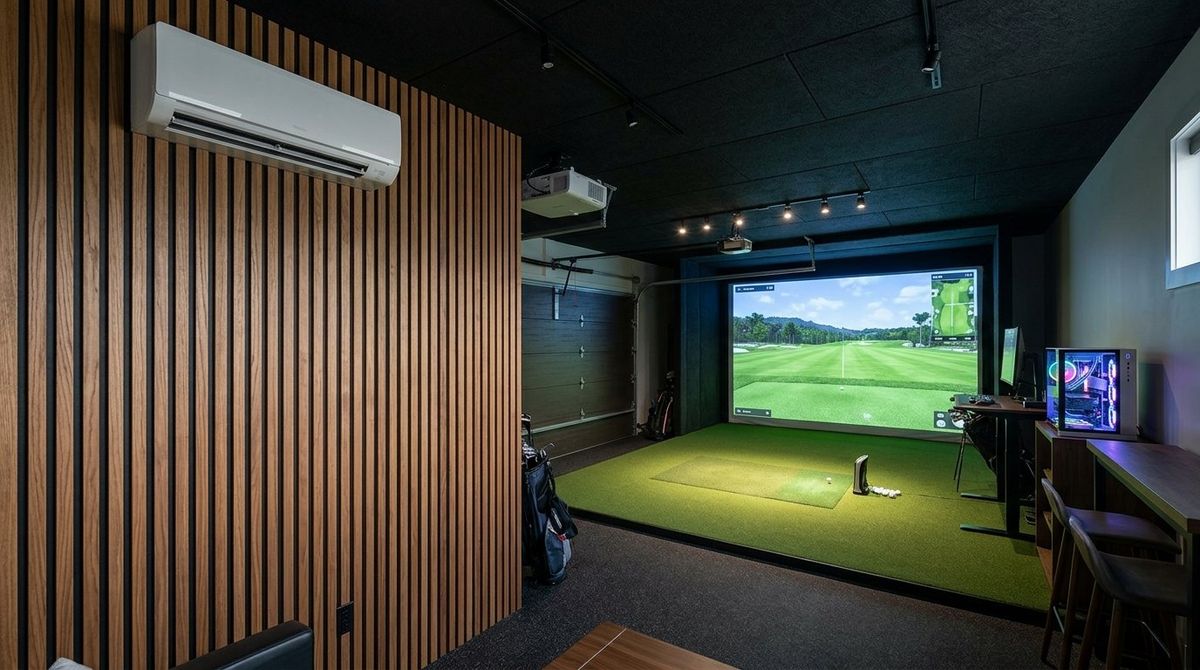
Executive HVAC Sizing Summary: Converting an attached or detached two-car garage into a four-season indoor golf simulator studio requires far more precision than reading a residential "square-footage rule of thumb" chart. Unlike a passive bedroom with \( 8.0\text{-ft} \) ceilings, a golf simulator bay combines a \( 10.0\text{-ft} \) to \( 12.0\text{-ft} \) driver-swing ceiling volume multiplier (\( 1.25\times \) to \( 1.50\times \)), an active internal electronic heat source (\( 650\text{ W} \) to \( 850\text{ W} \) RTX 4080/4090 gaming PC + \( 350\text{ W} \) to \( 450\text{ W} \) 4K laser projector injecting \( 4{,}100+\text{ BTU/hr} \) of continuous sensible heat), high-exertion golfer metabolic loads (\( 950\text{ BTU/hr} \) per active player), and sectional garage door thermal infiltration. For a standard \( 22\text{ ft} \times 24\text{ ft} \times 11\text{ ft} \) (\( 528\text{ sq ft} \)) insulated 2-car garage simulator bay, true peak thermal load reaches \( 26{,}732\text{ BTU/hr} \)—requiring a \( 24{,}000\text{ BTU} \) (\( 2.0\text{-Ton} \)) variable-speed inverter mini-split rather than an undersized \( 12{,}000 \) or \( 18{,}000\text{ BTU} \) unit. Audit your exact room geometry with the Golf Launch Monitor Fitter.
1. Calculation 1: The Complete 5-Factor Golf Simulator Mini-Split BTU Formula
As builders frequently report in r/Golfsimulator garage mini-split threads and hot garage cooling discussions, standard residential HVAC charts fail because they ignore ceiling volume and internal simulator electronics. To calculate your true design thermal load \( Q_{\text{total}} \) (in \( \text{BTU/hr} \)), sum five distinct physical heat components:
\[ Q_{\text{total}} = \left( A_{\text{floor}} \cdot F_{\text{insul}} \cdot \frac{H_{\text{ceiling}}}{8.0\text{ ft}} \right) + \left( W_{\text{sim-stack}} \cdot 3.41214 \right) + \left( 950 \cdot N_{\text{swing}} + 450 \cdot N_{\text{spectator}} \right) + Q_{\text{door}} \text{ BTU/hr} \]- Envelope Base Load (\( A_{\text{floor}} \cdot F_{\text{insul}} \)): Multiply floor area \( A_{\text{floor}}\text{ (sq ft)} \) by the envelope insulation factor \( F_{\text{insul}} \): use \( 22\text{ BTU/sq ft} \) for fully insulated R-15 stud walls and R-30+ ceiling/attic; \( 26\text{ to } 30\text{ BTU/sq ft} \) for standard insulated garage walls with moderate ceiling insulation; or \( 40\text{ BTU/sq ft} \) for uninsulated masonry/stud walls in hot summer climates.
- Swing Ceiling Volume Multiplier (\( H_{\text{ceiling}} / 8.0\text{ ft} \)): A \( 10.5\text{-ft} \) ceiling increases conditioned air volume by \( 1.3125\times \); an \( 11.0\text{-ft} \) ceiling increases volume by \( 1.375\times \); and a \( 12.0\text{-ft} \) ceiling increases volume by \( 1.50\times \).
- Sectional Garage Door Penalty (\( Q_{\text{door}} \)): Add \( +3{,}200\text{ BTU/hr} \) for an uninsulated aluminum pan sectional door, \( +1{,}400\text{ BTU/hr} \) for a 2-inch polyurethane R-12.9+ insulated door with perimeter PVC weatherstripping, or \( +400\text{ BTU/hr} \) if the overhead tracks are deleted and framed over.
| Simulator Bay Archetype | Bay Dimensions (\( L \times W \times H \)) | PC + Projector + Light Load | Calculated Peak \( Q_{\text{total}} \) | Recommended Mini-Split Capacity |
|---|---|---|---|---|
| Single-Bay Spare Room | \( 16'\times 14'\times 10' \) (\( 224\text{ sq ft} \)) | \( 950\text{ W} \) (\( 3{,}242\text{ BTU/hr} \)) | \( 11{,}892\text{ BTU/hr} \) | \( 12{,}000\text{ BTU} \) (\( 1.0\text{ Ton} \)) |
| Compact 2-Car Garage (R-15) | \( 20'\times 20'\times 10.5' \) (\( 400\text{ sq ft} \)) | \( 1{,}250\text{ W} \) (\( 4{,}265\text{ BTU/hr} \)) | \( 18{,}915\text{ BTU/hr} \) | \( 18{,}000 - 24{,}000\text{ BTU} \) |
| Standard 2-Car Sim Studio | \( 22'\times 24'\times 11' \) (\( 528\text{ sq ft} \)) | \( 1{,}350\text{ W} \) (\( 4{,}606\text{ BTU/hr} \)) | \( 26{,}732\text{ BTU/hr} \) | \( 24{,}000\text{ BTU} \) (\( 2.0\text{ Ton} \)) |
| 3-Car / Pole Barn Lounge | \( 30'\times 24'\times 12' \) (\( 720\text{ sq ft} \)) | \( 1{,}500\text{ W} \) (\( 5{,}118\text{ BTU/hr} \)) | \( 35{,}468\text{ BTU/hr} \) | \( 36{,}000\text{ BTU} \) (\( 3.0\text{ Ton} \)) |
2. Calculation 2 & 3: Gaming PC, 4K Projector & Golfer Metabolic Heat Loads
By the First Law of Thermodynamics, virtually \( 100\% \) of the electrical wattage consumed by your simulator hardware inside the room is dissipated into the bay air as sensible heat at the exact conversion constant of \( 3.41214\text{ BTU/hr per Watt} \):
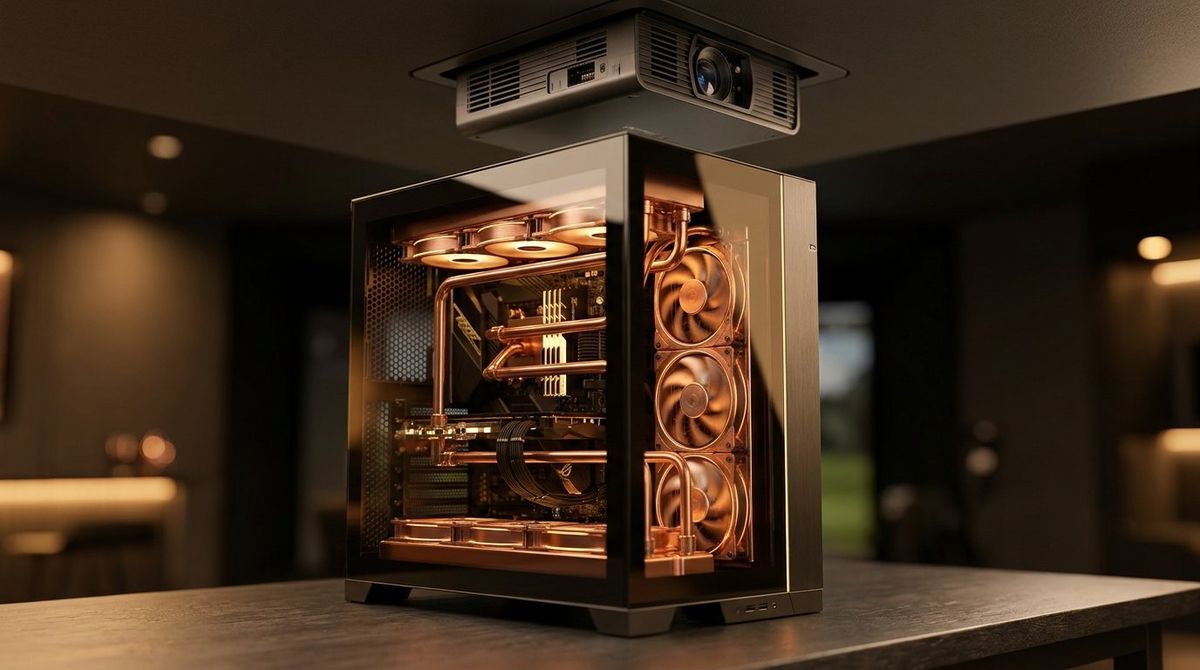
\[ Q_{\text{electronics}} = \left( W_{\text{PC-GPU}} + W_{\text{projector}} + W_{\text{monitors}} + W_{\text{launch-monitor}} + W_{\text{lighting}} \right) \times 3.41214 \text{ BTU/hr} \]- 4K Gaming PC Stack (\( 650\text{ W} - 850\text{ W} \)): Running GSPro at \( 3840 \times 2160\text{ px} \) (\( 60\text{ to } 120\text{ Hz} \)) on an NVIDIA RTX 4080 Super or RTX 4090 rig pulls \( 650\text{ W} \) to \( 780\text{ W} \) at the wall, injecting \( 2{,}218\text{ to } 2{,}661\text{ BTU/hr} \) straight under your hitting bay desk.
- Short-Throw 4K Laser/Lamp Projector (\( 320\text{ W} - 450\text{ W} \)): A high-lumen short-throw projector like the BenQ LK936ST (\( 5{,}100\text{ ANSI lumens} \), \( 410\text{ W} \) typical draw) or Optoma UHZ35ST radiates \( 1{,}100\text{ to } 1{,}535\text{ BTU/hr} \) directly at ceiling level where your overhead launch monitor cameras sit.
- Active Golfer Metabolic Load (\( Q_{\text{golfers}} \)): While a seated residential occupant emits \( \approx 400\text{ to } 450\text{ BTU/hr} \), an active golfer swinging a driver or 7-iron every \( 45\text{ seconds} \) generates \( 950\text{ BTU/hr} \) (\( \approx 420\text{ BTU/hr} \) sensible heat plus \( \approx 530\text{ BTU/hr} \) latent moisture perspiration that must be dehumidified by the evaporator coil).
3. Calculation 4: Worked Example for a 22' × 24' × 11' Two-Car Garage Bay
Let's run the step-by-step sizing audit for a \( 22\text{ ft} \times 24\text{ ft} \) (\( A_{\text{floor}} = 528\text{ sq ft} \)) insulated garage with an \( 11.0\text{-ft} \) ceiling, an R-12.9 insulated overhead door (\( Q_{\text{door}} = 1{,}400\text{ BTU/hr} \)), a \( 1{,}350\text{ W} \) PC + projector + dual-monitor stack, \( 1 \) active player, and \( 2 \) seated friends:
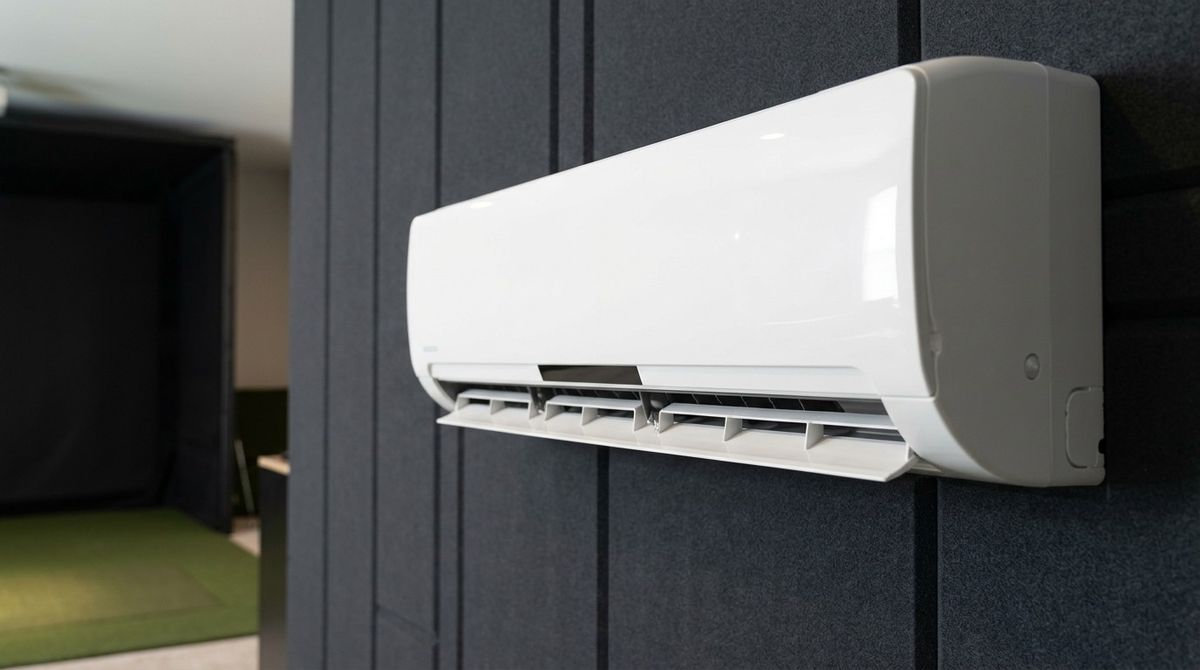
\[ \begin{aligned} Q_{\text{envelope}} &= 528 \cdot 26 \cdot \left(\frac{11.0}{8.0}\right) = 18{,}876\text{ BTU/hr} \\ Q_{\text{electronics}} &= 1{,}350\text{ W} \times 3.41214 = 4{,}606\text{ BTU/hr} \\ Q_{\text{occupants}} &= (1 \times 950) + (2 \times 450) = 1{,}850\text{ BTU/hr} \\ Q_{\text{total}} &= 18{,}876 + 4{,}606 + 1{,}850 + 1{,}400 = \mathbf{26{,}732\text{ BTU/hr}} \end{aligned} \]Installing a \( 24{,}000\text{ BTU} \) (\( 2.0\text{-Ton} \)) high-SEER2 variable-speed inverter mini-split (which modulates from \( 7{,}200\text{ BTU/hr} \) minimum up to \( 27{,}600\text{ BTU/hr} \) maximum boost capacity) matches this load without short-cycling.
4. Calculation 5: Cold-Climate Heating Derate & Optical Condensation Prevention
As northern builders emphasize in r/Golfsimulator winter garage heating discussions, two thermal rules protect your \( \$3{,}000 \) to \( \$15{,}000 \) optical launch monitor and projector lenses during sub-freezing winters:
- Low-Ambient COP & Capacity Derate: Standard heat pumps lose \( 25\% \) to \( 38\% \) of their rated heating output when outdoor ambient temperatures drop below \( 17^\circ\text{F} \) (\(-8.3^\circ\text{C}\)). In northern climates, select a cold-climate hyper-heat inverter rated for \( 100\% \) nominal heating capacity down to \( 5^\circ\text{F} \) (\(-15^\circ\text{C}\)) and operational down to \(-13^\circ\text{F} \) (\(-25^\circ\text{C}\)).
- Maintain a \( 55^\circ\text{F} \) (\( 12.8^\circ\text{C} \)) Winter Setback Temperature: Never let a simulator garage drop to \( 30^\circ\text{F} \) and then blast a \( 30{,}000\text{ BTU} \) propane or electric unit heater right before play. Rapidly warming humid air around cold glass lenses inside your projector and launch monitor triggers internal dew-point condensation when \( T_{\text{lens}} < T_{\text{dew}} \). Holding a steady \( 55^\circ\text{F} \) setback on your inverter mini-split and ramping to \( 68^\circ\text{F} \) thirty minutes before tee time keeps all optical assemblies above the dew point.
5. Recommended Garage Simulator HVAC & Insulation Hardware
- MRCOOL DIY 4th Gen 24,000 BTU 21.5 SEER2 Ductless Mini-Split Heat Pump — Pre-charged 25-foot Quick Connect line set allows weekend garage installation without vacuum pump gauges.
- Senville Aura 24,000 BTU Cold-Climate Arctic Inverter Heat Pump (-22F Rated) — Delivers full winter heating recovery in northern garages down to sub-zero ambient temperatures.
- Reach Barrier / Owens Corning Garage Door Reflective & Foam Insulation Kit — Cuts uninsulated aluminum pan door conductive heat gain by up to \( 1{,}800\text{ BTU/hr} \).
Audit Your Complete Golf Simulator Room Dimensions & Hardware Fit
Match your garage ceiling height, depth, and climate control requirements to the right launch monitor and enclosure.
Open the Golf Launch Monitor Fitter