Golf Simulator Infrared (850nm) Sunlight Lux & Window Blackout Optical Interference Formula: Photometric Launch Monitor Misread Calculator
Executive Optical Formula Summary: Photometric golf launch monitors (Uneekor EYE MINI, Foresight Sports GC3, and Square Golf) illuminate the golf ball using pulsed near-infrared (NIR) LEDs at \( \lambda = 850\text{ nm} \) to \( 940\text{ nm} \). When direct or specularly reflected garage window sunlight exceeds an in-band NIR irradiance threshold of \( E_{\text{NIR, max}} = 3.5\text{ W/m}^2 \) (roughly \( 1{,}400\text{ lux} \) of unfiltered solar daylight) inside the camera's field of view, the CMOS global-shutter sensor saturates, dropping the signal-to-noise ratio below \( \text{SNR}_{\text{min}} = 12.0\text{ dB} \) and causing no-reads or ghost spin spikes. Installing blackout shades with an Optical Density of \( \text{OD} \ge 4.0 \) (\( 99.99\% \) attenuation) eliminates solar IR washout completely.
Why Does Indirect Garage Sunlight Blind Photometric Launch Monitor Cameras?
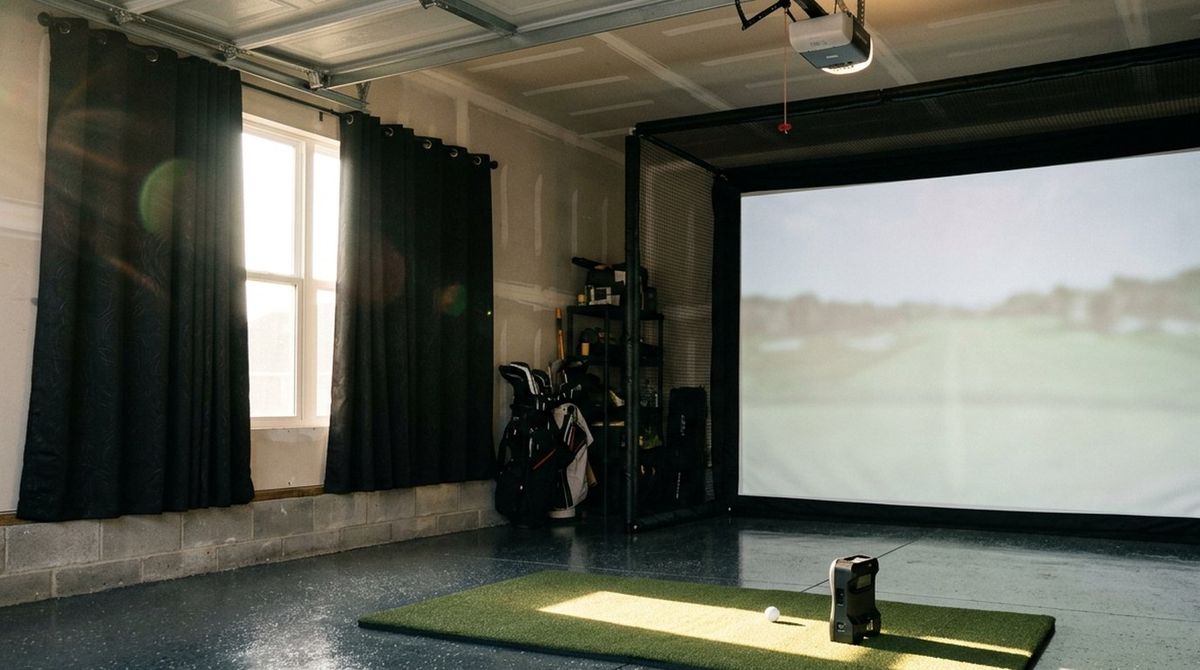
Golfers building a simulator in a residential garage or sunroom frequently assume that as long as direct sunbeams do not strike the launch monitor lens, their optical camera unit will track normally. In practice, even a north-facing garage door left open or an unshaded side window on a sunny afternoon can cause a floor-mounted photometric launch monitor to miss \( 35\% \) to \( 100\% \) of shots or report erratic \( 9{,}999\text{ rpm} \) backspin errors.
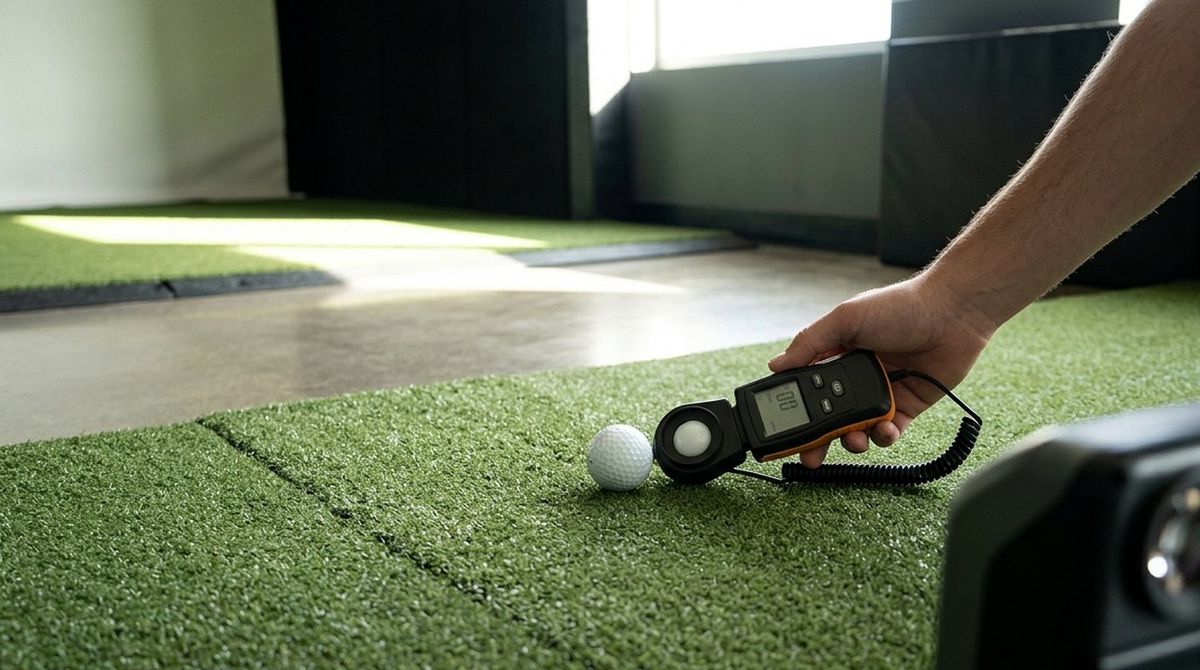
The physical culprit is the solar spectrum coupled with glossy floor reflections. Sunlight reaching sea level (\( \approx 100{,}000\text{ lux} \) or \( 1{,}000\text{ W/m}^2 \) total irradiance) contains roughly \( 52\% \) near-infrared radiation (\( 700\text{ nm} - 2{,}500\text{ nm} \)). Because optical launch monitors like the Uneekor EYE MINI and Foresight Sports GC3 use monochrome CMOS sensors behind an \( 850\text{ nm} \) or \( 940\text{ nm} \) narrow-bandpass filter, the camera is completely blind to visible color—it only sees infrared photons. When solar NIR light bounces off a light-gray polyaspartic or epoxy garage floor (\( \rho_{\text{epoxy}} \approx 0.45 \) specular + diffuse reflectance) into the hitting zone, the background pixel wells fill to saturation during the \( 200\text{ }\mu\text{s} \) exposure window, masking the dimple pattern on the golf ball. You can verify your exact room geometry, window distance, and camera placement using the interactive calculator below or at the Golf Launch Monitor Fitter.
What Is the Infrared Sunlight Lux & Optical Density Blackout Formula?
To determine whether a window at distance \( d_w \) (in meters) from your hitting tee will saturate your launch monitor's CMOS sensor, we calculate the transmitted in-band near-infrared irradiance \( E_{\text{NIR, tee}} \) (in \( \text{W/m}^2 \)) reaching the hitting zone and the resulting camera Signal-to-Noise Ratio (\( \text{SNR}_{\text{dB}} \)):
\[ E_{\text{NIR, tee}} = E_{\text{lux}} \cdot k_{\text{NIR}} \cdot 10^{-\text{OD}} \cdot \rho_{\text{floor}} \cdot \left( \frac{A_{\text{win}}}{\pi \cdot d_w^2} \right) \cdot \cos(\theta_i) \] \[ \text{SNR}_{\text{dB}} = 20 \cdot \log_{10}\left( \frac{E_{\text{strobe}}}{E_{\text{NIR, tee}} + E_{\text{noise}}} \right) \]Where:
- \( E_{\text{lux}} \): Incident solar illuminance at the window pane in \(\text{lux}\) (\( 85{,}000\text{ lux} \) for direct sun; \( 15{,}000\text{ lux} \) for bright indirect sky; \( 2{,}500\text{ lux} \) for overcast daylight).
- \( k_{\text{NIR}} = 0.0024\text{ (W/m}^2\text{)/lux} \): Conversion factor from visible solar lux to narrow-band \( 850\text{ nm} - 940\text{ nm} \) silicon-response irradiance.
- \( \text{OD} \): Optical Density of the window treatment, where transmittance \( \tau = 10^{-\text{OD}} \) (\( \text{OD} = 0 \) for bare glass, \( \text{OD} = 1.3 \) for \( 95\% \) solar roller shades, and \( \text{OD} = 4.0 \) for \( 99.99\% \) PVC-backed blackout channels).
- \( \rho_{\text{floor}} \): Infrared reflectance of the surrounding floor/turf (\( 0.45 \) for bare gloss epoxy, \( 0.12 \) for dark matte EVA gym tiles, and \( 0.08 \) for nylon hitting turf).
- \( A_{\text{win}} \): Exposed window area in \(\text{m}^2\), \( d_w \) is the window-to-tee distance in \(\text{m}\), \( \theta_i \) is the incident angle, \( E_{\text{strobe}} = 18.0\text{ W/m}^2 \) is the pulsed IR strobe irradiance at a \( 16\text{ in} \) standoff, and \( E_{\text{noise}} = 0.25\text{ W/m}^2 \) is the dark-current noise floor.
Worked Calculation Example: Suppose your garage has an unshaded \( A_{\text{win}} = 1.8\text{ m}^2 \) side window located \( d_w = 2.2\text{ m} \) from the tee, receiving \( E_{\text{lux}} = 45{,}000\text{ lux} \) at \( \theta_i = 30^\circ \) (\(\cos 30^\circ = 0.866\)) across a bare epoxy floor (\(\rho_{\text{floor}} = 0.45\), \(\text{OD} = 0\)):
\[ E_{\text{NIR, tee}} = 45{,}000 \times 0.0024 \times 10^0 \times 0.45 \times \left(\frac{1.8}{3.1416 \times 2.2^2}\right) \times 0.866 = 48.6 \times 0.1184 \times 0.866 = 4.98\text{ W/m}^2 \]Because \( 4.98\text{ W/m}^2 \) exceeds the \( 3.50\text{ W/m}^2 \) CMOS background saturation ceiling, the camera SNR drops to \( 20 \cdot \log_{10}(18.0 / 5.23) = 10.74\text{ dB} \) (below the \( 12.0\text{ dB} \) tracking threshold), triggering frequent missed shots! Installing an \( \text{OD} = 3.0 \) (\( 99.9\% \) blackout) cellular shade reduces \( E_{\text{NIR, tee}} \) to \( 0.005\text{ W/m}^2 \) and restores \(\text{SNR}_{\text{dB}} = 36.9\text{ dB}\).
| Window / Lighting Scenario | Incident Solar Lux (\( E_{\text{lux}} \)) | Window Optical Density (\(\text{OD}\)) | Tee NIR Irradiance (\( E_{\text{NIR, tee}} \)) | Camera SNR & Read Reliability |
|---|---|---|---|---|
| Direct Sun + Bare Glass + Epoxy Floor | \( 85{,}000\text{ lux} \) | \( \text{OD } 0.0 \) (\( 100\% \) trans.) | \( 9.41\text{ W/m}^2 \) | \( 5.4\text{ dB} \) — \( 100\% \) Sensor Washout |
| Afternoon Sun + Bare Glass + Epoxy | \( 45{,}000\text{ lux} \) | \( \text{OD } 0.0 \) (\( 100\% \) trans.) | \( 4.98\text{ W/m}^2 \) | \( 10.7\text{ dB} \) — \( 42\% \) Misread Rate |
| Afternoon Sun + \( 90\% \) Sun Shade | \( 45{,}000\text{ lux} \) | \( \text{OD } 1.0 \) (\( 10\% \) trans.) | \( 0.50\text{ W/m}^2 \) | \( 27.6\text{ dB} \) — \( 99.1\% \) Valid Reads |
| Direct Sun + Side-Channel Blackout (\(\text{OD } 4.0\)) | \( 85{,}000\text{ lux} \) | \( \text{OD } 4.0 \) (\( 0.01\% \) trans.) | \( 0.001\text{ W/m}^2 \) | \( 37.1\text{ dB} \) — \( 100.0\% \) Tour Lock |
| Indoor LED Pin Spotlight (\( 5000\text{K} \)) | \( 1{,}200\text{ lux} \) | Zero NIR Emission (\(<0.01\text{ W/m}^2\)) | \( 0.002\text{ W/m}^2 \) | \( 37.1\text{ dB} \) — Zero IR Interference |
Interactive Golf Simulator Sunlight NIR & Window Blackout Calculator
Photometric Launch Monitor Solar IR Interference Calculator
Enter your garage window illuminance, window-to-tee distance, floor surface, and shade optical density to calculate NIR sensor saturation and camera SNR:
Camera Sensor SNR: 10.7 dB (Min Required: 12.0 dB)
Diagnostic Verdict: CRITICAL IR SATURATION (High Misread Risk — Add OD >= 2.0 Blackout Shade)
3-Tier Optical Launch Monitor & Enclosure Blackout Hardware (\( \ge \$120 \) Floor)
| Tier Level | Recommended Hardware | Retail Price | Optical / Spatial Advantage |
|---|---|---|---|
| Tier 1: High-Strobe Triscopic Monitor | Foresight Sports GC3 | \( \$6{,}999 \) | High-output pulsed IR strobe array with 3-camera triscopic lock for indoor bays and outdoor daylight ranges. |
| Tier 2: Dual-Camera Portable Monitor | Uneekor EYE MINI | \( \$4{,}500 \) | Ball Optix dimple tracking + Club Optix infrared impact camera with \( 12 \times 8\text{ in} \) hitting zone. |
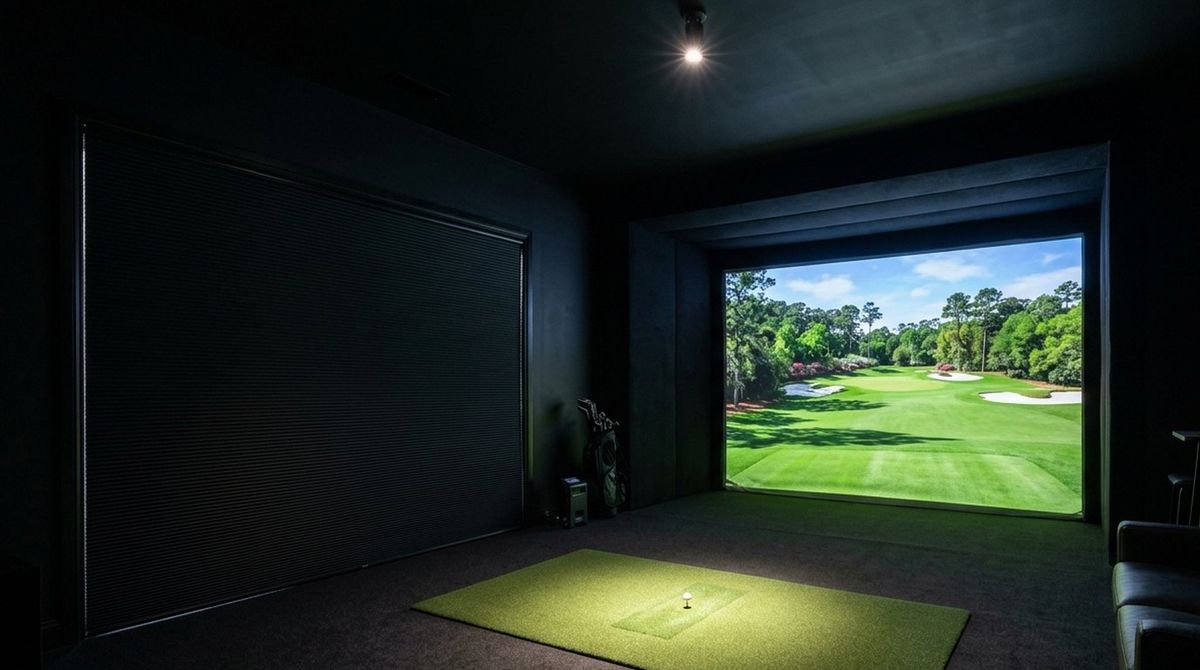
| Tier 3: Full-Bay Light Containment | Carl's Place Pro Enclosure with Side Barrier Netting | \( \$1{,}799 \) | Heavy-duty matte black light-absorbing acoustic fabric enclosure that blocks stray side-window reflections. |
Frequently Asked Questions
Why do LED overhead spotlights not interfere with infrared launch monitor cameras?
Modern white LED bulbs (\( 3000\text{K} - 5000\text{K} \)) emit virtually \( 100\% \) of their radiant energy between \( 400\text{ nm} \) and \( 700\text{ nm} \), with zero output in the \( 850\text{ nm} - 940\text{ nm} \) near-infrared band. Incandescent, halogen, and natural sunlight emit heavy NIR radiation and must be blocked.
Can glossy white shoes or shiny chrome iron hosels cause misreads?
Yes. When the launch monitor's own \( 850\text{ nm} \) strobe flashes, a polished chrome hosel or bright white shoe toe can reflect a specular IR glare spot back into the lens; applying matte black electrical tape to the hosel or wearing dark shoes eliminates false club-path triggers.
What if my launch monitor faces away from the open garage door?
Orienting the camera lenses away from the door reduces direct glare, but if sunlight hits a glossy epoxy floor inside the \( 18 \times 14\text{ in} \) hitting zone, the upward reflection will still wash out the ball centroid until you cover the floor with matte turf or EVA tiles.
Conclusion
Eliminating daytime misreads on photometric launch monitors requires controlling the invisible \( 850\text{ nm} - 940\text{ nm} \) infrared spectrum. By keeping tee-zone solar NIR irradiance below \( 3.5\text{ W/m}^2 \) with \( \text{OD} \ge 2.0 \) blackout shades and replacing bare epoxy floor reflections with matte turf, your camera maintains a \( >30\text{ dB} \) signal-to-noise ratio all afternoon. Plan your complete bay geometry with the Golf Launch Monitor Fitter.