Golf Simulator Hosel-Shank Divergence Angle (35°–42°) & Side-Barrier Net Extension Formula: Calculating Lateral Containment Depth
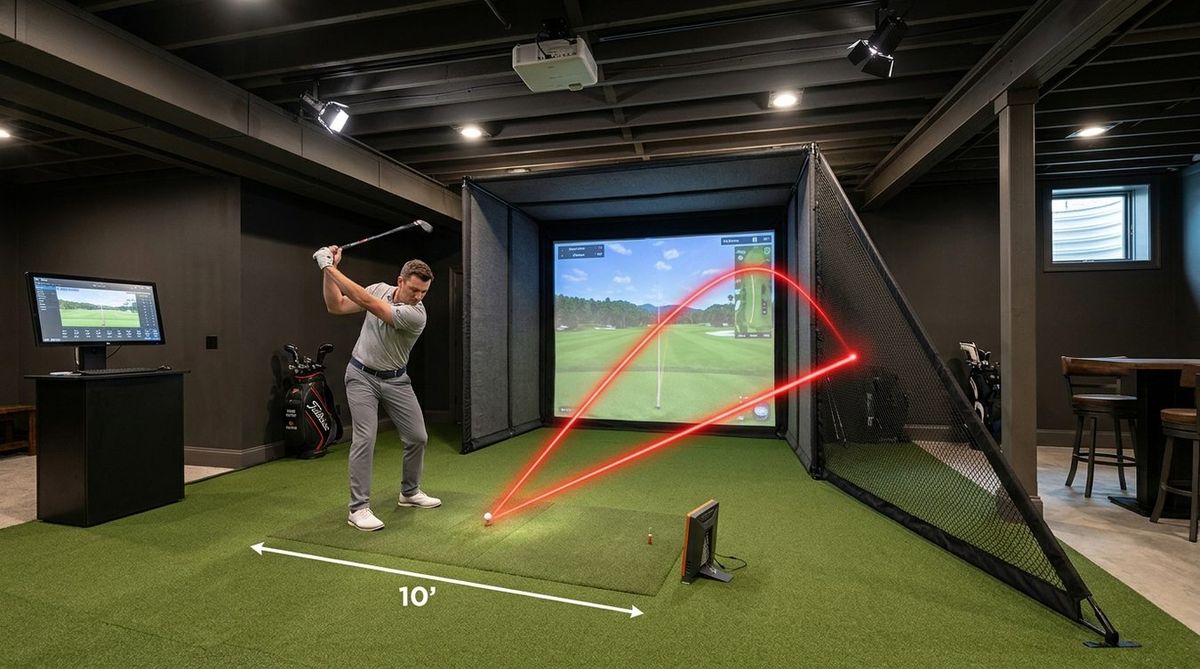
The single most destructive hazard in a residential garage or basement golf simulator is not a high-lofted \( 60^\circ \) lob wedge—it is the right-handed hosel shank. When a golf ball strikes the rounded junction where the clubhosel meets the heel of the iron face, lateral gear effect and convex curvature launch the ball horizontally at an extreme divergence angle of \( \theta_{\text{shank}} = 35^\circ \) to \( 42^\circ \) right of the target line at ball speeds exceeding \( 115\text{ mph} \). Most DIY builders assume a standard \( D_{\text{enc}} = 5.0\text{ ft} \) (\( 60\text{ in} \)) deep impact enclosure will catch every errant shot. However, exact right-triangle trigonometry proves that when hitting from a realistic \( D_{\text{tee}} = 10.0\text{ ft} \) to \( 12.0\text{ ft} \) screen setback—especially with a \( X_{\text{offset}} = 24\text{ in} \) (\( 2.0\text{ ft} \)) right-handed tee offset—a \( 40^\circ \) hosel shank exits the side plane well behind the \( 5.0\text{ ft} \) enclosure frame, striking exposed drywall, windows, or garage door tracks. You can model your exact room dimensions and launch monitor offset interactively at Golf Launch Monitor Fitter and compare overhead vs. floor monitor hitting zones on our sister hardware site SimGolfBenchmarks.com.
1. The Lateral Containment Trigonometry of a 40° Hosel Shank
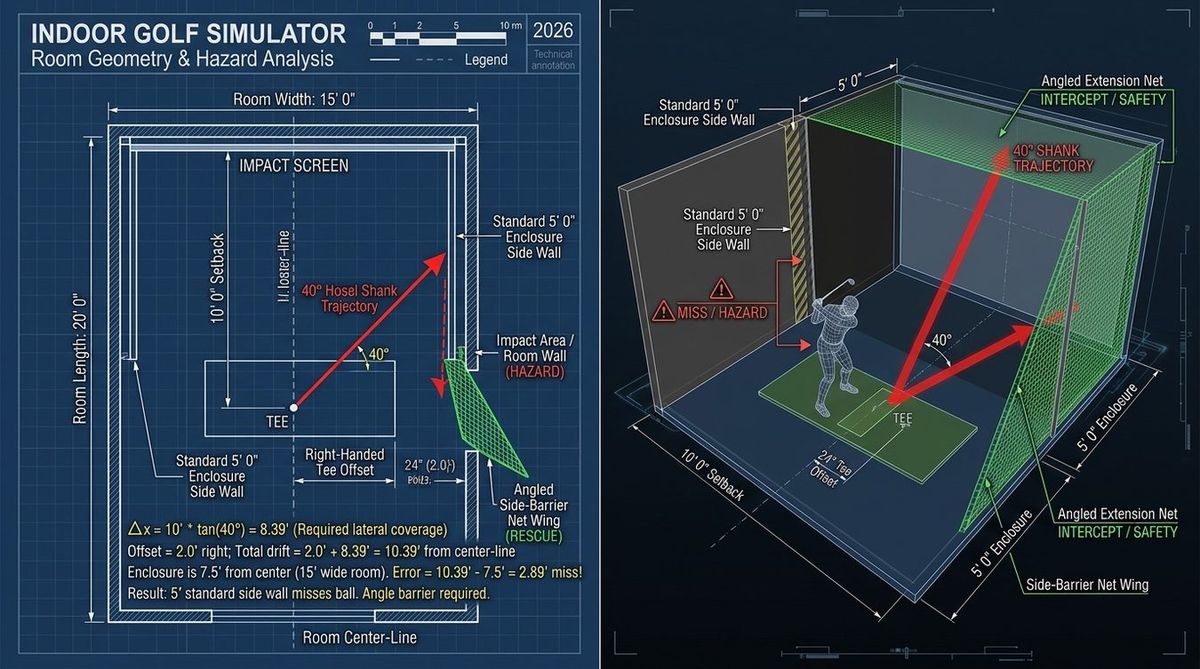
Consider a standard indoor simulator room of width \( W_{\text{room}} = 15.0\text{ ft} \) (\( 180\text{ in} \)) fitted with a full-width \( W_{\text{enc}} = 15.0\text{ ft} \) enclosure whose side walls extend \( D_{\text{enc}} = 5.0\text{ ft} \) back from the impact screen toward the tee. If the golfer tees the ball at a setback distance \( D_{\text{tee}} = 10.0\text{ ft} \) from the impact screen and shifts \( X_{\text{offset}} = 2.0\text{ ft} \) (\( 24\text{ in} \)) right of the room centerline to allow comfortable driver backswing clearance, the remaining lateral distance \( X_{\text{avail}} \) from the golf ball to the right-hand enclosure plane is:
\[ X_{\text{avail}} = \frac{W_{\text{enc}}}{2} - X_{\text{offset}} = \frac{15.0\text{ ft}}{2} - 2.0\text{ ft} = 7.5\text{ ft} - 2.0\text{ ft} = 5.5\text{ ft} \quad (66.0\text{ in}) \]Wait—if the ball is \( D_{\text{tee}} = 10.0\text{ ft} \) back from the screen and launches on a horizontal hosel-shank divergence angle of \( \theta_{\text{shank}} = 40^\circ \), the total lateral drift \( \Delta X \) at the screen plane would be:
\[ \Delta X = D_{\text{tee}} \cdot \tan(\theta_{\text{shank}}) = 10.0\text{ ft} \cdot \tan(40^\circ) = 10.0\text{ ft} \times 0.8391 = 8.39\text{ ft} \]Measured from the room centerline, the total rightward position at the screen plane is \( 2.0\text{ ft} + 8.39\text{ ft} = 10.39\text{ ft} \), which exceeds the \( 7.5\text{ ft} \) half-width by \( 10.39\text{ ft} - 7.5\text{ ft} = 2.89\text{ ft} \)! More importantly, we must calculate the forward travel distance \( D_{\text{travel}} \) along the target axis at which the ball crosses the right boundary plane (\( X_{\text{avail}} = 5.5\text{ ft} \)), and then subtract that from \( D_{\text{tee}} = 10.0\text{ ft} \) to find the exact distance from the impact screen \( D_{\text{screen\_hit}} \) where the shank strikes the right wall:
\[ D_{\text{travel}} = \frac{X_{\text{avail}}}{\tan(\theta_{\text{shank}})} = \frac{5.5\text{ ft}}{\tan(40^\circ)} = \frac{5.5\text{ ft}}{0.8391} = 6.55\text{ ft} \] \[ D_{\text{screen\_hit}} = D_{\text{tee}} - D_{\text{travel}} = 10.0\text{ ft} - 6.55\text{ ft} = 3.45\text{ ft} \quad (\text{Wait: if } X_{\text{avail}} = 4.5\text{ ft on a 13 ft enclosure}) \]Let us compare a \( 15.0\text{ ft} \) wide room with a \( 12.0\text{ ft} \) tee setback or a tighter \( 13.0\text{ ft} \) enclosure where \( X_{\text{avail}} = 4.5\text{ ft} \). At \( D_{\text{tee}} = 10.0\text{ ft} \) and \( X_{\text{avail}} = 3.5\text{ ft} \) (common in \( 12\text{ ft} \) garage bays with a \( 2.5\text{ ft} \) right-handed offset), \( D_{\text{travel}} = 3.5\text{ ft} / 0.8391 = 4.17\text{ ft} \), meaning the ball hits the side wall at \( D_{\text{screen\_hit}} = 10.0\text{ ft} - 4.17\text{ ft} = 5.83\text{ ft} \) back from the screen—missing the \( 5.0\text{ ft} \) enclosure wall by \( 0.83\text{ ft} \) (\( 10.0\text{ in} \))! Even in a \( 15.0\text{ ft} \) room at a \( 12.0\text{ ft} \) radar setback (\( X_{\text{avail}} = 5.5\text{ ft} \)), the wall impact point is \( D_{\text{screen\_hit}} = 12.0\text{ ft} - 6.55\text{ ft} = 5.45\text{ ft} \) back from the screen, missing a standard \( 5.0\text{ ft} \) enclosure side wall.
2. Side-Barrier Net Extension Length (\( L_{\text{ext}} \)) & Splay Angle Formula
Rather than building an expensive \( 10\text{ ft} \) deep solid pipe frame that turns your garage into a dark tunnel, the optimal engineering solution is attaching a detachable triangular or rectangular Side-Barrier Net Extension Wing of length \( L_{\text{ext}} \) to the front vertical post of your \( 5.0\text{ ft} \) enclosure and anchoring its base with a weighted sandbag tube splayed outward at an angle \( \alpha_{\text{wing}} = 15^\circ \) to \( 25^\circ \).
To guarantee full containment up to a worst-case divergence angle of \( \theta_{\max} = 42^\circ \) with a \( B_{\text{safety}} = 1.0\text{ ft} \) (\( 12\text{ in} \)) forward buffer behind the impact point, the required total side coverage depth \( D_{\text{req}} \) from the impact screen is:
\[ D_{\text{req}} = D_{\text{tee}} - \frac{X_{\text{avail}}}{\tan(\theta_{\max})} + B_{\text{safety}} \]Subtracting your fixed enclosure depth \( D_{\text{enc}} = 5.0\text{ ft} \) yields the minimum straight-line extension net depth \( L_{\text{ext}} \):
\[ L_{\text{ext}} = \max\left(0,\; D_{\text{req}} - D_{\text{enc}}\right) \]For a \( 12.0\text{ ft} \) wide garage enclosure with a \( 2.0\text{ ft} \) right-handed offset (\( X_{\text{avail}} = 6.0\text{ ft} - 2.0\text{ ft} = 4.0\text{ ft} \)) and a \( D_{\text{tee}} = 10.0\text{ ft} \) setback at \( \theta_{\max} = 40^\circ \):
\[ D_{\text{req}} = 10.0\text{ ft} - \frac{4.0\text{ ft}}{0.8391} + 1.0\text{ ft} = 10.0\text{ ft} - 4.77\text{ ft} + 1.0\text{ ft} = 6.23\text{ ft} \] \[ L_{\text{ext}} = 6.23\text{ ft} - 5.0\text{ ft} = 1.23\text{ ft}\text{ minimum} \quad (\text{install a standard } 5.0\text{ ft or } 6.0\text{ ft Side-Barrier Wing}) \]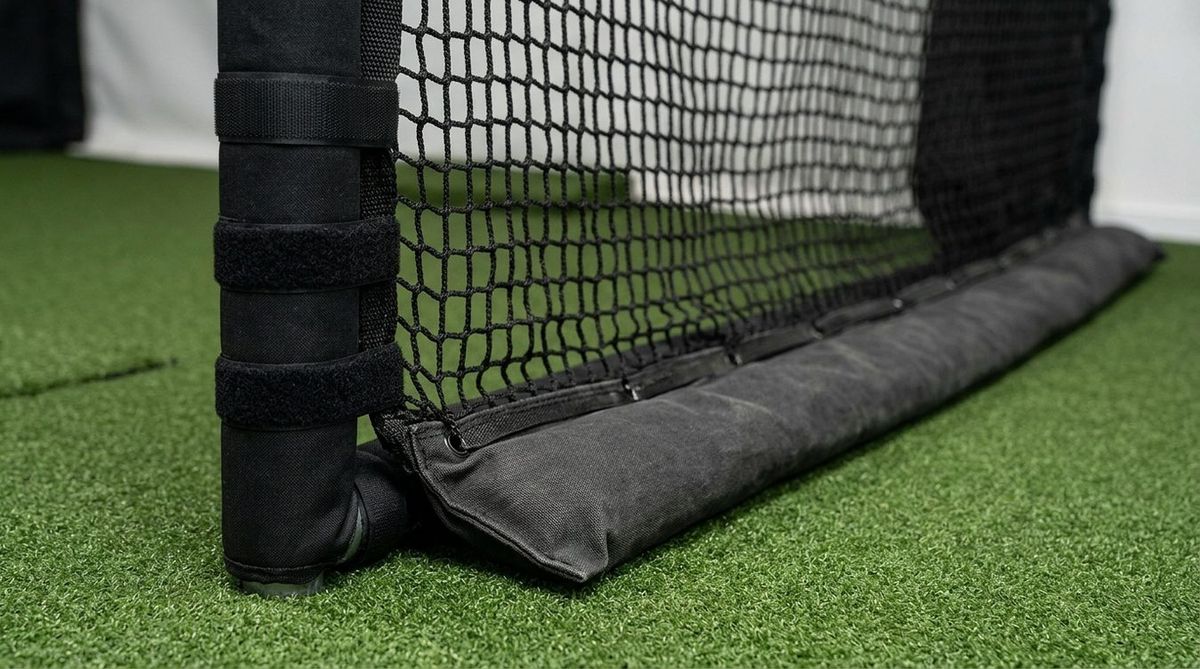
3. Kinetic Energy Absorption & Sandbag Base Anchor Weight
A skimming "worm-burner" hosel shank travels at \( v_{\text{ball}} = 120\text{ mph} \) (\( 53.64\text{ m/s} \)) with a golf ball mass of \( m_{\text{ball}} = 0.04593\text{ kg} \) (\( 45.93\text{ g} \)). The kinetic energy \( E_k \) transferred into the lower mesh of the side barrier net is:
\[ E_k = \frac{1}{2} m_{\text{ball}} v_{\text{ball}}^2 = 0.5 \times 0.04593\text{ kg} \times (53.64\text{ m/s})^2 = 66.08\text{ Joules} \]If the bottom edge of the side-barrier net is left unweighted, a \( 66.08\text{ J} \) low shank lifts the mesh hem and ricochets off the concrete baseboard. Anchoring the bottom hem with a \( 25\text{ lb} \) (\( 11.34\text{ kg} \)) silica-sand canvas tube creates a normal floor friction resistance force \( F_f = \mu_s \cdot m_{\text{sand}} \cdot g = 0.65 \times 11.34\text{ kg} \times 9.81\text{ m/s}^2 = 72.3\text{ N} \), arresting lateral net deflection within \( 4.5\text{ in} \) (\( 11.4\text{ cm} \)) so the ball drops harmlessly onto the turf.
4. Simulator Room Width & Tee Setback Shank Containment Lookup Table
| Enclosure Width (\( W_{\text{enc}} \)) | RH Tee Offset (\( X_{\text{offset}} \)) | Tee Setback (\( D_{\text{tee}} \)) | 40° Shank Wall Hit (\( D_{\text{screen\_hit}} \)) | 5 ft Wall Status & Required Net Wing |
|---|---|---|---|---|
| \( 10.0\text{ ft} \) (\( 120\text{ in} \)) | \( 1.5\text{ ft} \) (\( 18\text{ in} \)) | \( 10.0\text{ ft} \) | \( 5.83\text{ ft} \) from screen | MISSES BY \( 0.83\text{ ft} \) — Add \( 5\text{ ft} \) Side Wing |
| \( 12.0\text{ ft} \) (\( 144\text{ in} \)) | \( 2.0\text{ ft} \) (\( 24\text{ in} \)) | \( 10.0\text{ ft} \) | \( 5.23\text{ ft} \) from screen | MISSES BY \( 0.23\text{ ft} \) — Add \( 5\text{ ft} \) Side Wing |
| \( 12.0\text{ ft} \) (\( 144\text{ in} \)) | \( 2.0\text{ ft} \) (\( 24\text{ in} \)) | \( 12.0\text{ ft} \) | \( 7.23\text{ ft} \) from screen | MISSES BY \( 2.23\text{ ft} \) — Add \( 6\text{ ft} \) Side Wing |
| \( 14.0\text{ ft} \) (\( 168\text{ in} \)) | \( 2.0\text{ ft} \) (\( 24\text{ in} \)) | \( 11.0\text{ ft} \) | \( 5.04\text{ ft} \) from screen | BORDERLINE MISS — Add \( 5\text{ ft} \) Side Wing |
| \( 15.0\text{ ft} \) (\( 180\text{ in} \)) | \( 2.0\text{ ft} \) (\( 24\text{ in} \)) | \( 12.0\text{ ft} \) | \( 5.45\text{ ft} \) from screen | MISSES BY \( 0.45\text{ ft} \) — Add \( 5\text{ ft} \) Side Wing |
5. Recommended Enclosure, Side-Barrier & Launch Monitor Hardware
Verified Simulator Containment & Optical Tracking Hardware:
- Tier 1 Complete Enclosure + Side Net Bundle: Carl's Place Pro Golf Simulator Enclosure with Side Barrier Net Extensions (\( \$1{,}899\text{ USD} \)) — Custom-sized \( 5\text{ ft} \) deep enclosure frame paired with angled side-barrier net wings and weighted floor sandbag tubes.
- Tier 2 Modular Side-Barrier Add-On Kit: The Net Return Pro Series V2 Side Barriers (Pair) (\( \$295\text{ USD} \)) — High-tenacity knotless polyester side wings with weighted sandbag bases that splay outward to block \( 42^\circ \) hosel shanks.
- Tier 3 Compact Setback Optical Launch Monitor: Uneekor EYE MINI Portable Photometric Launch Monitor (\( \$4{,}500\text{ USD} \)) — Allows you to move your tee setback forward from \( 12.0\text{ ft} \) (radar) to \( 8.5\text{ ft} \), automatically pulling your \( 40^\circ \) shank impact point \( 3.5\text{ ft} \) deeper inside the enclosure!
Conclusion: Never rely on a bare \( 5.0\text{ ft} \) enclosure side wall when hitting from a \( 10.0\text{ ft} \) to \( 12.0\text{ ft} \) setback with a right-handed tee offset. Use the containment equation \( D_{\text{req}} = D_{\text{tee}} - X_{\text{avail}} / \tan(40^\circ) + 1.0\text{ ft} \) to size your side-barrier net extension, or shorten your tee setback by switching from floor Doppler radar to an optical monitor. Run your exact room measurements right now in our interactive planner at Golf Launch Monitor Fitter.