Golf Simulator Floor-Mounted Projector Enclosure and Wedge Loft Clearance Formula: 5 Spatial Calculations
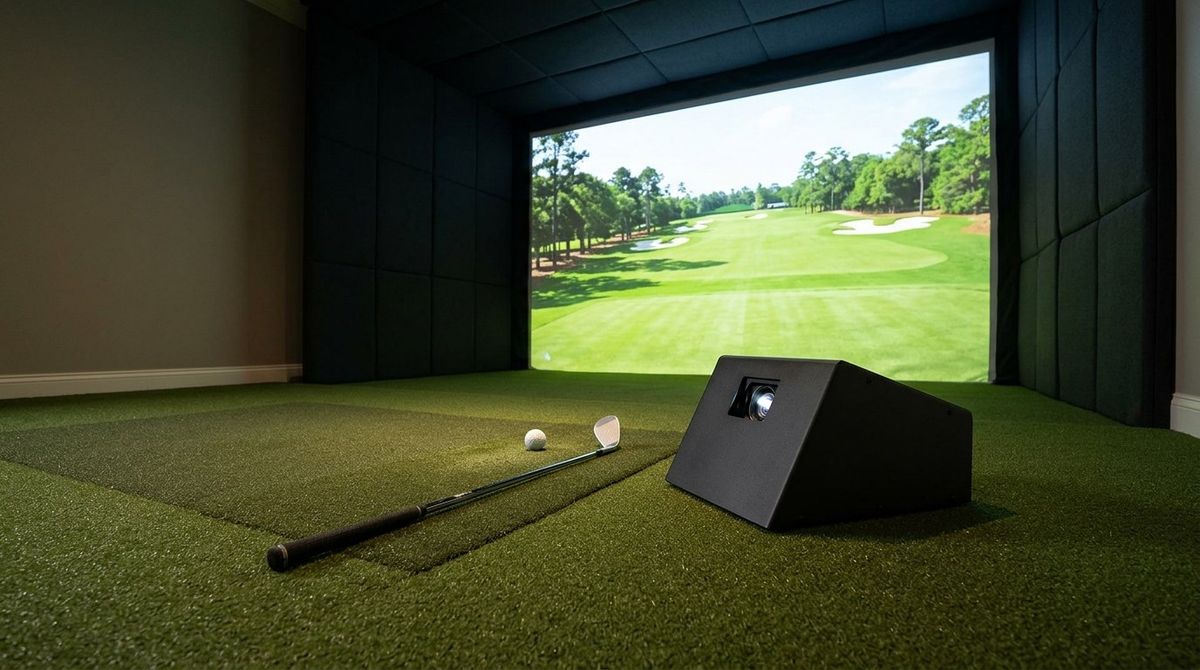
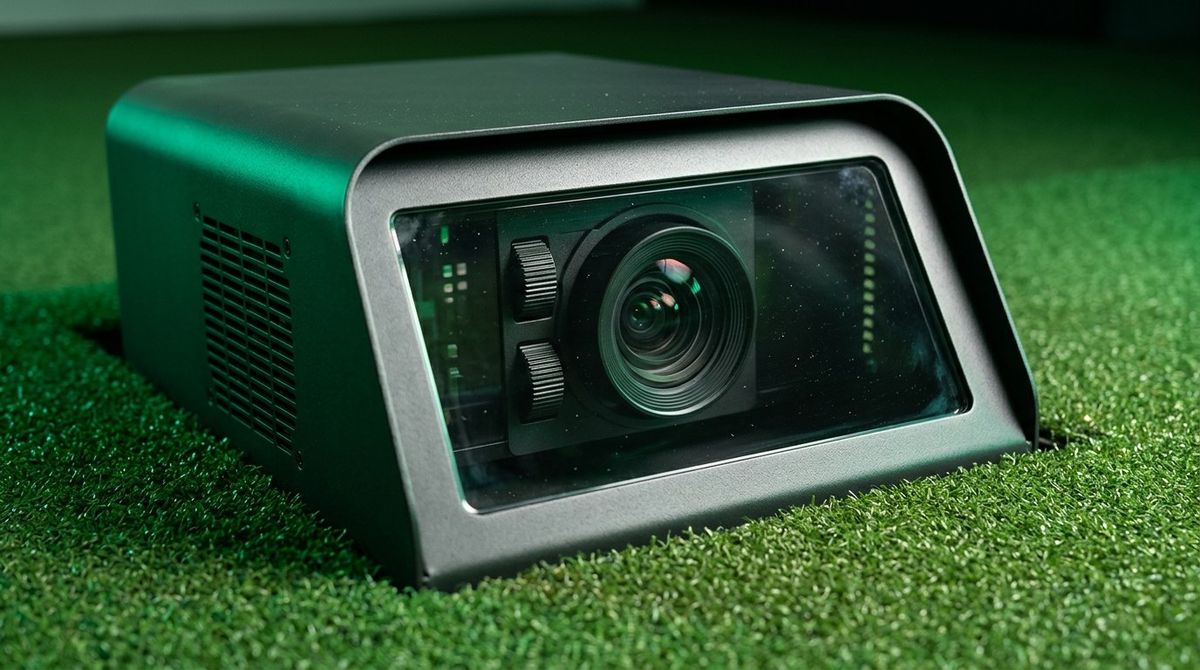
Ceiling-mounting a golf simulator projector is not always structurally feasible. In garages with \(14\text{ ft to }20\text{ ft}\) vaulted ceilings, rooms obstructed by standard overhead sectional garage door tracks, or basement bays with low \(8\text{ ft }6\text{ in}\) ceilings where an overhead mount would sit directly inside the driver follow-through path, a heavy-gauge floor-mounted projector enclosure (such as a turf-topped steel armor housing paired with a short-throw projector like the BenQ AH700ST or BenQ LK936ST) solves the mounting dilemma.
However, placing a \(7.5\text{- to }9.0\text{-inch}\)-tall steel and polycarbonate enclosure on the simulator floor between the hitting strip and the impact screen introduces three critical spatial hazards: low-launch thin shots striking the rear ramp of the housing, steep \(60^\circ\) lob wedge divots and follow-through clubheads clipping the enclosure, and optical beam shadowing if the box sits inside the ball-flight cone. This engineering guide derives the five exact trigonometric formulas required to position a floor-mounted projector enclosure safely—and you can model your exact room dimensions interactively using the Golf Launch Monitor Fitter calculator.
1. Formula 1: Short-Throw Floor Enclosure Distance from the Impact Screen
Before evaluating club and ball clearance, we must establish where the floor projector lens must sit relative to the impact screen (\(D_{\text{throw}}\)) based on your screen's horizontal width (\(W_{\text{screen}}\)) and your projector's optical throw ratio (\(R_{\text{throw}}\)):
\[D_{\text{throw}} = W_{\text{screen}} \times R_{\text{throw}}\]Once \(D_{\text{throw}}\) is fixed, the forward standoff distance from the golf ball tee line to the rear edge of the floor projector enclosure (\(D_{\text{ball}\rightarrow\text{box}}\)) is determined by subtracting \(D_{\text{throw}}\) and the enclosure housing length (\(L_{\text{box}}\), typically \(16\text{ in} = 1.33\text{ ft}\)) from your total tee-to-screen distance (\(D_{\text{tee}}\)):
\[D_{\text{ball}\rightarrow\text{box}} = D_{\text{tee}} - D_{\text{throw}} - L_{\text{box}}\]Worked Example: Suppose your impact screen is \(W_{\text{screen}} = 12.0\text{ ft}\) (\(144\text{ in}\)) wide in a \(16:9\) aspect ratio (\(6.75\text{ ft}\) tall), your tee line is \(D_{\text{tee}} = 10.5\text{ ft}\) (\(126\text{ in}\)) from the screen, and you use a ultra-short-throw simulator projector set to a throw ratio of \(R_{\text{throw}} = 0.50\):
\[D_{\text{throw}} = 12.0\text{ ft} \times 0.50 = 6.0\text{ ft}\text{ }(72\text{ inches from screen})\] \[D_{\text{ball}\rightarrow\text{box}} = 126\text{ in} - 72\text{ in} - 16\text{ in} = 38\text{ inches}\text{ }(3.17\text{ ft ahead of the ball})\]2. Formula 2: Minimum Follow-Through Clubhead Extension Clearance
A regulation \(45.5\text{-inch}\) driver swung by a \(6\text{ ft }0\text{ in}\) golfer reaches its maximum forward horizontal extension (\(X_{\text{club,max}}\)) at roughly \(30^\circ\text{ to }40^\circ\) past impact before the wrists hinge upward into the follow-through finish. To ensure the clubhead never strikes a floor projector enclosure placed in front of the hitting strip, the forward standoff distance (\(D_{\text{ball}\rightarrow\text{box}}\)) or lateral offset (\(Y_{\text{offset}}\)) must exceed the forward clubhead release envelope:
\[X_{\text{club,safe}} = L_{\text{arm}} + L_{\text{club}} \times \cos(\theta_{\text{release}}) + B_{\text{lunge}}\]Using a forward lead-arm reach past the ball of \(L_{\text{arm}} = 12\text{ in}\), an effective horizontal club projection at release of \(20\text{ in}\), and a \(4\text{ in}\) forward weight-shift buffer (\(B_{\text{lunge}}\)), the minimum longitudinal clearance directly in front of the golfer's swing path is:
\[X_{\text{club,safe}} = 12\text{ in} + 20\text{ in} + 4\text{ in} = 36\text{ inches}\text{ }(3.0\text{ ft})\]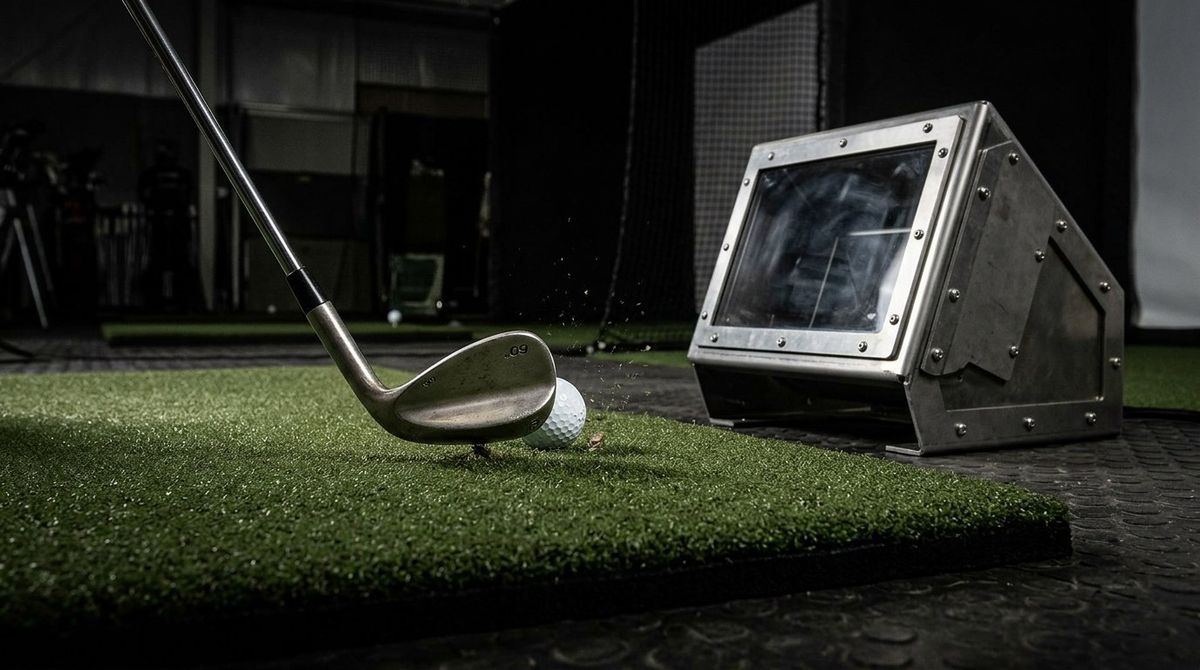
3. Formula 3: Vertical Ball Launch Angle Cone (60° Wedge vs. Thin Driver)
Why do golfers crack floor-mounted projector housings or trigger dangerous ricochets when the box is placed directly on the center target line? We can calculate the exact height of the golf ball center (\(H_{\text{ball}}(x)\)) at a forward distance \(x = D_{\text{ball}\rightarrow\text{box}}\) for any vertical launch angle (\(\theta_{\text{launch}}\)) and ball radius (\(r_{\text{ball}} = 0.84\text{ in}\)):
\[H_{\text{ball}}(x) = r_{\text{ball}} + x \times \tan(\theta_{\text{launch}})\]Conversely, the critical minimum launch angle (\(\theta_{\text{crit}}\)) required for the bottom edge of a golf ball to clear a floor enclosure of height \(H_{\text{box}} = 8.0\text{ in}\) with a \(1.5\text{ in}\) safety margin positioned at \(x = 38\text{ in}\) ahead of the tee is:
\[\theta_{\text{crit}} = \arctan\left(\frac{H_{\text{box}} + 1.5\text{ in} - r_{\text{ball}}}{x}\right) = \arctan\left(\frac{8.0 + 1.5 - 0.84}{38}\right) = \arctan(0.2279) = 12.84^\circ\]Compare \(\theta_{\text{crit}} = 12.84^\circ\) against real-world golf club launch angles:
- \(60^\circ\) Lob Wedge (\(\theta_{\text{launch}} = 38^\circ\text{ to }44^\circ\)): At \(x = 38\text{ in}\) ahead of the tee, a \(40^\circ\) wedge shot is already at \(H_{\text{ball}}(38) = 0.84 + 38 \times \tan(40^\circ) = 32.73\text{ in}\) above the floor—clearing an \(8.0\text{-inch}\) floor box by nearly \(25\text{ inches}\) (and climbing to \(H_{\text{screen}} = 126 \times \tan(40^\circ) = 105.7\text{ in} = 8.81\text{ ft}\) at the impact screen, which requires an overhead baffle if your screen is only \(8.0\text{ ft}\) tall).
- Driver (\(\theta_{\text{launch}} = 10.5^\circ\text{ to }14.0^\circ\)) & Thin/Topped Shots (\(\theta_{\text{launch}} = 3.0^\circ\text{ to }8.0^\circ\)): A tour-trajectory driver launched at \(11.0^\circ\) reaches only \(H_{\text{ball}}(38) = 0.84 + 38 \times \tan(11.0^\circ) = 8.23\text{ in}\) at the enclosure—meaning every low driver, 3-wood stinger, or thin iron shot launched below \(12.84^\circ\) will slam directly into a center-mounted floor box!
4. Formula 4: Lateral Target-Line Offset & Horizontal Keystone Angle
To eliminate \(98\%+\) of low-liner ball strikes without blocking the projector's light beam, you must shift the floor enclosure laterally outside the ball-to-screen target line (toward the golfer's chest side for a single-handed bay, or outside the dual-handed hitting strip) by a lateral offset distance \(Y_{\text{offset}}\). At a forward distance \(x = 38\text{ in}\), a lateral offset of \(Y_{\text{offset}} = 20\text{ in}\) (\(1.67\text{ ft}\)) places the inner edge of a \(14\text{-inch}\)-wide floor enclosure outside a \(\pm 19.6^\circ\) horizontal dispersion cone (\(\theta_{\text{horiz}}\)):
\[\theta_{\text{horiz}} = \arctan\left(\frac{Y_{\text{offset}} - 0.5 \times W_{\text{box}}}{D_{\text{ball}\rightarrow\text{box}}}\right) = \arctan\left(\frac{20\text{ in} - 7\text{ in}}{38\text{ in}}\right) = \arctan(0.3421) = 18.89^\circ\]When the projector lens is offset laterally by \(Y_{\text{offset}} = 20\text{ in}\) (\(1.67\text{ ft}\)) from the screen's horizontal centerline at a throw distance of \(D_{\text{throw}} = 72\text{ in}\) (\(6.0\text{ ft}\)), the required horizontal optical lens shift percentage (\(\text{Shift}_{H}\%\)) or horizontal keystone angle (\(\alpha_{\text{key}}\)) is:
\[\text{Shift}_{H}\% = \left(\frac{Y_{\text{offset}}}{W_{\text{screen}}}\right) \times 100\% = \left(\frac{20\text{ in}}{144\text{ in}}\right) \times 100\% = 13.89\%\] \[\alpha_{\text{key}} = \arctan\left(\frac{Y_{\text{offset}}}{D_{\text{throw}}}\right) = \arctan\left(\frac{20\text{ in}}{72\text{ in}}\right) = 15.52^\circ\]Because \(15.52^\circ\) is well within the \(\pm 25^\circ\text{ to }\pm 30^\circ\) 2D Keystone and 4-Corner Fit range of modern golf simulator projectors (and within the optical horizontal lens shift range of premium units like the BenQ LK936ST), the image squares up cleanly across the impact screen.
5. Formula 5: Vertical Throw Offset & Bottom-Edge Turf Shadow Clearance
Finally, when a projector sits inside a floor housing with its optical lens center at height \(H_{\text{lens}} = 5.5\text{ in}\) above the floor, angling the projector upward by tilt angle \(\phi_{\text{tilt}}\) raises the bottom border of the image (\(H_{\text{bottom}}\)) at the screen according to:
\[H_{\text{bottom}} = H_{\text{lens}} + D_{\text{throw}} \times \tan(\phi_{\text{tilt}})\]To keep the bottom edge of the projected fairway flush with the turf (\(H_{\text{bottom}} \le 3.5\text{ in}\)), select a projector with a \(100\%\text{ to }105\%\) native upward vertical offset so you can keep the projector chassis level (\(\phi_{\text{tilt}} = 0^\circ\text{ to }1.5^\circ\)) inside the floor box without inducing severe vertical trapezoid distortion.
6. Floor Projector Placement Reference Lookup Table (10.5 ft Tee Distance)
| Screen Width (\(16:9\)) | Throw Ratio (\(R_{\text{throw}}\)) | Lens-to-Screen (\(D_{\text{throw}}\)) | Ball-to-Box Standoff (\(x\)) | Centerline \(\theta_{\text{crit}}\) | Recommended Lateral Offset (\(Y_{\text{offset}}\)) |
|---|---|---|---|---|---|
| \(10.0\text{ ft}\) (\(120\text{ in}\)) | \(0.50\) | \(60.0\text{ in}\) (\(5.0\text{ ft}\)) | \(50.0\text{ in}\) | \(9.83^\circ\) | \(18.0\text{ in}\) (\(\alpha_{\text{key}} = 16.70^\circ\)) |
| \(12.0\text{ ft}\) (\(144\text{ in}\)) | \(0.50\) | \(72.0\text{ in}\) (\(6.0\text{ ft}\)) | \(38.0\text{ in}\) | \(12.84^\circ\) | \(20.0\text{ in}\) (\(\alpha_{\text{key}} = 15.52^\circ\)) |
| \(12.0\text{ ft}\) (\(144\text{ in}\)) | \(0.60\) | \(86.4\text{ in}\) (\(7.2\text{ ft}\)) | \(23.6\text{ in}\) (Too close!) | \(20.15^\circ\) | Move tee back to \(11.5\text{ ft}\) + \(22\text{ in}\) offset |
| \(13.3\text{ ft}\) (\(160\text{ in}\)) | \(0.50\) | \(80.0\text{ in}\) (\(6.67\text{ ft}\)) | \(30.0\text{ in}\) (Extend tee to \(11\text{ ft}\)) | \(16.10^\circ\) | \(22.0\text{ in}\) (\(\alpha_{\text{key}} = 15.38^\circ\)) |
Frequently Asked Questions (FAQ)
Will a floor-mounted projector enclosure interfere with a floor-standing camera launch monitor like a GC3 or Eye Mini?
Not if you place the floor projector enclosure at least \(36\text{ to }42\text{ inches}\) forward of the ball and offset it \(18\text{ to }22\text{ inches}\) laterally. Photometric floor monitors capture ball flight within the first \(12\text{ to }18\text{ inches}\) after impact, well behind the projector enclosure.
What thickness of polycarbonate shield is required for a floor projector enclosure window?
Always use a minimum \(0.25\text{-inch}\) (\(6.35\text{ mm}\)) optical-grade polycarbonate impact window angled at \(45^\circ\text{ to }55^\circ\) so any stray low ball deflects upward toward the impact screen rather than rebounding straight back toward the golfer's shins.
Map Your Exact Floor or Ceiling Projector Throw Distance
Want to test how your screen width, tee distance, and projector throw ratio fit inside your garage or basement? Launch our free interactive spatial calculator at Golf Launch Monitor Fitter to verify your exact enclosure clearances.