Golf Simulator Dual-Handed Offset Tee & Overhead Camera FOV Overlap Formula: Left-vs-Right-Handed Minimum Bay Width Math
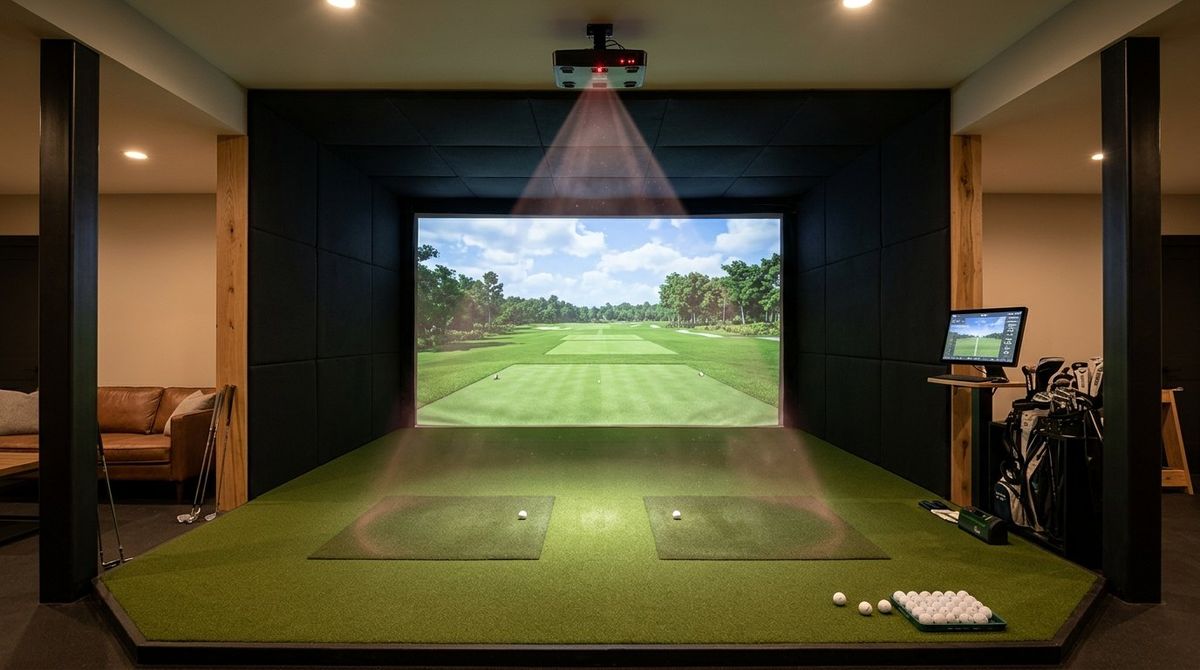
Executive Spatial Summary: Designing an indoor golf simulator for both right-handed (RH) and left-handed (LH) players from a single centered tee requires a minimum room width of \( W_{\text{room}} \ge 14.0\text{ ft} \) (\( 168\text{ in} \) / \( 4.27\text{ m} \)) so each player has \( 7.0\text{ ft} \) (\( 84\text{ in} \) / \( 2.13\text{ m} \)) of backswing clearance from the ball to the wall behind their back. However, when your garage or spare room is between \( 11.5\text{ ft} \) (\( 138\text{ in} \)) and \( 13.5\text{ ft} \) (\( 162\text{ in} \)) wide, centered hitting is impossible with a \( 45.5\text{-inch} \) driver—you must split the hitting zone into two symmetrical offset tees separated by \( d_{\text{LR}} = 2 \cdot R_{\text{back}} - W_{\text{room}} \). Crucially, your ceiling-mounted overhead launch monitor's active hitting zone width \( W_{\text{FOV}} \) must be greater than or equal to \( d_{\text{LR}} + 4.0\text{ in} \), or else shots struck from the outer tees will fall outside the optical capture cone. Run your exact room width and overhead camera specs inside the Golf Launch Monitor Fitter and compare commercial hardware in our SimGolfBenchmarks Overhead Launch Monitor Guides.
1. The Dual-Handed Backswing Clearance & Offset Tee Spacing Formula
As home builders frequently discover in r/Golfsimulator 14-foot lefty/righty width threads, dual-handed launch monitor switching discussions, and offset righty/lefty projector placement guides, a golfer's horizontal swing envelope is highly asymmetric relative to the golf ball. At address with a \( 45.5\text{-inch} \) (\( 1.156\text{ m} \)) driver, the golfer stands \( d_{\text{stance}} \approx 32\text{ to }36\text{ in} \) (\( 0.81\text{ to }0.91\text{ m} \)) from the ball, and during the backswing and follow-through release, the driver clubhead extends a total horizontal radius \( R_{\text{back}} \) from the ball toward the wall behind the golfer's back:
\[ R_{\text{back}} = d_{\text{stance}} + L_{\text{arm\_club}} \cdot \cos(\theta_{\text{plane}}) + B_{\text{safety}} \approx 84.0\text{ in} \text{ } (7.0\text{ ft} / 2.13\text{ m}) \]Meanwhile, toward the wall in front of the golfer's chest (the toe side of the club), the clubhead extends only \( R_{\text{front}} \approx 48.0\text{ in} \) (\( 4.0\text{ ft} \) / \( 1.22\text{ m} \)) past the golf ball during an inside-to-out follow-through. Therefore:
- Single-Handed Minimum Bay Width: \( W_{\text{min,single}} = R_{\text{back}} + R_{\text{front}} = 84\text{ in} + 48\text{ in} = 132\text{ in} \) (\( 11.0\text{ ft} \) / \( 3.35\text{ m} \)), with the tee offset \( 18\text{ in} \) (\( 0.46\text{ m} \)) from room centerline.
- Dual-Handed Centered Tee Width: For both a righty and a lefty to hit from the exact same center tee (\( d_{\text{LR}} = 0\text{ in} \)), both sides of the room require \( R_{\text{back}} = 84\text{ in} \), demanding \( W_{\text{min,center}} = 2 \cdot R_{\text{back}} = 168\text{ in} \) (\( 14.0\text{ ft} \) / \( 4.27\text{ m} \))—or \( 180\text{ in} \) (\( 15.0\text{ ft} \)) for players over \( 6\text{ ft }2\text{ in} \) tall.
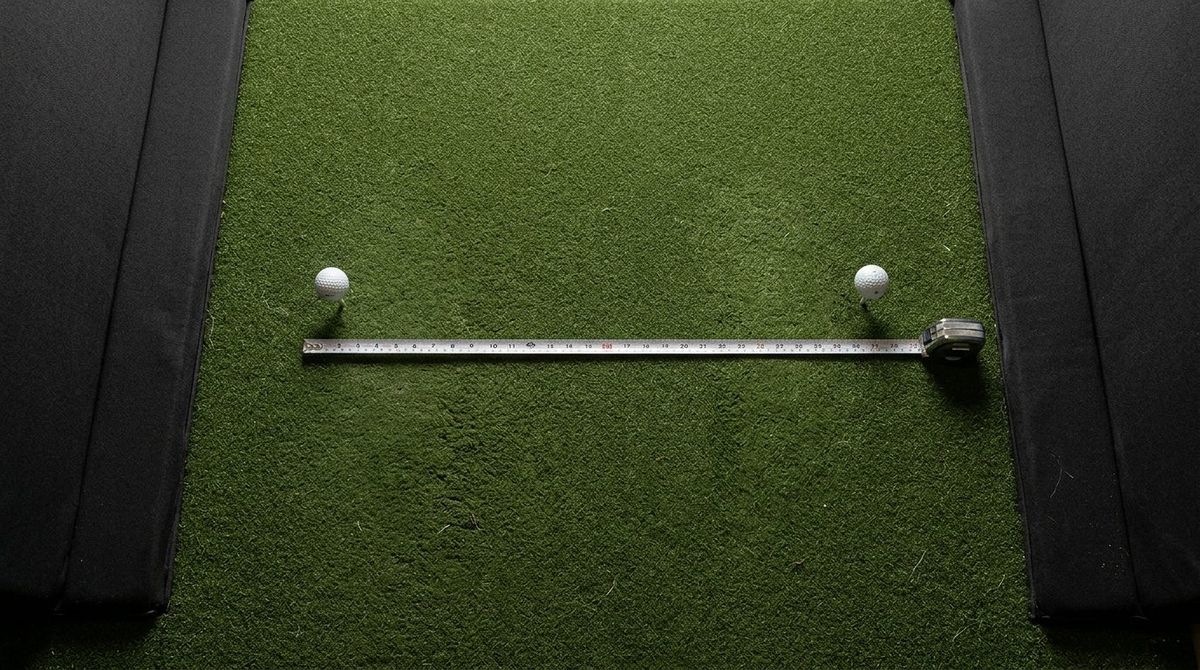
- Dual-Handed Offset Tee Separation Formula (\( 11.0\text{ ft} \le W_{\text{room}} < 14.0\text{ ft} \)): When room width \( W_{\text{room}} \) is narrower than \( 2 \cdot R_{\text{back}} \), the right-handed tee position \( x_{\text{RH}} \) (measured from the left wall) must be at least \( R_{\text{back}} \), and the left-handed tee position \( x_{\text{LH}} \) must be at most \( W_{\text{room}} - R_{\text{back}} \). This places the RH tee to the right of centerline and the LH tee to the left of centerline by a mandatory lateral tee separation \( d_{\text{LR}} \):
Where \( \delta_{\text{margin}} = 2.0\text{ in} \) (\( 5.1\text{ cm} \)) is the lateral tee-placement tolerance required on the outer edges of the overhead camera's capture box so a slightly off-center tee placement still registers.
2. Overhead Launch Monitor Hitting Zone Width vs Room Width Lookup Table
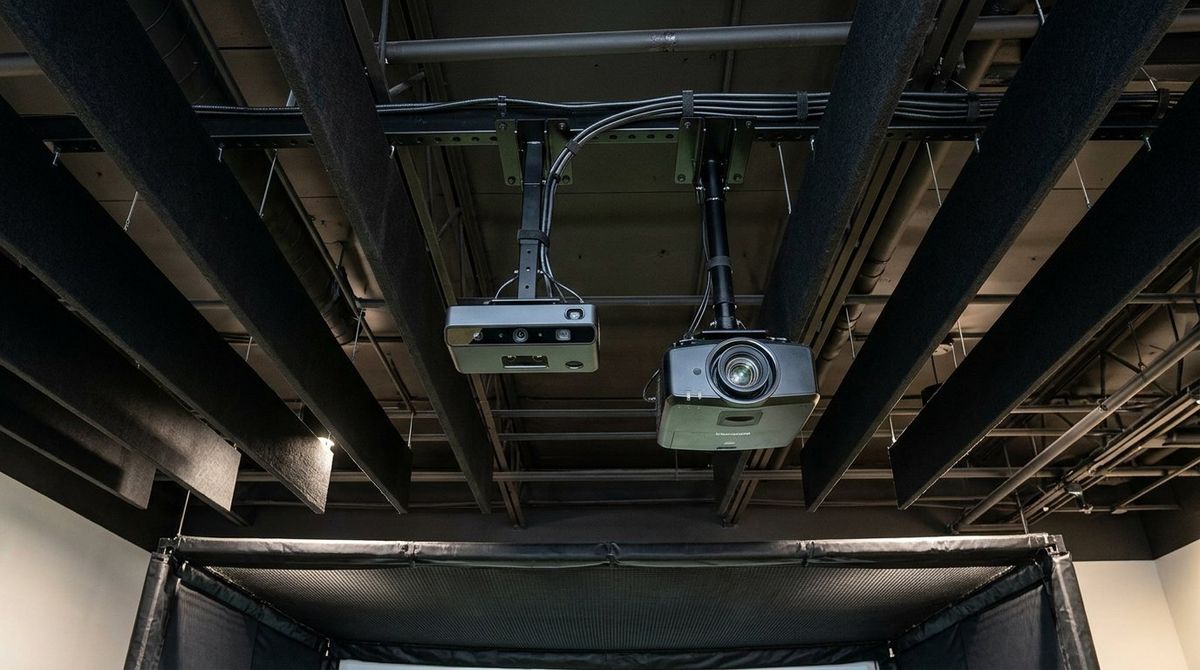
Can a single fixed overhead launch monitor cover both offset tees without a ceiling slider track? Let us compare the official lateral hitting zone widths \( W_{\text{FOV}} \) of the top overhead monitors—the Foresight Sports Falcon (\( 28.0\text{ in} \text{ W} \times 23.3\text{ in} \text{ D} \)), Uneekor EYE XO2 (\( 28.0\text{ in} \text{ W} \times 21.0\text{ in} \text{ D} \)), Trackman iO DUO (\( 28.0\text{ in} \text{ W} \)), ProTee VX (\( 25.0\text{ in} \text{ W} \times 21.0\text{ in} \text{ D} \)), and Uneekor EYE XO (\( 16.0\text{ in} \text{ W} \times 12.0\text{ in} \text{ D} \))—assuming \( R_{\text{back}} = 84.0\text{ in} \) (\( 7.0\text{ ft} \)) and \( 2 \cdot \delta_{\text{margin}} = 4.0\text{ in} \):
| Clear Room Width (\( W_{\text{room}} \)) | Centerline Offset per Player (\( \pm \Delta x \)) | Required Tee Separation (\( d_{\text{LR}} \)) | Min Camera Zone Width (\( W_{\text{FOV,min}} \)) | Compatible Fixed Overhead Launch Monitors (No Slider Track) |
|---|---|---|---|---|
| \( 14.0\text{ ft} \) (\( 168\text{ in} \) / \( 4.27\text{ m} \)) | \( 0.0\text{ in} \) (Shared Center Tee) | \( 0.0\text{ in} \) (\( 0\text{ cm} \)) | \( 4.0\text{ in} \) (\( 10.2\text{ cm} \)) | All Overheads (Falcon, EYE XO2, ProTee VX, EYE XO, Trackman iO) |
| \( 13.5\text{ ft} \) (\( 162\text{ in} \) / \( 4.11\text{ m} \)) | \( \pm 3.0\text{ in} \) from center | \( 6.0\text{ in} \) (\( 15.2\text{ cm} \)) | \( 10.0\text{ in} \) (\( 25.4\text{ cm} \)) | Falcon (\( 28\text{ in} \)), EYE XO2 (\( 28\text{ in} \)), ProTee VX (\( 25\text{ in} \)), EYE XO (\( 16\text{ in} \)) |
| \( 13.0\text{ ft} \) (\( 156\text{ in} \) / \( 3.96\text{ m} \)) | \( \pm 6.0\text{ in} \) from center | \( 12.0\text{ in} \) (\( 30.5\text{ cm} \)) | \( 16.0\text{ in} \) (\( 40.6\text{ cm} \)) | Falcon (\( 28\text{ in} \)), EYE XO2 (\( 28\text{ in} \)), ProTee VX (\( 25\text{ in} \)), EYE XO (at limit) |
| \( 12.5\text{ ft} \) (\( 150\text{ in} \) / \( 3.81\text{ m} \)) | \( \pm 9.0\text{ in} \) from center | \( 18.0\text{ in} \) (\( 45.7\text{ cm} \)) | \( 22.0\text{ in} \) (\( 55.9\text{ cm} \)) | Falcon (\( 28\text{ in} \)), EYE XO2 (\( 28\text{ in} \)), ProTee VX (\( 25\text{ in} \)) — EYE XO fails |
| \( 12.0\text{ ft} \) (\( 144\text{ in} \) / \( 3.66\text{ m} \)) | \( \pm 12.0\text{ in} \) from center | \( 24.0\text{ in} \) (\( 61.0\text{ cm} \)) | \( 28.0\text{ in} \) (\( 71.1\text{ cm} \)) | Falcon (\( 28\text{ in} \)), EYE XO2 (\( 28\text{ in} \)), Trackman iO DUO (\( 28\text{ in} \)) only |
| \( 11.5\text{ ft} \) (\( 138\text{ in} \) / \( 3.51\text{ m} \)) | \( \pm 15.0\text{ in} \) from center | \( 30.0\text{ in} \) (\( 76.2\text{ cm} \)) | \( 34.0\text{ in} \) (\( 86.4\text{ cm} \)) | Requires ceiling linear slider track (\( \ge 10\text{ in} \) travel) + dual hitting strips |
3. Worked Calculation: Designing a 12'4" (148-Inch) Garage Bay for RH + LH Play
Suppose your framed and drywalled garage bay is \( W_{\text{room}} = 148.0\text{ in} \) (\( 12\text{ ft }4\text{ in} \) / \( 3.76\text{ m} \)) wide, and you play weekly rounds with a left-handed golfer. Both players require \( R_{\text{back}} = 84.0\text{ in} \) (\( 7.0\text{ ft} \)) of driver backswing clearance:
- Calculate Required Tee Separation (\( d_{\text{LR}} \)): \[ d_{\text{LR}} = 2(84.0\text{ in}) - 148.0\text{ in} = 168.0\text{ in} - 148.0\text{ in} = 20.0\text{ in} \text{ } (50.8\text{ cm}) \] The right-handed tee sits \( +10.0\text{ in} \) right of room centerline (\( 84.0\text{ in} \) from the left wall, \( 64.0\text{ in} \) from the right wall), and the left-handed tee sits \( -10.0\text{ in} \) left of room centerline (\( 64.0\text{ in} \) from the left wall, \( 84.0\text{ in} \) from the right wall).
- Calculate Minimum Overhead Hitting Zone Width (\( W_{\text{FOV,min}} \)): \[ W_{\text{FOV,min}} = 20.0\text{ in} + 4.0\text{ in} = 24.0\text{ in} \text{ } (61.0\text{ cm}) \] Both the Foresight Falcon (\( 28.0\text{ in} \)), Uneekor EYE XO2 (\( 28.0\text{ in} \)), and ProTee VX (\( 25.0\text{ in} \)) cover this \( 24.0\text{ in} \) span without moving the launch monitor!
- Select Hitting Strip Layout: A standard single hitting strip is only \( 12.0\text{ in} \) (\( 30.5\text{ cm} \)) wide, which is too narrow for a \( 20.0\text{ in} \) tee separation. You must either install a wide \( 28\text{ in} \times 16\text{ in} \) center turf insert or recess two \( 12\text{ in} \times 30\text{ in} \) hitting strips centered at \( -10.0\text{ in} \) and \( +10.0\text{ in} \).
4. Frequently Asked Questions (FAQ)
Can I use a floor-based camera launch monitor like a GC3 or Eye Mini for lefty/righty play in a 12.5-foot room?
You can physically swing in a \( 12.5\text{ ft} \) room using two offset tees (\( \pm 9.0\text{ in} \) from centerline), but because a floor-based camera unit sits \( 18\text{ to }22\text{ in} \) in front of the golfer's toes facing the ball, you will have to pick up and carry the launch monitor across the mat every time a left-handed and right-handed player alternate shots (or use GSPro's "Finish Out Hole" setting so you only move the unit 18 times per round instead of 72 times).
Where should I mount my projector in an offset dual-handed simulator bay?
Always mount the projector aligned to the horizontal center of the impact screen so the projected image fills the screen without horizontal keystone distortion, and use your simulator software's (GSPro / FSX Play /Uneekor Refine) Software Aim Offset slider to shift the virtual pin target \( +10\text{ in} \) right for RH players and \( -10\text{ in} \) left for LH players.
What happens if I mount an overhead launch monitor on a ceiling slider track?
In a tight \( 11.0\text{ to }11.8\text{ ft} \) room where \( d_{\text{LR}} \) reaches \( 30\text{ to }36\text{ in} \), a heavy-duty linear bearing ceiling track lets you slide an overhead monitor \( 12\text{ in} \) left or right in 3 seconds with positive spring-detent stops—preserving \( 100\% \) optical spin accuracy in a single-car garage.
Run Your Exact Room Width & Dual-Handed Tee Offset Math
Enter your room width, ceiling height, and tallest golfer height to see which overhead and floor launch monitors fit your space without wall strikes.
Open the Golf Launch Monitor Fitter Calculator