Golf Simulator Custom Aspect Ratio (4:3 vs 16:10 vs 16:9) 4K Pixel Crop & Effective Lumen Loss Formula: 6 NVIDIA Resolution & Throw Calculations
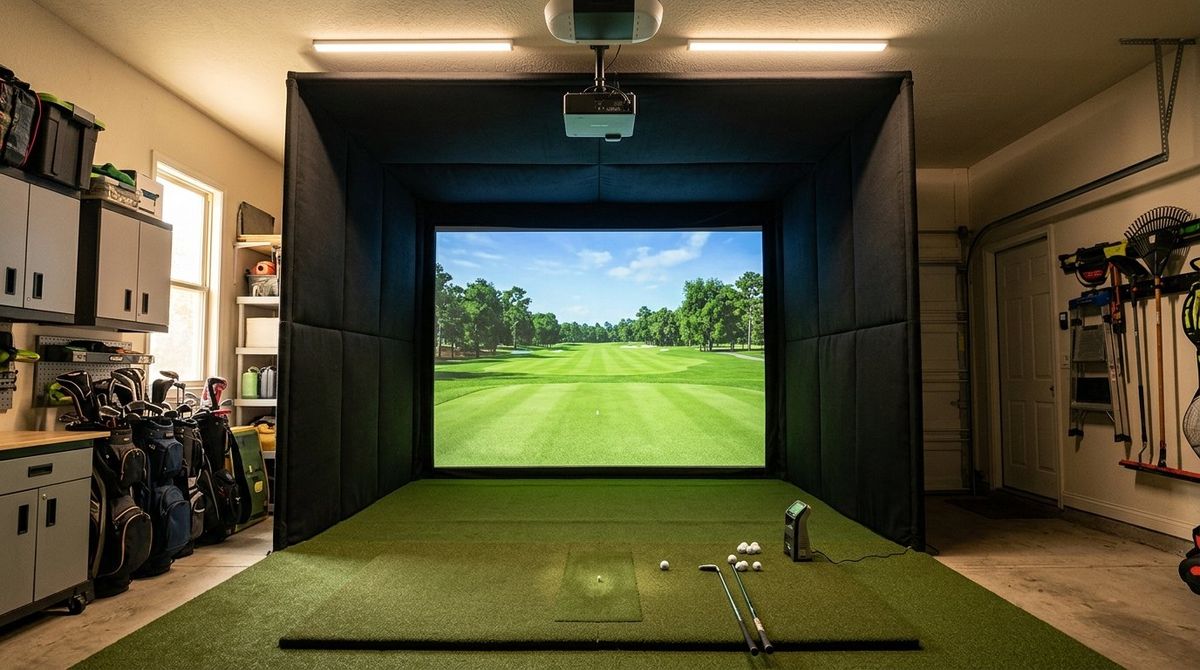
Executive Optical Summary: Most residential garage golf simulator bays are \( 10.0\text{ ft} \text{ to } 13.0\text{ ft} \) wide with \( 9.0\text{ ft} \text{ to } 10.0\text{ ft} \) ceilings—making a native \( 16:9 \) widescreen impact screen (\( 16.0\text{ ft} \times 9.0\text{ ft} \)) physically impossible to fit without shrinking screen height down to a cramped \( 5.6\text{ ft} \text{ to } 6.7\text{ ft} \). To preserve a tall \( 8.5\text{ ft} \text{ to } 9.0\text{ ft} \) vertical wedge-capture target inside a \( 10\text{ ft} \text{ to } 12\text{ ft} \) enclosure, builders use a native \( 16:9 \) 4K UHD projector (\( 3840 \times 2160\text{ px} \)) and force a custom \( 16:10 \), \( 4:3 \), or arbitrary enclosure resolution in NVIDIA Control Panel. However, cropping horizontal DMD mirror columns to match a narrower screen discards \( 10.0\% \text{ to } 34.4\% \) of your active 4K pixels and proportionally reduces effective on-screen ANSI lumens while forcing you to mount the projector \( 11.1\% \text{ to } 33.3\% \) farther back! Run all 6 optical equations below and verify your exact room geometry in the Golf Launch Monitor Fitter.
1. Calculation 1 & 2: Native 4K DMD Pixel Crop Formula (\( P_{\text{H,custom}} \)) for Any Screen Width & Height
As home studio builders frequently debate in r/Golfsimulator BenQ TK700STi 16:10 aspect ratio threads, BenQ AK700ST 4K 16:10 scaling discussions, and 4:3 vs 16:10 aspect ratio comparisons, consumer 4K golf simulator projectors (such as the BenQ AK700ST, BenQ LK936ST, and TK710STi) use a physical \( 16:9 \) DLP micromirror chip with \( P_{\text{H,native}} = 3840\text{ horizontal pixels} \) and \( P_{\text{V,native}} = 2160\text{ vertical pixels} \) (\( N_{\text{native}} = 8{,}294{,}400\text{ total pixels} \)).
When you project onto a taller, narrower enclosure of viewable width \( W_s \) and viewable height \( H_s \) (where screen aspect ratio \( R_{\text{screen}} = \frac{W_s}{H_s} < \frac{16}{9} = 1.778 \)), you must never stretch the \( 16:9 \) image vertically (which distorts golf balls into ovals) or letterbox the top and bottom (which leaves \( 18\text{ to } 27\text{ inches} \) of unlit white canvas above and below the fairway). Instead, you zoom/position the projector so the native \( 2160\text{-pixel} \) vertical height of the \( 16:9 \) chip fills the full physical screen height \( H_s \), and then crop the left and right horizontal pixel columns inside NVIDIA Control Panel so the active image width matches \( W_s \) without spilling onto your black side-baffle curtains:
\[ P_{\text{V,custom}} = 2160\text{ px}, \qquad P_{\text{H,custom}} = \text{round}\left( 2160 \cdot \frac{W_s}{H_s} \right)\text{ px} \] \[ \eta_{\text{pixel}} = \frac{P_{\text{H,custom}} \cdot 2160}{3840 \cdot 2160} = \frac{R_{\text{screen}}}{1.7778} \times 100\% \]For example, on a popular Carl's Place \( 12.0\text{ ft} \times 9.0\text{ ft} \) (\( 144\text{ in} \times 108\text{ in} \), \( R_{\text{screen}} = 1.333 \) or \( 4:3 \)) enclosure, your exact custom NVIDIA resolution is \( P_{\text{H,custom}} = 2160 \cdot \frac{144}{108} = 2880 \times 2160\text{ px} \), retaining \( \eta_{\text{pixel}} = 75.0\% \) (\( 6{,}220{,}800\text{ active pixels} \)—still \( 3.0\times \) sharper than \( 1080\text{p} \)!).
| Enclosure Viewable Size (\( W_s \times H_s \)) | Aspect Ratio (\( R_{\text{screen}} \)) | Exact NVIDIA Custom Resolution | Active Pixels (\( \text{MP} \)) | Pixel & Lumen Retention (\( \eta_{\text{pixel}} \)) | Throw Distance Multiplier (\( M_{\text{throw}} \)) |
|---|---|---|---|---|---|
| \( 16.0\text{ ft} \times 9.0\text{ ft} \) (\( 192\text{"} \times 108\text{"} \)) | \( 16:9 \) (\( 1.78 \)) | \( 3840 \times 2160\text{ px} \) (Native 4K) | \( 8.29\text{ MP} \) | \( 100.0\% \) (\( 0\% \) Loss) | \( 1.000\times \) (Baseline Throw) |
| \( 13.6\text{ ft} \times 8.5\text{ ft} \) (\( 163\text{"} \times 102\text{"} \)) | \( 16:10 \) (\( 1.60 \)) | \( 3456 \times 2160\text{ px} \) | \( 7.46\text{ MP} \) | \( 90.0\% \) (\(-10.0\%\) Loss) | \( 1.111\times \) (\(+11.1\%\) Farther Back) |
| \( 12.0\text{ ft} \times 9.0\text{ ft} \) (\( 144\text{"} \times 108\text{"} \)) | \( 4:3 \) (\( 1.33 \)) | \( 2880 \times 2160\text{ px} \) | \( 6.22\text{ MP} \) | \( 75.0\% \) (\(-25.0\%\) Loss) | \( 1.333\times \) (\(+33.3\%\) Farther Back) |
| \( 10.0\text{ ft} \times 8.5\text{ ft} \) (\( 120\text{"} \times 102\text{"} \)) | \( 1.18:1 \) (Narrow Bay) | \( 2541 \times 2160\text{ px} \) | \( 5.49\text{ MP} \) | \( 66.2\% \) (\(-33.8\%\) Loss) | \( 1.511\times \) (\(+51.1\%\) Farther Back) |
| \( 9.0\text{ ft} \times 9.0\text{ ft} \) (\( 108\text{"} \times 108\text{"} \)) | \( 1:1 \) (Square Bay) | \( 2160 \times 2160\text{ px} \) | \( 4.67\text{ MP} \) | \( 56.25\% \) (\(-43.75\%\) Loss) | \( 1.778\times \) (\(+77.8\%\) Farther Back) |
2. Calculation 3 & 4: Effective Throw Ratio Shift (\( TR_{\text{eff}} \)) & Mounting Distance Formula
Here is the #1 mounting mistake documented in r/Golfsimulator BenQ LK936ST custom resolution threads: projector manufacturers specify Throw Ratio (\( TR_{\text{native}} = \frac{D_{\text{throw}}}{W_{\text{native}}} \)) relative to the full \( 16:9 \) image width, not your cropped \( 4:3 \) or \( 16:10 \) screen width! Because a custom NVIDIA resolution turns off the outer DMD mirrors while keeping the optical lens cone unchanged, the projector must be mounted at the distance required to cast a phantom \( 16:9 \) image of width \( W_{\text{phantom}} = H_s \cdot \frac{16}{9} \):
\[ W_{\text{phantom}} = H_s \cdot \left(\frac{16}{9}\right) = 1.7778 \cdot H_s \] \[ D_{\text{throw}} = TR_{\text{native}} \cdot W_{\text{phantom}} = TR_{\text{native}} \cdot H_s \cdot \left(\frac{16}{9}\right), \qquad TR_{\text{eff}} = TR_{\text{native}} \cdot \left(\frac{1.7778}{R_{\text{screen}}}\right) \]Consider a \( 12.0\text{ ft} \text{ wide} \times 9.0\text{ ft} \text{ tall} \) (\( 4:3 \)) screen using a projector with a native throw ratio of \( TR_{\text{native}} = 0.81 \) (such as the BenQ LK936ST at minimum zoom):
- Naive (Wrong) Calculation: Multiplying \( 0.81 \times 12.0\text{ ft} = 9.72\text{ ft} \) leaves your projected image only \( 6.75\text{ ft} \) tall—missing the top and bottom \( 27\text{ inches} \) of your \( 9.0\text{ ft} \) screen!
- Exact Phantom-Width Calculation: To fill \( H_s = 9.0\text{ ft} \) vertically, the phantom \( 16:9 \) width is \( W_{\text{phantom}} = 9.0\text{ ft} \times 1.7778 = 16.0\text{ ft} \), requiring a lens-to-screen throw distance of: \[ D_{\text{throw}} = 0.81 \times 16.0\text{ ft} = 12.96\text{ ft} \quad (12\text{ ft } 11.5\text{ in}) \] And if you want the lens mounted at \( D_{\text{throw}} = 10.5\text{ ft} \text{ to } 11.5\text{ ft} \) directly above the tee box so the golfer never casts a shadow, you need a shorter-throw projector with \( TR_{\text{native}} = 0.69 \text{ to } 0.72 \) (such as the BenQ AK700ST at \( 0.69 \times 16.0\text{ ft} = 11.04\text{ ft} \)).
3. Calculation 5 & 6: Effective ANSI Lumen Loss (\( L_{\text{eff}} \)), Foot-Lamberts, & Movie-Mode Profile Switching
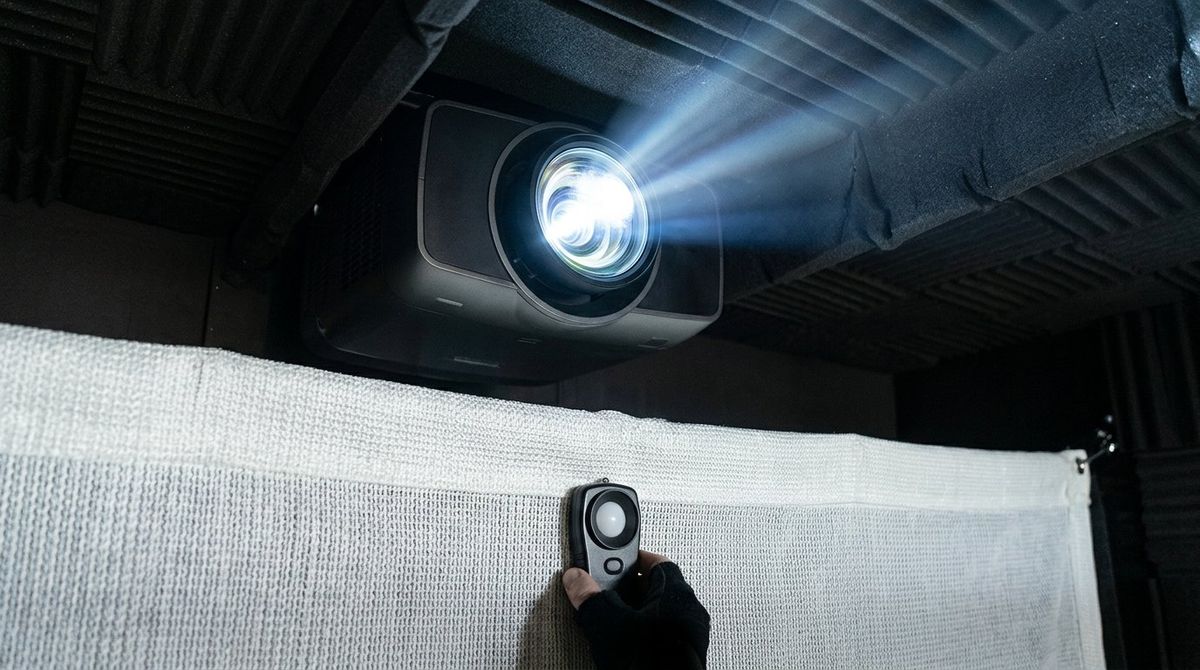
When NVIDIA Control Panel blacks out the outer \( 1 - \eta_{\text{pixel}} \) columns of micromirrors on a DLP chip, those mirrors dump their light into the projector's internal light trap. Your Effective On-Screen Lumens (\( L_{\text{eff}} \)) and resulting screen luminance in Foot-Lamberts (\(\text{fL}\)) across screen gain \( G_{\text{screen}} \approx 0.85 \) (typical multi-layer impact fabric) are:
\[ L_{\text{eff}} = L_{\text{ANSI}} \cdot \left( \frac{R_{\text{screen}}}{1.7778} \right)\text{ lumens}, \qquad \text{Luminance}_{\text{fL}} = \frac{L_{\text{eff}} \cdot G_{\text{screen}}}{W_s \cdot H_s} = \frac{L_{\text{ANSI}} \cdot G_{\text{screen}}}{1.7778 \cdot H_s^2}\text{ fL} \]Notice a remarkable optical cancellation in the second equation: because both \( L_{\text{eff}} \) and screen area \( A_s = W_s \cdot H_s \) scale linearly with \( W_s \) at a fixed height \( H_s \), your surface brightness per square foot (\(\text{fL}\)) depends only on your screen height \( H_s \)! On a \( 12.0\text{ ft} \times 9.0\text{ ft} \) (\( 108\text{ sq ft} \)) screen with \( G_{\text{screen}} = 0.85 \):
- \( 3{,}000\text{-Lumen} \) Projector (e.g., BenQ TK700STi): Cropping to \( 4:3 \) leaves \( L_{\text{eff}} = 3{,}000 \times 0.75 = 2{,}250\text{ active lumens} \), yielding \( \text{Luminance}_{\text{fL}} = \frac{2{,}250 \times 0.85}{108\text{ sq ft}} = 17.71\text{ fL} \) (ideal for controlled ambient lighting \( \le 50\text{ lux} \)).
- \( 4{,}000\text{-Lumen} \) Laser Projector (e.g., BenQ AK700ST): Cropping to \( 4:3 \) leaves \( L_{\text{eff}} = 4{,}000 \times 0.75 = 3{,}000\text{ active lumens} \), yielding \( 23.61\text{ fL} \).
- \( 5{,}100\text{-Lumen} \) Commercial Laser (e.g., BenQ LK936ST): Cropping to \( 4:3 \) leaves \( L_{\text{eff}} = 5{,}100 \times 0.75 = 3{,}825\text{ active lumens} \), yielding a daylight-cutting \( 30.10\text{ fL} \).
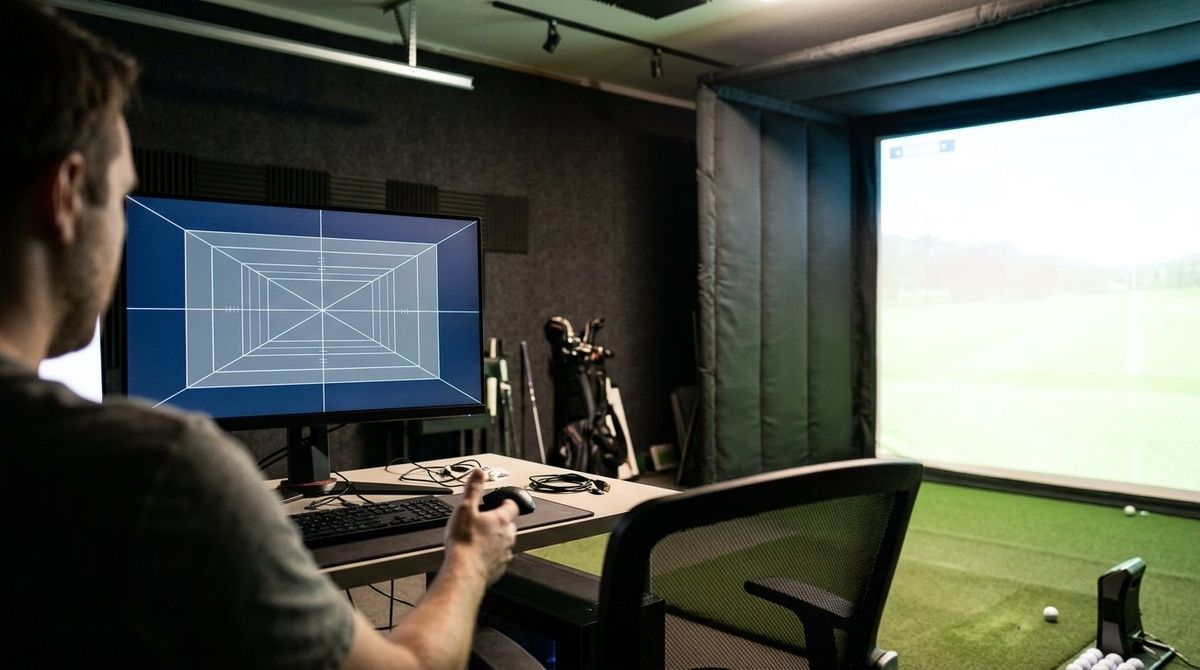
Finally, if you want to watch \( 16:9 \) NFL games or movies on HDMI 2 (via Apple TV or Roku) when the projector is mounted at the farther \( 4:3 \) throw distance (\( 12.96\text{ ft} \)), use a projector with Digital Shrink (\( 0.75\times \)) or Motorized Zoom memory so you can shrink the \( 16.0\text{ ft} \) native width back down to \( 12.0\text{ ft} \) with a single remote preset.
Calculate Your Exact Custom Resolution, Throw Distance & Lumen Target
Plug your enclosure width, ceiling height, and projector model into our interactive calculator to get your exact NVIDIA custom pixel dimensions and mounting distance.
Open the Golf Launch Monitor Fitter