Golf Simulator Ceiling Height Formula: 5 Essential Driver Swing Arc and Hitting Mat Stack Calculations
Nothing ruins a home golf simulator faster thanIndoor Swing Syndrome (ISS)—the subconscious flinch where a golfer flattens their follow-through out of fear of smashing a $600 carbon driver head into the garage ceiling joists. Standard retailer charts claim that a 9-foot (108-inch) ceiling works for golfers up to 6'0" tall, yet thousands of builders inr/Golfsimulator ceiling height threadsstill gouge their drywall on their first full swing. Why? Because static standing-height rules ignore the three variables that actually govern peak clubhead elevation:swing plane steepness angle ((\(\theta\))),hitting mat + subfloor foam stack rise (\(H_{\text{mat}}\))), andoverhead baffle or projector mount drop (\(H_{\text{baffle}}\))).
In this comprehensivegolf simulator ceiling height formulaengineering guide, we derive the exact trigonometric swing-arc equation for a standard 45.5-inch driver, walk through step-by-step arithmetic for golfers from 5'6" to 6'6", and show you how to reclaim 2 to 8 inches of vertical clearance in tight garages. To test your room's exact dimensions alongside projector throw and launch monitor placement, open our interactiveGolf Launch Monitor Fitter.
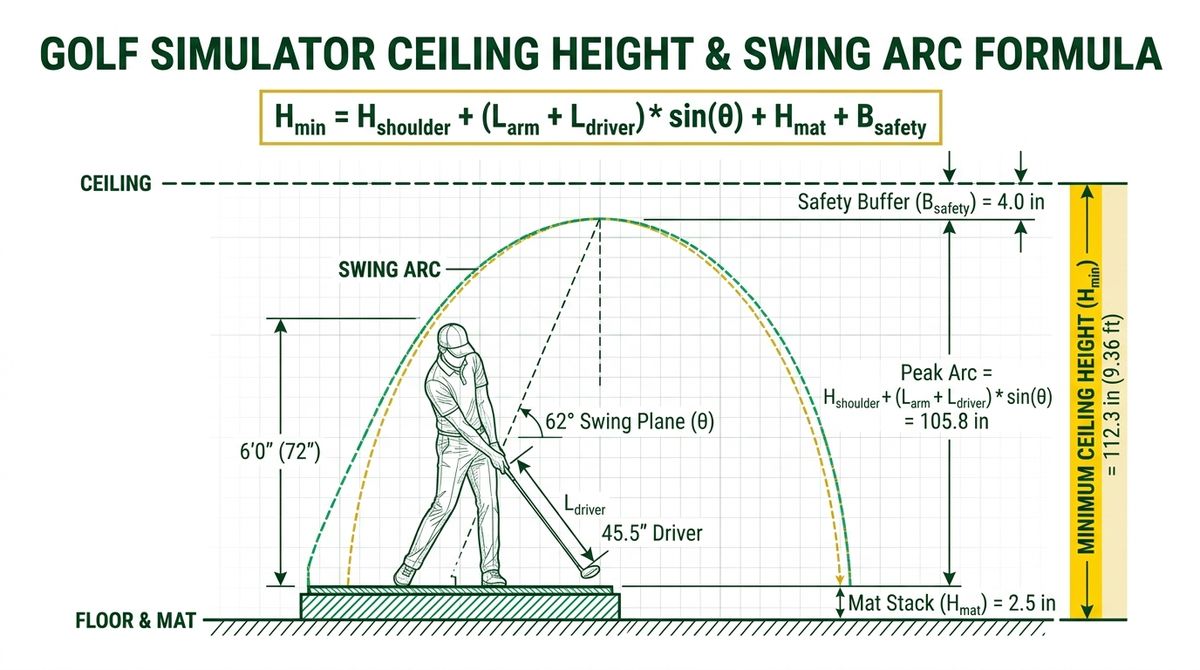
Quick Ceiling Height Formula & Benchmark Takeaways The Master Ceiling Clearance Equation: $$H_{\text{min}} = H_{\text{shoulder}} + \left( L_{\text{arm\_eff}} + L_{\text{club}} \right) \cdot \sin(\theta) + H_{\text{mat}} + H_{\text{baffle}} + B_{\text{safety}}$$ The Hidden 4-Inch Vertical Squeeze: Adding a 2.5-inch elbow-safe hitting mat stack on the floor and 1.5-inch acoustic baffles on the ceiling shrinks a 9'0" (108 in) garage down to 8'8" (104 in) of net swing height . Verified 6'0" Golfer Driver Benchmark: A 6'0" (72 in) golfer with a 62° upright driver follow-through on a 2.5-inch mat stack requires 112.3 inches (9 ft 5 in) of raw ceiling height for a fearless full swing.
1. Why Standing-Height Rules Fail: The Physics of the High Follow-Through
When most golfers measure their garage for an indoor bay—whether pairing it with ourGolf Simulator Lateral Offset Hitting Zone Formulaor ourProjector Throw Distance Guide—they make a critical biomechanical error: they pause at the top of theirbackswingto check ceiling clearance. In 95% of full driver swings, the highest vertical point of the clubhead arc does not occur at the top of the backswing, where the trail elbow is folded at 90 degrees and the wrists are hinged. Instead,peak vertical clubhead elevation occurs 30 to 45 milliseconds after impact during the high-hands follow-through extension, when both arms are fully extended upward and Centrifugal force pulls the 45.5-inch driver shaft along the inclined swing plane.
Furthermore, two golfers who both stand exactly 6'0" (72 inches) tall in golf shoes can have a6.2-inch difference in peak clubhead heightbased solely on their swing plane angle (\(\theta\)):
- Flatter / Rounded Swing Plane (\(\theta = 55^\circ\))): Common among shorter-iron sweepers or players who rotate their lead arm around their ribcage. The sine multiplier is (\sin(55^\circ) = 0.8192).
- Standard Athletic Driver Plane (\(\theta = 60^\circ\text{ to }62^\circ\))): Typical of modern full-extension driver releases. The sine multiplier rises to (\sin(62^\circ) = 0.8829).
- Steep / Upright High-Hands Finish (\(\theta = 66^\circ\))): Common among tall, high-launch players who extend their hands high above their lead shoulder on the follow-through. The sine multiplier reaches (\sin(66^\circ) = 0.9135)—adding 5.1 inches of vertical clubhead peak over a 55° swing!
2. Deriving the Master Golf Simulator Ceiling Height Formula
To eliminate guesswork and replace the crude "60-inch pool noodle test" often debated onr/Golfsimulator, we model the golfer-and-club system as a two-segment kinematic chain anchored on top of the hitting mat stack:
Let us define each physical input in inches so you can audit your exact studio:
- (\(H_{\text{golfer}}\)) & (\(H_{\text{shoes}}\)): Barefoot standing height in inches plus spikeless golf shoe sole thickness (typically (\(1.0\text{ in}\))). Biomechanical anthropometry establishes that the glenohumeral (lead shoulder) pivot during an athletic golf finish sits at approximately (\(0.818 \times H_{\text{golfer}}\)) (about 58.9 inches above the shoe sole for a 72-inch golfer, or ~53.0 inches during dynamic posture compression before upward extension).
- (\(L_{\text{arm\_eff}}\)) (Effective Radial Arm Extension Above Shoulder Pivot): Because the hands grip the club 1.0 inch below the butt cap and the lead wrist unhinges dynamically through the high finish, the net radial extension contributed by the lead arm beyond the shoulder pivot along the swing plane averages (\(7.5\text{ to }8.5\text{ inches}\)) for a standard build.
- (\(L_{\text{club}}\)) (Total Club Length): Standard men's driver length is (\(45.5\text{ inches}\)) (3-wood is (\(43.0\text{ in}\)), 5-hybrid is (\(40.0\text{ in}\)), and 7-iron is (\(37.0\text{ in}\))). Combined with (\(L_{\text{arm\_eff}} = 7.5\text{ in}\)), the effective radial lever arm for a driver is (\(R_{\text{total}} = 53.0\text{ inches}\)).
- (\(H_{\text{mat}}\)) (Hitting Mat + Subfloor Stack Height): As emphasized in r/Golfsimulator mat thickness discussions , an injury-preventing hitting strip (such as a 2.38-inch SIGPRO Softy or 1.75-inch Country Club Elite / Fiberbuilt strip laid over 0.75-inch EVA puzzle tiles) raises the golfer's feet (\(2.0\text{ to }2.75\text{ inches}\)) above the concrete slab.
- (\(H_{\text{baffle}}\)) & (\(B_{\text{safety}}\)): Acoustic ceiling foam panels or enclosure top tarps drop the effective ceiling by (\(1.0\text{ to }1.5\text{ inches}\)), while a minimum (\(4.0\text{-inch dynamic safety buffer}\)) prevents psychological flinching.
3. Step-by-Step Worked Calculation: 6'0" Golfer in a 9.5-Foot Garage
Let us run the complete arithmetic for a6'0" (72.0-inch) golferswinging a standard45.5-inch driveron an upright(\(\theta = 62^\circ\)) swing planewhile standing on a2.5-inch hitting mat + subfloor stack(\(H_{\text{mat}} = 2.5\text{ in}\))) with a4.0-inch safety buffer(\(B_{\text{safety}} = 4.0\text{ in}\))) and bare drywall ceiling (\(H_{\text{baffle}} = 0\text{ in}\))):
- 1. Step 1 — Calculate Shoulder Pivot Elevation (\(H_{\text{shoulder}}\))): $$H_{\text{shoulder}} = 0.818 \times 72.0 = 58.90\text{ inches above the hitting mat}$$
- 2. Step 2 — Calculate Vertical Swing Arc Rise (\(\Delta Z_{\text{swing}}\))): Using an effective arm-plus-driver radial lever of (\(53.0\text{ inches}\)) at (\(\theta = 62^\circ\)) (\(\sin 62^\circ = 0.88295\)): \(\Delta Z_{\text{swing}} = 53.0 \times 0.88295 = 46.80\text{ inches}\)
- 3. Step 3 — Compute Peak Clubhead Height Above Mat Surface (\(H_{\text{peak}}\))): $$H_{\text{peak}} = 58.90 + 46.80 = \mathbf{105.7\text{ to }105.8\text{ inches}} ; (8\text{ ft } 9.8\text{ in above the mat})$$ Notice the trap: At 8 ft 9.8 in above the mat, the driver head would barely clear a 9'0" (108 in) ceiling by 2.2 inches if the golfer stood on bare concrete—leaving zero room for a hitting mat!
- 4. Step 4 — Add Hitting Mat Stack (\(2.5\text{ in}\))) and Safety Buffer (\(4.0\text{ in}\))): $$H_{\text{min}} = 105.8 + 2.5 + 4.0 = \mathbf{112.3\text{ inches}} ; (\mathbf{9\text{ ft } 4.3\text{ in}}, \text{ rounded to } \mathbf{9\text{ ft } 5\text{ in}})$$
4. Complete Golfer Height & Club Selection Ceiling Clearance Table
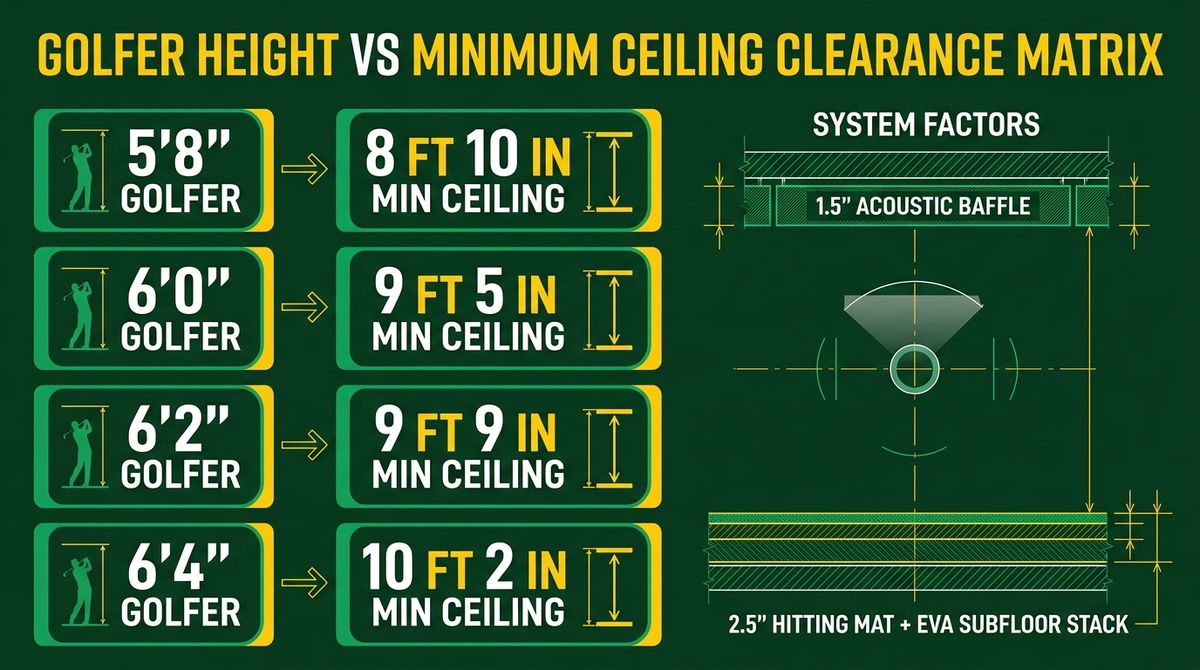
Use the verified engineering lookup table below (calculated with a 2.5-inch hitting mat stack and 4.0-inch safety buffer at a 62° swing plane) to check whether your room supports a full 45.5-inch driver, a 43.0-inch 3-wood, or an iron-only setup:
Golfer Height
Shoulder Pivot (\(H_{\text{shoulder}}\)))
Peak Driver Arc Above Mat
Min Ceiling for 7-Iron (37 in)
Min Ceiling for 3-Wood (43 in)
Min Safe Ceiling for Driver (45.5 in)
5'6" (66 in)
54.0 in
100.8 in
8 ft 4 in (100.0 in)
8 ft 9 in (105.1 in)
8 ft 11.5 in (107.3 in)
5'8" (68 in)
55.6 in
102.4 in
8 ft 5.5 in (101.6 in)
8 ft 10.5 in (106.7 in)
9 ft 1 in (108.9 in) (8'10" w/ thin mat)
5'10" (70 in)
57.3 in
104.1 in
8 ft 7 in (103.3 in)
9 ft 0.5 in (108.4 in)
9 ft 2.5 in (110.6 in)
6'0" (72 in)
58.9 in
105.8 in
8 ft 9 in (104.9 in)
9 ft 2 in (110.1 in)
9 ft 5 in (112.3 in)
6'2" (74 in)
60.5 in
107.4 in
8 ft 10.5 in (106.5 in)
9 ft 3.5 in (111.7 in)
9 ft 6.5 in – 9 ft 9 in (Steep)
6'4" (76 in)
62.2 in
109.1 in
9 ft 0 in (108.2 in)
9 ft 5.5 in (113.4 in)
9 ft 8 in – 10 ft 2 in (Steep)
As the table demonstrates, a 5'8" golfer using a recessed 1.0-inch hitting strip and 2.5-inch buffer can comfortably swing a driver in an8 ft 10 inceiling room, whereas a 6'2" to 6'4" player with an upright follow-through needs9 ft 9 in to 10 ft 2 inof vertical room.
5. Three Structural Hacks to Reclaim 2 to 8 Inches of Ceiling Clearance
If your garage or basement falls 2 to 4 inches short of the driver threshold in our table, do not compromise by buying a rock-hard 0.5-inch turf mat that causes medial epicondylitis (golfer's elbow). Instead, use one of these three proven spatial modifications:
1. Recess the Hitting Strip Flush into a 1.0-Inch Stance Platform (+1.5 in Saved): Instead of stacking a 2.5-inch hitting strip on top of a 1.0-inch platform, frame your stance platform at 1.25 inches and drop your deep foam/divot strip into a cutout opening so its top turf surface sits just 1.25 inches above the concrete slab.
2. Align the Follow-Through Arc Between Open Ceiling Joists (+7.25 to +9.25 in Saved): In an unfinished basement or garage where 2×8 or 2×10 ceiling joists run perpendicular to your target line on 16-inch centers, slide your hitting mat 4 to 6 inches forward or backward so the peak of your driver follow-through arcs directly into the 14.5-inch open bay between two joists.
3. Switch from Overhead to Floor Photometric Launch Monitors in 9.0-Foot Rooms: As noted in Top Shelf Golf's room guides , overhead ceiling bars require 9.0 to 10.5 feet of mounting elevation and place hardware in the upper ceiling plane; a side-mounted photometric unit leaves the entire ceiling cavity unobstructed.
Calculate Your Exact Ceiling, Width & Throw Clearances Now Enter your golfer height, room dimensions, and mat thickness into our free interactive calculator to see which launch monitors and enclosures fit your space without swing restrictions. Open the Golf Launch Monitor Fitter →
Frequently Asked Questions
Can a 6-foot golfer swing a driver in a 9-foot ceiling golf simulator?
It is borderline and depends on your swing plane and mat thickness. A 6'0" golfer with a standard 62° driver swing peaks at105.8 inches above their shoes. On a 2.5-inch hitting mat stack (108.3 inches total), the driver head will brush a 9-foot (108-inch) ceiling unless the golfer has a flatter (≤56°) swing plane or recesses the hitting strip flush with the floor.
How much ceiling height does a golf simulator hitting mat take up?
A joint-safe simulator flooring build typically consumes1.75 to 2.75 inchesof vertical ceiling clearance once you combine 0.75-to-1.0-inch interlocking EVA foam subfloor tiles with a 1.5-to-2.38-inch shock-absorbing hitting strip.
What is the minimum ceiling height for an iron-only golf simulator?
Because a 7-iron measures 37.0 inches (8.5 inches shorter than a 45.5-inch driver), vertical swing arc height drops by approximately7.5 inches. A 6'0" golfer can comfortably swing mid-to-short irons in an8 ft 9 in (105-inch)room.
Run the Interactive Calculator: Use our Golf Launch Monitor Fitter to model your exact parameters and tolerances in real time.