Golf Simulator Ball Rebound Angle and Ceiling Ramp Formula: 5 Spatial Safety Calculations
One of the most dangerous mechanical hazards in a home golf simulator is an uncalculated high-speed ball ricochet off the impact screen or upper enclosure header. Builders routinely focus on driver ball speeds (160+ mph) hitting the center of the screen, yet center-screen driver strikes launch at low vertical angles (\( 10^\circ\text{ to }14^\circ \)) and drop harmlessly onto the turf strip. The real safety threat comes from high-lofted 56-degree sand wedges and 60-degree lob wedges struck from 8 to 10 feet away, which climb at \( 38^\circ\text{ to }48^\circ \) launch angles and slam into the upper third of the screen or the exposed front ceiling joist.
In this comprehensive golf simulator ball rebound angle formula guide, we model impact screen coefficient of restitution (\( e_{\text{screen}} \)), backspin-induced upward climb during screen pocket deformation, ballistic return distance (\( D_{\text{return}} \)), and the exact geometry for an angled ceiling deflector ramp. You can verify your exact tee-to-screen distance and ceiling height inside our interactive Golf Launch Monitor Fitter.
Key Engineering & Financial Benchmarks
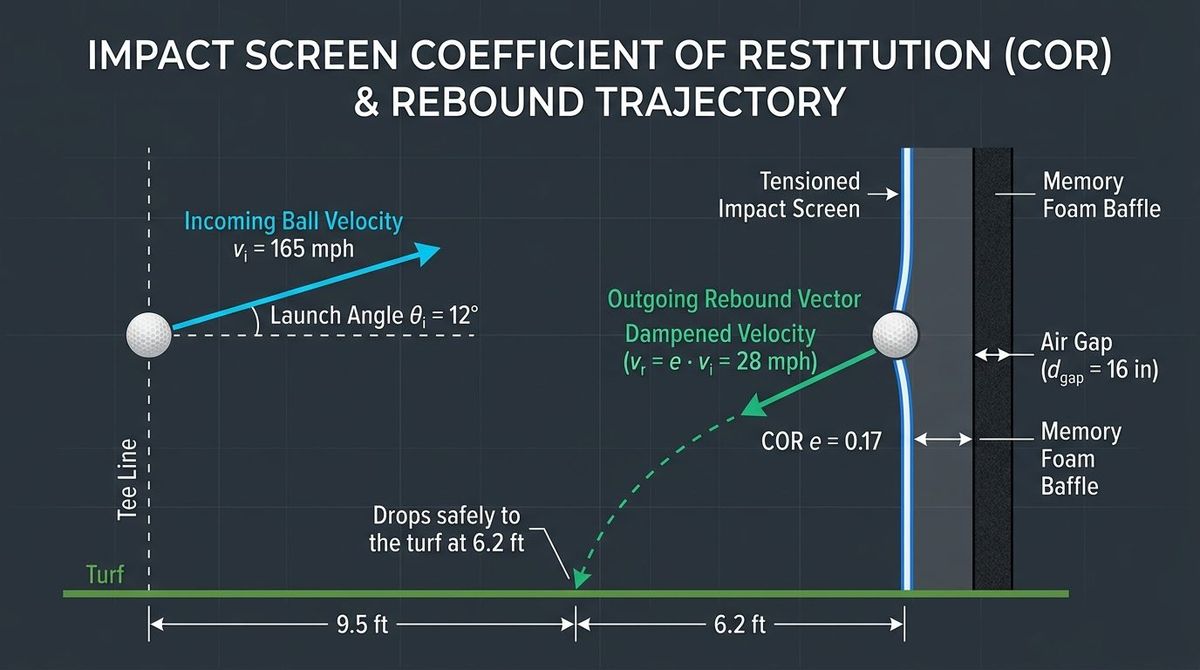
- The Screen Restitution Ceiling (\( e_{\text{screen}} \le 0.22 \)): A properly tensioned triple-layer polyester impact screen with a foam backer absorbs 95%+ of kinetic energy, reducing a 150 mph (220 ft/s) ball to a \( 220 \times 0.18 = \mathbf{39.6\text{ ft/s}} \) (27 mph) gentle return roll.
- The Wedge Strike Height Equation: At a 9.0-foot tee-to-screen standoff, a 60° lob wedge launched at \( \theta_{\text{launch}} = 44^\circ \) strikes the screen at \( H_{\text{impact}} = 108 \times \tan(44^\circ) = \mathbf{104.3\text{ inches}} \) (8 ft 8.3 in)—right at the top grommet pipe of a 9-foot enclosure!
- Return Trajectory Angle Formula: Forward screen tilt or a 15-degree angled ceiling safety baffle deflects upward wedge strikes downward at \( \theta_{\text{return}} = \theta_{\text{launch}} - 2\alpha_{\text{baffle}} \), trapping the ball safely before it rebounds toward the golfer.
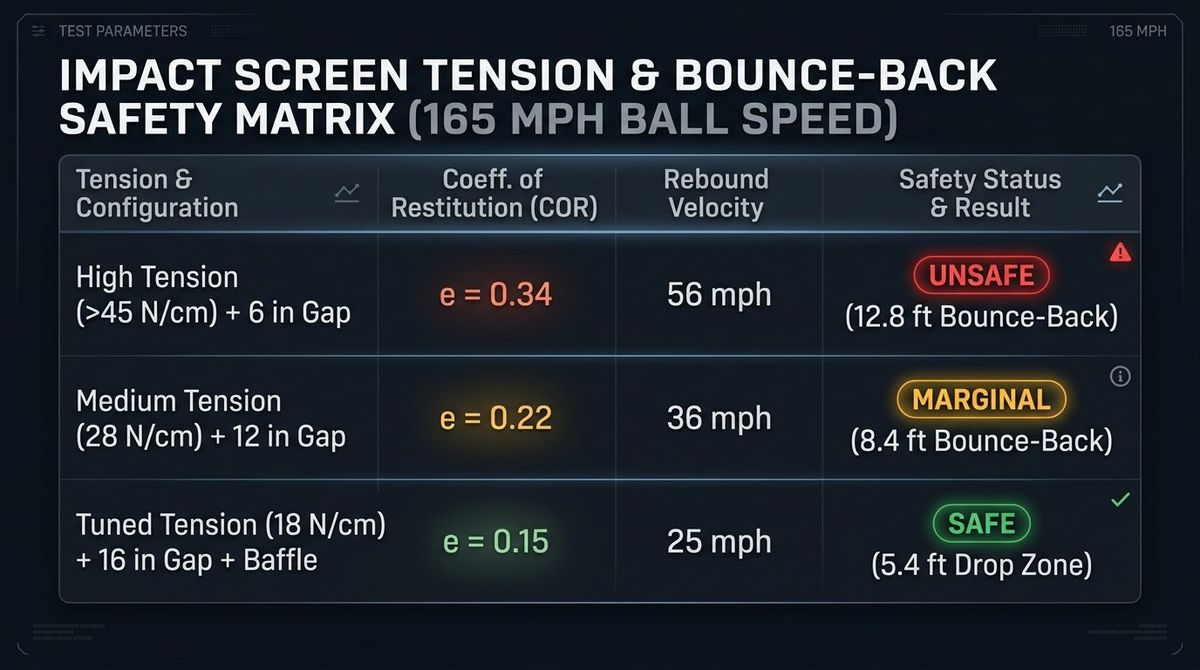
- Optimal Bungee Tension Rule: Remove 30% to 40% of corner side-bungee cords and maintain a 12-to-16-inch rear air buffer so the screen pockets 6 to 9 inches on impact.
1. Impact Screen Strike Height & High-Loft Wedge Geometry
Before calculating how a golf ball rebounds off the screen, you must determine the vertical elevation (\( H_{\text{impact}} \)) where each club in your bag intersects the vertical impact plane at a horizontal tee-to-screen distance \( D_{\text{tee}} \):
Suppose your hitting strip sits \( D_{\text{tee}} = 9.0\text{ feet} \) (108.0 inches) from a 9-foot-tall (108-inch) impact enclosure:
- Driver (\( \theta_{\text{launch}} = 12.5^\circ \)): \( H_{\text{impact}} = 108.0 \times \tan(12.5^\circ) = 108.0 \times 0.2217 = \mathbf{23.9\text{ inches}} \) above the floor (safely in the lower belly of the screen).
- 7-Iron (\( \theta_{\text{launch}} = 21.0^\circ \)): \( H_{\text{impact}} = 108.0 \times \tan(21.0^\circ) = 108.0 \times 0.3839 = \mathbf{41.5\text{ inches}} \) above the floor (dead center).
- 56° Sand Wedge (\( \theta_{\text{launch}} = 36.0^\circ \)): \( H_{\text{impact}} = 108.0 \times \tan(36.0^\circ) = 108.0 \times 0.7265 = \mathbf{78.5\text{ inches}} \) (6 ft 6.5 in).
- 60° Lob Wedge Flop Shot (\( \theta_{\text{launch}} = 44.0^\circ \)): \( H_{\text{impact}} = 108.0 \times \tan(44.0^\circ) = 108.0 \times 0.9657 = \mathbf{104.3\text{ inches}} \) (8 ft 8.3 in—striking the rigid top steel crossbar or upper grommet hem!).
2. Coefficient of Restitution (CoR) & Ballistic Rebound Distance Formula
When a golf ball strikes a woven impact screen at initial velocity \( v_{\text{in}} \), the ratio of outbound rebound speed \( v_{\text{out}} \) to inbound speed is governed by the screen's normal Coefficient of Restitution (\( e_{\text{screen}} \)):
Once the ball leaves the screen face at elevation \( H_{\text{impact}} \) (in feet) with horizontal rebound velocity \( v_{x,\text{out}} = v_{\text{out}} \cdot \cos(\theta_{\text{rebound}}) \) and downward angle \( \theta_{\text{rebound}} \), its first floor-bounce distance from the screen (\( D_{\text{bounce}} \)) is given by projectile kinematics (\( g = 32.174\text{ ft/s}^2 \)):
3. Screen Tension, CoR & Rebound Speed Benchmark Matrix
Compare how screen fabric construction, bungee tension, and impact location control rebound speed and first-bounce landing distance on a 150 mph (220 ft/s) shot:
| Screen Configuration & Tension | Restitution (\(e_{\text{screen}}\)) | Energy Absorbed | Rebound Speed (\(v_{\text{out}}\)) | First Floor Bounce (\(D_{\text{bounce}}\)) | Studio Safety Rating |
|---|---|---|---|---|---|
| 3-Layer Poly + Foam Backer (Slack Tuned) | 0.15 to 0.17 | 97.1% to 97.7% | 22.5 to 25.5 mph | 4.2 to 5.1 ft from screen | Optimal (Gentle turf roll) |
| Standard 3-Layer Impact Screen (Medium) | 0.20 to 0.22 | 95.2% to 96.0% | 30.0 to 33.0 mph | 6.0 to 7.2 ft from screen | Safe (1 bounce before tee) |
| Over-Tensioned Drum-Tight Screen | 0.28 to 0.34 | 88.4% to 92.2% | 42.0 to 51.0 mph | 9.5 to 12.4 ft (Hits golfer!) | Hazardous (Remove 35% bungees) |
| Unpadded Top EMT Frame / Header Strike | 0.55 to 0.68 | 53.8% to 69.7% | 60.0+ mph ricochet | Direct head-level line drive | Critical Hazard (Install baffle!) |
4. Ceiling Protection Ramp & Angled Baffle Deflection Math
How do you neutralize high-lofted 60-degree wedge shots that climb above \( 42^\circ \) toward the front ceiling lip? Never leave bare drywall or an unpadded flat metal header directly in front of the top of the screen. Instead, install an Angled Ceiling Deflector Ramp (or Hanging Heavy-Velvet Baffle) sloped downward toward the screen at angle \( \alpha_{\text{ramp}} = 12^\circ\text{ to }18^\circ \) across the first 36 inches ahead of the screen:
5. Frequently Asked Questions (FAQ)
How do I reduce bounce-back on my golf simulator impact screen without making the projector image wrinkly?
Keep the four corner bungees and top grommet row attached to maintain a flat projection plane, but unclip every second bungee along the left, right, and bottom borders. Hanging a heavy moving blanket or 2-inch memory-foam mattress topper 2 inches behind the screen also dampens rebound by 30%+ without affecting front image flatness.
Why do high-spin wedge shots climb up the screen before bouncing back?
A sand wedge spinning at 9,500 RPM creates strong upward tangential friction when its urethane cover bites into the woven polyester pocket, causing the ball to climb 3 to 5 inches vertically inside the fabric indentation and rebound at a flatter, higher trajectory than a low-spin iron.
What is the minimum safe tee-to-screen distance to avoid rebound injuries?
Maintain at least 8.0 to 10.0 feet between the golf tee and the impact screen. Standing closer than 7.5 feet leaves less than 0.18 seconds of human reaction time if a mishit ball catches a rigid frame edge.
6. Standard Operating Verification & Audit Checklist
Before locking in your final configuration or production parameters for golf simulator ball rebound angle formula, execute this five-point verification protocol across your workspace and accounting records to ensure repeatable field performance:
- Rear Air Gap Standoff Verification: Measure at least 14 to 16 inches of clear air space between the back of the tensioned impact screen and any rigid rear wall or framing stud.
- Side & Bottom Bungee De-Tensioning: Keep corner and top-row grommet bungees secure for a flat projector image, but remove 30% to 40% of side/bottom bungees so the screen pockets 6 to 9 inches on impact.
- 60° Lob Wedge Strike Height Audit: Multiply your tee-to-screen distance by tan(44°) (0.966) to verify whether high-lofted wedge shots strike near the upper steel frame pipe.
- Angled Ceiling Safety Baffle Installation: Mount a 15-degree downward-sloped memory-foam ceiling ramp or heavy velvet baffle across the top header to deflect high wedge shots straight down into the turf.
- First-Bounce Drop Zone Test: Strike three 150+ mph driver shots and confirm the first floor bounce lands within 5.5 feet of the screen (<= 65% of tee distance) via the Golf Launch Monitor Fitter below.
Model Your Exact Parameters & Tolerances
Run your custom numbers through our interactive engineering and financial calculator to verify your setup in real time.