Best Golf Simulator Mat for Narrow 10ft Rooms: 4 Essential Features to Avoid Crippling Injuries
Installing the best golf simulator mat for narrow 10ft rooms is the most critical decision you will make when retrofitting a small space or garage bay. Striking thousands of golf balls off hard concrete subfloors in a restricted footprint quickly exposes poor equipment choices, frequently resulting in debilitating wrist tendonitis or golfer's elbow.
Compact 10-foot rooms create specific challenges: you must preserve swing symmetry while accommodating offset hitting angles without tripping over bulky mat edges. Selecting a mat engineered for small footprints ensures safety, long-term joint health, and clean sensor tracking.
Quick Answer / Key Takeaways
- Primary Mat Requirement: A continuous stance-and-hit surface or modular insert mat to avoid dangerous stance imbalances in narrow 10-foot zones.
- Subfloor Cushioning: Minimum 1.5-inch to 2-inch thickness featuring viscoelastic gel or open-cell deceleration layers to eliminate bounce-back trauma on concrete.
- Launch Monitor Compatibility: Low-grain synthetic nylon turf to eliminate optical tracking errors and radar reflections.
Feature 1: Subfloor Shock Attenuation and Joint Preservation
The defining feature of the best golf simulator mat for narrow 10ft rooms is its shock-absorption mechanism. Cheaper range mats rely on dense rubber backing glued beneath thin nylon fibers, which transfers excessive impact shock directly back into the golfer's lead hand, wrist, and lead elbow. Over hundreds of swings, this repeated trauma can cause severe medial epicondylitis.
In narrow rooms where hitting positions are restricted, players tend to repeatedly strike the exact same spot on the mat. Look for composite construction using a 3D fiber matrix, deep polyurethane foam, or viscoelastic gel pods that let the clubhead travel downward and through the ball without abrupt deceleration.
To explore how strike deflection impacts ball launch data on indoor sensors, review the hitting strip impact benchmarks published on SimGolf Benchmarks.
Feature 2: Dimensions Tailored to Narrow Footprints
In a 10-foot wide bay, space is at a premium; a standard 5x5-foot commercial range mat can dominate the floor and force unnatural swing paths. A 4x7-foot or 5x7-foot center-strike configuration or a dedicated 1x3-foot modular hitting strip embedded into flush perimeter turf works best.
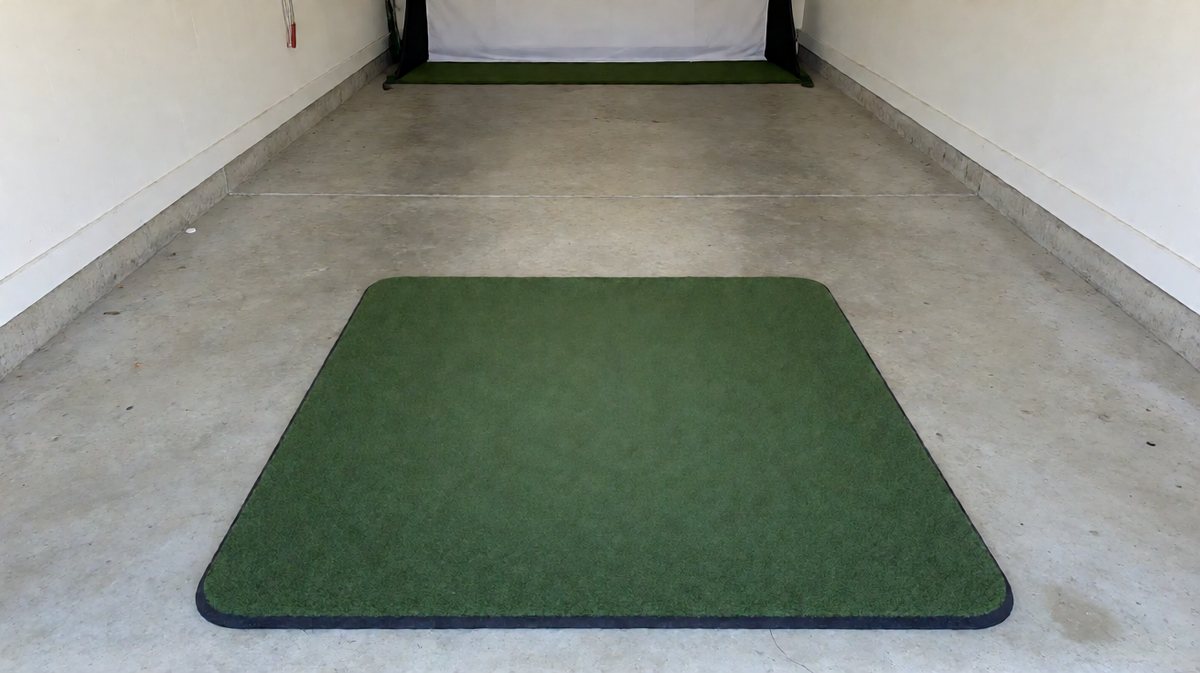
When your space is restricted, standing partially on the mat and partially on the bare floor creates uneven footing that disrupts your pelvis rotation and spine angle. Using a modular hitting strip recessed directly into matching stance-level EVA foam tiles preserves your balance while maximizing floor space.
To check how a 10-foot room width constrains your mat size and club swing path, run your bay dimensions through the Golf Launch Monitor Room Fit Calculator.
Feature 3: Non-Directional Turf Pile and True Clubhead Interaction
Low-cost mats often feature stiff, directional curled nylon that grabs the clubface prematurely. This artificial resistance produces misleading launch monitor feedback by artificially boosting spin numbers and masking fat shots that would dig in on natural fairway turf.
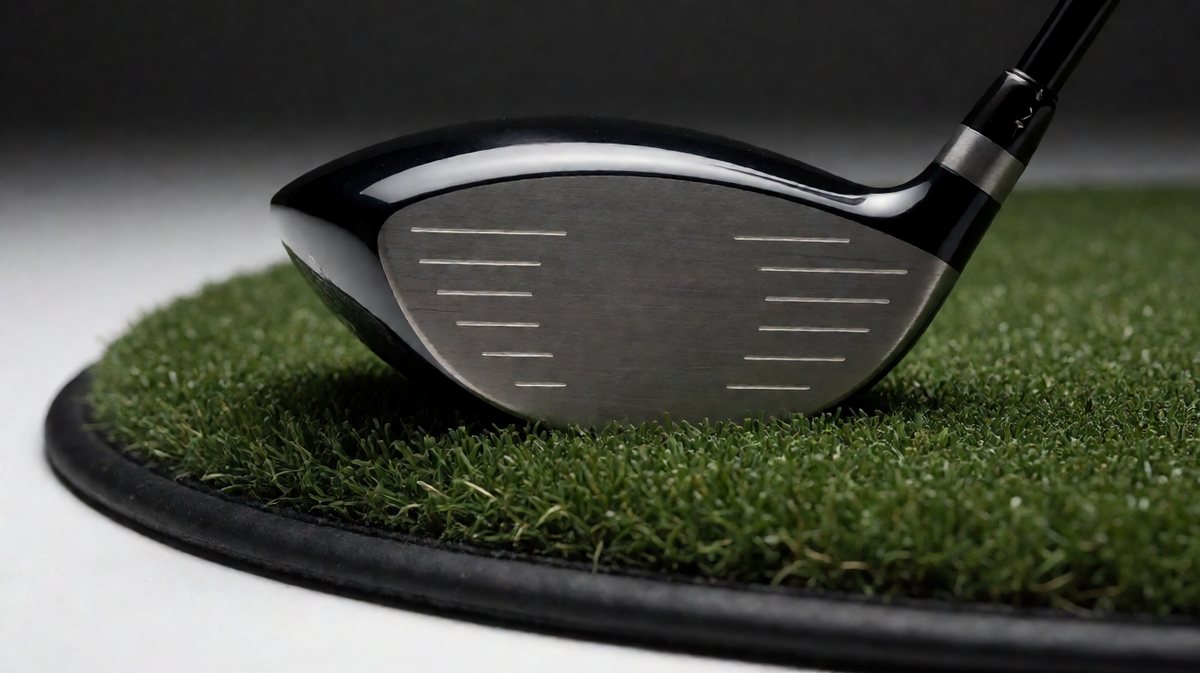
The best indoor surfaces use dense, non-directional nylon monofilament fibers that mimic real sod. High-grade fiber weaves allow your irons to dig naturally beneath the ball's equator without catching plastic turf grain, delivering true launch angles and honest ball speed numbers.
Clinical research from the American College of Sports Medicine highlights how artificial turf deceleration profiles contribute to chronic musculoskeletal overuse syndromes in repetitive sports activities.
Feature 4: Flat Lay Rigidity and Slip Resistance on Smooth Floors
Garage and basement installations place mats on sealed concrete or smooth epoxy surfaces. Narrow rooms amplify lateral forces: if your hitting mat slides even an inch during weight transfer, your alignment relative to the impact screen shifts, leading to errant ball strikes.
High-end mats feature a weighted, high-density rubber backing that grips smooth subfloors without requiring permanent glues or perimeter anchor bolts. Mats with interlocking sub-bases or heavy polyurethane foundations lay flat right out of the box, eliminating edge curling that poses a dangerous tripping hazard in tight 10-foot spaces.
| Mat Style | Recommended Footprint | Shock Absorption Tech | Ideal Bay Type |
|---|---|---|---|
| Continuous Single-Unit Mat | 5' x 7' or 4' x 8' | Viscoelastic Polyurethane | Shared family setups |
| Modular Recessed Strip | 12" x 30" (in foam subfloor) | Free-floating gel insert | Dedicated narrow 10ft bays |
| Dual-Stance Offset Mat | 4' x 6' | 3D Fiber Spring System | Single-player offset bays |
| Budget Dual-Layer Mat | 5' x 5' | Thin EVA Sheet (Under 15mm) | Not recommended for concrete |
Preventative DIY Hack: The Floating Underlayment Method for Concrete
If your hitting mat feels firm against your garage floor, build this shock-absorbing DIY underlayment to protect your joints:
- Lay a Vapor Barrier: Roll a 6-mil polyethylene sheet across the bare concrete to prevent moisture from condensing under your foam base.
- Install High-Density EVA Foam Tiles: Interlock 1-inch thick, high-density 24lb EVA gym tiles across your full 10-foot hitting zone.
- Route the Hitting Well: Use a utility knife to cut an exact 12x30-inch opening in the center of the tiles where your hitting strip will sit.
- Insert a Removable Hitting Strip: Drop a premium gel-based hitting strip into the cutout so it sits flush with your stance tiles.
- Secure Outer Turf: Lay low-pile turf across the remaining EVA foam using heavy-duty double-sided indoor carpet tape to create a uniform walking surface.
This DIY approach significantly reduces impact shock while maintaining a professional appearance and preserving your long-term joint health during extended practice sessions.